CHAPTER 01
Six hundred and fifty-eight
Start at the bottom of the table. Four cords carry the numbers 89, 258, 273 and 38. Another cord carries 658.
The addition works. Eighty-nine and 258 make 347; another 273 brings the running total to 620; the last 38 makes 658. You can check it on a scrap of paper. Someone arranged the cords so that their relationship could survive without that paper.
The object is a khipu, also spelled quipu: an Andean cord record. This one appears in L. Leland Locke’s 1912 paper “The Ancient Quipu, a Peruvian Knot Record”. Locke identified it as B8713 in the American Museum of Natural History’s Bandelier collection, from Huando, north of Lima. His photograph shows a cluster of long cords spreading downward, with six others drawn upward and out to the sides. The object has been arranged to expose its construction.
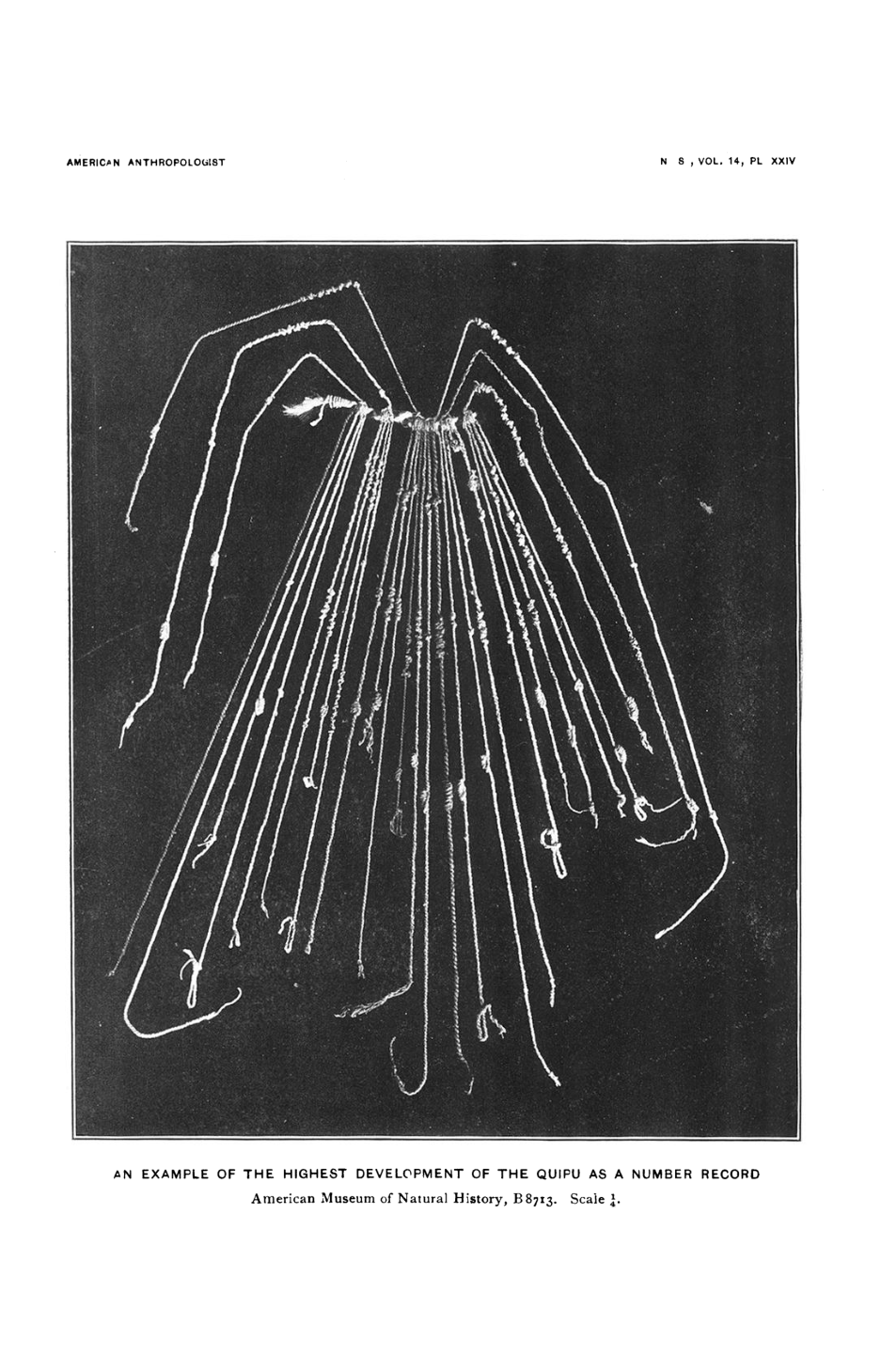
B8713, Plate XXIV in Locke’s 1912 paper. Public-domain scan from the original article. The historical caption’s claim about the “highest development” is Locke’s judgment, not a classification adopted here.
The photograph is worth enlarging. Some cords bend back on themselves at their lower ends. Small knots interrupt otherwise fine lines. There are thicker, irregular stretches that a reader of the photograph cannot confidently resolve. The dark ground makes the cords visible but suppresses much of their color. A table elsewhere in the article restores color as words: brown, blue, white and combinations of them.
For the group that adds to 658, Locke recorded the four hanging cords and the upper cord as light brown. That is a useful observation. It does not tell us whether the group concerned people, animals, crops or something else. The addition supplies a relation among five values. It has not supplied a noun.
This distinction is easy to lose. Once a sum works, the whole object begins to feel readable. We picture an accountant, a delivery, a storehouse, a finished entry. Any of those pictures may outrun the evidence. The arithmetic allows a more modest but still substantial statement: the arrangement is consistent with a subtotal being recorded separately from its components.
Locke proposed that the six groups represented four kinds of object across six periods, perhaps years. His paper does not establish that interpretation. The same layout could serve other arrangements. Before assigning the groups to a calendar, we would need evidence for the periods. Before calling the four cords categories of goods, we would need evidence for the categories.
There is another reason to keep the table open. Higher up, a different group refuses to balance. The four values printed there add to 1,517; the upper cord reads 1,417. Locke included a footnote about a fragmentary subsidiary cord and the discrepancy of one hundred.
A popular account could keep 658 and omit 1,417. That would make the discovery easier to tell. It would also remove the part that most resembles actual work: a good interpretation meeting an inconvenient object.
We will come back to the discrepancy. First we need to see how a length of cord can distinguish 604 from 64, why an empty stretch may be meaningful, and why those rules cannot simply be imposed on every object called a khipu. The examples ahead include archaeological records, colonial documents and cords made in the twentieth century. They belong to different places and circumstances. Their shared material does not make them interchangeable.
CHAPTER 02
Where the six goes
Write 604 in large figures. Cover the zero with a finger. The six and four are still present, but their spacing now carries a burden that the hidden symbol previously made explicit. If you push the remaining figures together, you obtain 64.
Decimal notation gives a digit its value partly through position. Six in the hundreds place contributes six hundred. Six in the tens place contributes sixty. The mark itself is unchanged.
In the numerical khipu convention described in Ashok Khosla’s reading guide, groups of knots occupy successive decimal positions along a cord. Higher places use clusters of single knots. At the units level, long knots with multiple turns represent two through nine; a figure-eight knot represents one. An empty position can stand for zero when its place is established by the surrounding arrangement. These are the basic rules for a common numerical form, not a complete inventory of Andean cord practices.
Now make a diagram on paper. Draw three vertical lines of equal length. Across them, lightly mark a hundreds band, a tens band and a units band. Label the lines A, B and C. On A, put six dots in the hundreds band and write “long knot: four turns” in the units band. Leave the tens band empty. A represents 604.
On B, put six dots in the tens band and the same four-turn notation below. B represents 64. On C, put six dots in the hundreds band and four dots in the tens band, leaving the units empty. C represents 640.
The diagram is a modern exercise. Dots are standing in for knots; its ruled bands are an aid for the lesson. It is not a drawing of a particular ancient object or an instruction for reconstructing one exactly.
| Exercise cord | Hundreds | Tens | Units | Value |
|---|---|---|---|---|
| A | Six single knots | Empty | Four-turn long knot | 604 |
| B | Empty | Six single knots | Four-turn long knot | 64 |
| C | Six single knots | Four single knots | Empty | 640 |
Notice how little counting alone accomplishes. A and B have the same specified knot construction in this diagram. Their values differ because the upper cluster occupies a different register. Counting everything and reporting “ten” would discard the arrangement that makes the record useful.
The distinction at the units position helps too. A figure-eight knot carrying one unit is different from a single knot carrying one ten or one hundred. Reading therefore involves both form and location. It is a closer inspection than simply feeling bumps along a string.
Try adding a fourth cord for 61. Six single knots go in the tens band; a figure-eight knot goes in the units band. A fifth cord for 600 has six single knots in the hundreds band and no numerical knots in the lower two bands. You can now test whether someone else reads the five values you intended.
Keep the guidelines visible for the first attempt. Then erase them and retain the original spacing. If the second reader is unsure where the hundreds end and the tens begin, that uncertainty is informative. You have discovered a requirement of the representation. The arrangement needs enough regularity or contextual evidence for its positions to be recognized.
Moving one cluster is not decoration. If the six on A slips down into the tens position, your diagram changes from 604 to 64. A copyist who carefully preserves the number of marks but changes their placement has copied the ingredients and altered the number.
CHAPTER 03
An empty place
There are at least three different things an empty-looking part of a record might tell us. The recorded quantity may be zero. The quantity may not have been recorded. Or the part carrying it may have disappeared.
These possibilities should be separated before any arithmetic begins. A blank cell in a modern table does not become zero because a calculation would be easier that way. A broken cord deserves the same care.
Return to our invented diagram for 604. Its tens band is deliberately empty. We know that because we made the diagram, aligned the registers and retained the units below. Now tear off the lower half of the paper. The hundreds remain visible; the tens and units do not. It would be wrong to read the surviving upper portion as 600 with confidence. The missing part might once have held any lower two digits.
Under the exercise’s rules, and assuming the hundreds cluster survives completely, the original number could lie anywhere from 600 through 699. That is one hundred possible values. The surviving six hundreds impose a real constraint. They do not choose among those values.
If the tens band also survives and contains three single knots, the range narrows to 630 through 639. A surviving figure-eight knot in the units band would narrow it to 631. Each additional observation removes possibilities. A guess entered as if it were an observation merely hides them.
This is why condition belongs in a transcription. “No knot observed in an intact units register” and “units register missing” should produce different records. If a database allows only a number, the transcriber may be forced to conceal the difference or put it in a separate note. Anyone analyzing the number later must know where that note went.
One small exercise makes the consequences unpleasantly clear. Suppose you have five invented entries: 12, 8, an unreadable value, 20 and 10. The four readable entries total fifty. You can report a known subtotal of fifty and one unreadable entry. You cannot report a complete total of fifty unless you have independent grounds for giving the unreadable entry a value of zero.
Nor is the average ten. Ten is the mean of a five-entry list only after you have silently assigned zero to the missing value. The average of the four readable entries is twelve and a half. The average of all five remains unknown. A missing observation has become a false result through a single convenient substitution.
For our paper exercise, give each cord two fields. One contains the value, if readable. The other describes its state: intact, partly missing or uncertain. Use an actual zero only when you mean zero. If you want a machine-readable version, leave the value empty when it is unknown and explain that choice in a short note beside the file.
You can make the record more precise by preserving what was seen before calculating the number. Six knots in a particular cluster remain an observation even if the register is uncertain. Record the cluster, its position and the uncertainty. Another reader may later recover the register from neighboring cords.
Six visible knots can be recorded with confidence while their numerical value remains uncertain.
CHAPTER 04
The hundred that will not fit
Locke’s table is small enough to audit in full. Its six groups give us a useful mix: exact agreements, uncertain readings and missing material. The printed page preserves the awkwardness.
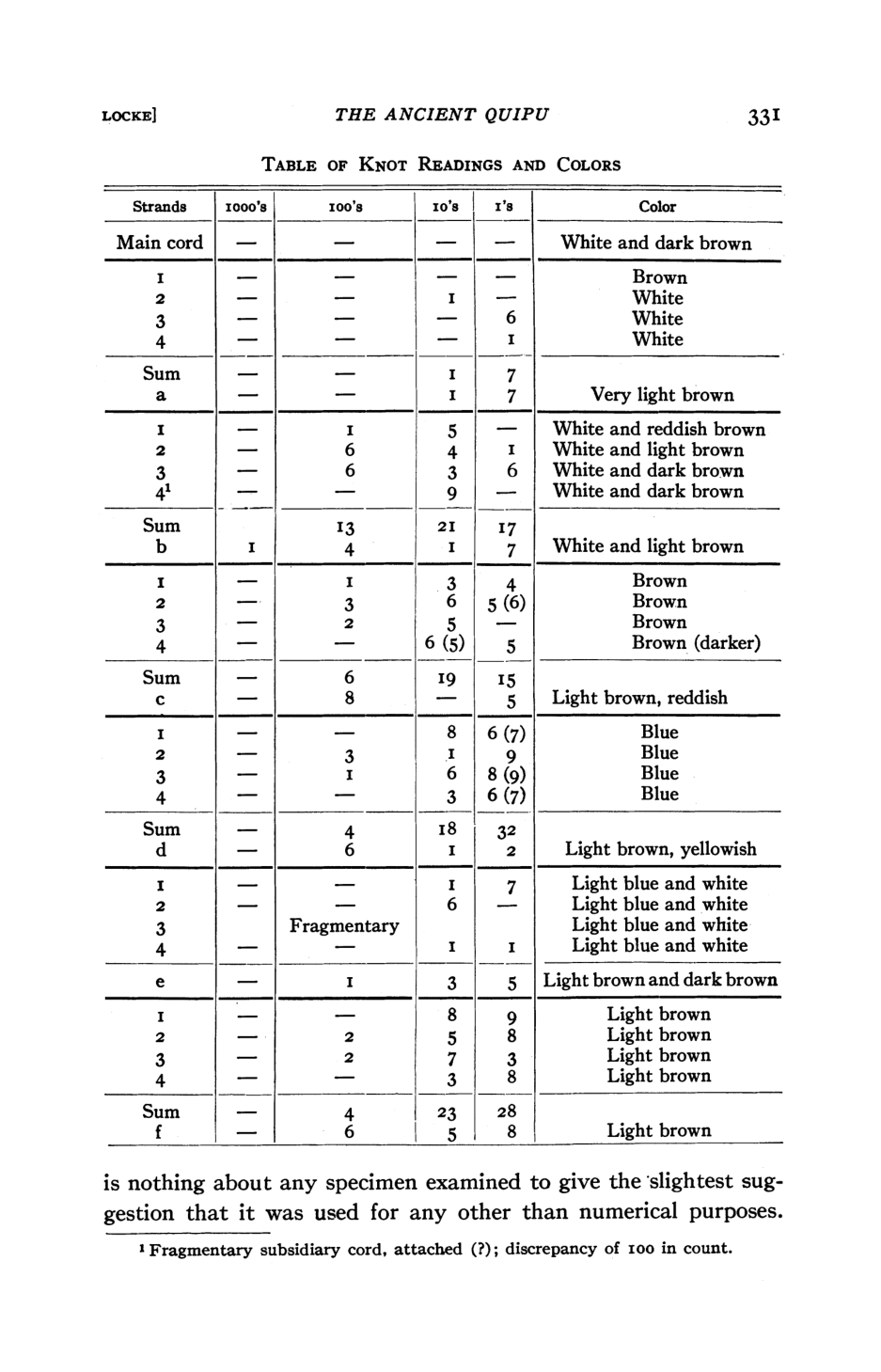
Page 331 of Locke’s paper. Parentheses, the fragmentary row and the footnote are part of the original evidence. Public domain.
Group a is straightforward. Its four hanging cords give 0, 10, 6 and 1, totaling 17. The upper cord a also gives 17. Group f, our opening example, gives 658 both ways.
Group b contains 150, 641, 636 and 90. Add the hundreds first: one hundred, six hundred and six hundred make thirteen hundred. The tens contribute fifty, forty, thirty and ninety, or 210. The units contribute one and six, or seven. Together they make 1,517.
The printed sum row introduces a further inconsistency. It lists thirteen hundreds, twenty-one tens and seventeen units. Taken literally, those raw column sums give 1,527. But the component entries show only one and six in the units column, totaling seven. Using those visible components gives 1,517. The sum row is therefore not an independent, flawless check on the entries above it.
This is a defect in the printed table we are auditing. It should not be attributed to the maker of the khipu without examining the object and the history of its transcription. A modern reader encounters several stages at once: cord, reading, arithmetic and typesetting. An error at one stage need not have existed at the others.
The upper cord is transcribed as 1,417. The difference is exactly one hundred. Locke’s note mentions a fragmentary subsidiary cord attached, with a question mark, to the fourth cord. The note is a lead to inspect, not a completed repair of the account. The printed table does not establish that a surviving, independently readable subsidiary contributes the required hundred in the required direction.
Groups c and d are more delicate. For c, the unparenthesized readings are 134, 365, 250 and 65. They add to 814. The table offers a six instead of the five units in the second value, and a five instead of the six tens in the fourth. Make both changes and the list becomes 134, 366, 250 and 55. It now totals 805, matching the upper cord.
For d, the unparenthesized values 86, 319, 168 and 36 total 609. Three parenthesized increases of one produce 87, 319, 169 and 37. Those total 612, matching the upper cord d.
The parenthesized readings may be well motivated by the physical knots. They should still be kept distinct from the readings they replace. If a proposed total helps decide an ambiguous digit, the agreement obtained afterward is not entirely independent evidence for the total. Part of the agreement was used to choose the digits.
Group e contains 17, 60, a fragmentary third entry and 11. Its upper cord reads 135. The readable components total 88. Subtracting 88 from 135 gives 47.
That calculation is useful. Forty-seven is the missing value required if the upper cord totals those four entries and if the other readings are correct. It is not a new observation of the fragmentary cord. In a careful transcription, “unreadable; 47 would balance the group” is an honest entry. Replacing the fragmentary cell with an unqualified 47 would erase the distinction.
Here is a compact audit made from the printed table:
| Group | Components as first printed | Upper cord | Result |
|---|---|---|---|
| a | 0 + 10 + 6 + 1 = 17 | 17 | Agrees |
| b | 150 + 641 + 636 + 90 = 1,517 | 1,417 | Difference of 100 |
| c | 134 + 365 + 250 + 65 = 814 | 805 | Proposed readings give 805 |
| d | 86 + 319 + 168 + 36 = 609 | 612 | Proposed readings give 612 |
| e | 17 + 60 + unknown + 11 | 135 | Missing value would need to be 47 |
| f | 89 + 258 + 273 + 38 = 658 | 658 | Agrees |
This table does not undo Locke’s achievement. It shows its scale more accurately. Numerical structure can be convincingly present in an object whose every entry is not secure. Damage, ambiguous knots and an imperfect transcription need not make the whole interpretation worthless. Equally, a strong general interpretation need not make each troublesome detail disappear.
There is a second claim in the 1912 paper that requires more resistance. Locke concluded that the specimens he examined gave no suggestion of nonnumerical use. That is a statement about his sample and what he recognized in it. It cannot establish that all khipus, in all periods and communities, recorded only numbers.
The discrepancy of one hundred remains on the page.
CHAPTER 05
Before the knot
A cord has already been made by the time anyone ties a number into it. Its fibers have been selected and worked; strands may have been combined; colors may change along its length. A transcription that begins and ends with the knots arrives late.
You can see one of these choices with two pieces of ordinary yarn. Hold them side by side and twist them together. Look at the diagonal made by the outer strands. Reverse the twist and the diagonal slopes the other way. The letters S and Z are useful visual reminders because their middle strokes slope in opposite directions. This little demonstration concerns the final twist of the combined strands. It does not tell you how each original strand was spun.
That distinction is easily missed in a flat photograph. A strand can contain its own finer structure. A complete description may need to follow the material through more than one level. “Twisted left” is incomplete unless you know which level is being described and how the observer oriented the object.
Attachment adds another set of choices. A pendant can be joined to a primary cord; a subsidiary can hang from a pendant. The same collection of colored lengths can therefore form different structures. Put a short cord directly on the main line, and it sits beside the other pendants. Put it on one of those pendants, and it belongs beneath that cord in the branching arrangement.
Here is another modern paper exercise. Draw a horizontal line with three pendants, A, B and C. Attach two smaller lines to B. Label them B1 and B2. Now list the structure as five rows: A, B, C, B1, B2. If you preserve only those names and their colors, you have lost the attachment relationships. Add a “parent” column: A, B and C belong to the primary cord; B1 and B2 belong to B.
The extra column lets another person reconstruct the branching diagram. It does not explain what the branches meant. A physical relationship has become recoverable without its historical interpretation becoming known.
Color creates a similar temptation to move too quickly. If every cord in a group is blue, the repetition may help identify the group. It does not follow that blue has one fixed meaning across every khipu. A local convention, a contrast with a neighboring group and a universal dictionary are three very different claims.
Even naming the color requires choices. Consider a cord made from a pale strand and a dark strand twisted together. At a distance it may look intermediate in tone. Close up, its two components remain distinct. “Brown” and “white with brown” could describe different observations, not merely different vocabulary. The photograph, lighting, magnification and condition all affect what can be recorded confidently.
Locke’s table kept mixed colors as mixed colors. His main cord is described as white and dark brown. Several pendants combine white with other browns. Converting the entire table to one color per row would throw away distinctions that he bothered to preserve.
There is no need to decide in advance that each distinction carries a separate message. Some may arise from manufacture, repair or available material. The first job is less ambitious: record a feature clearly enough that someone can test whether it matters. An unexplained difference is still worth keeping when it can be described reliably.
CHAPTER 06
The wrapped cords
The numerical rules in our first exercise should not become a filter that makes other constructions invisible.
Jeffrey Splitstoser’s account of a Wari khipu at Dumbarton Oaks describes an object with roughly a thousand cords and extensive colored wrapping. His 2019 research presentation places Wari examples in the period around 600–1000 CE, centuries before the Inka imperial records that dominate many introductions. He treats their role in the origin of khipus as a research question, not a fully recovered chain of invention.
Wrapping gives a cord another surface. Colored thread can cover a section of an underlying cord, producing bands whose order, length and combination can be described. A knot count alone would miss those bands. If a recording form contains boxes only for hundreds, tens and units, the object may appear to offer little information because the form has asked so little of it.
We can test that failure without borrowing an interpretation of Wari signs. Draw a vertical line and surround three successive sections with colored rectangles: red, cream, red. Beside it draw cream, red, cream. Give both drawings zero dots. A dot-counting table now reports them as identical. A sequence description distinguishes them immediately.
Reverse the first sequence from top to bottom. Red, cream, red remains the same. Reverse red, red, cream and it becomes cream, red, red. Orientation makes no difference to the first example and an obvious difference to the second. If the observer did not record which end was which, the second sequence can acquire two descriptions.
Length provides another variable. Three equal bands are different from one long band and two short bands, even when the color order is identical. But recording length introduces a practical question: measured in millimeters, in proportions of the wrapped section, or in broad categories? Each choice retains some distinctions and discards others.
These invented sequences are deliberately simple. They demonstrate the work of description rather than a theory about what Wari wrapping meant. With a real object, a researcher must also distinguish deliberate boundaries from fading, missing thread or later disturbance.
The age of an example adds a separate issue. A date attached to one object should not automatically become the invention date of a whole practice. The earliest surviving or studied example is a lower bound on what has been found, not a witness to the first occasion on which someone made one. A tradition can have predecessors that have not survived or have not been recognized.
Nor does a long interval authorize us to fill in a smooth technical progression. A wrapped Wari cord and an Inka numerical pendant may share features and differ in important ways. Establishing the relationship requires comparisons that preserve both. Calling the earlier object a rough first version of the later one would assume the answer.
The Dallas Museum of Art’s khipu record, for an Inka object dated 1400–1570, gives cotton, plant fiber and indigo among its materials. Put that catalog entry beside the Wari account and the word “khipu” becomes a starting point for comparison. It does not tell us that every object under the name uses the same grammar.
Keep the wrapped section in the description even if the knot-counting form has no place for it.
CHAPTER 07
What was in the storehouse
At Inkawasi in Peru’s Cañete Valley, the evidence includes crops as well as cords. Gary Urton and Alejandro Chu’s study of the storehouse archive describes thirty-four khipus found in a context containing chili peppers, peanuts and black beans. Some were associated with, or covered by, stored produce. Pairs of khipus tied together carried closely comparable numerical records. The authors also considered whether a grid marked on the floor related to units of accounting.
That is a much stronger starting point for a goods account than a color chosen from an isolated museum object. It is still not a word-for-word translation. A khipu found with peanuts does not make every brown cord a peanut entry. A floor division does not become a known number of kilograms without evidence connecting space, contents and measurement.
Suppose, as a modern example, that a storeroom receives twelve baskets. A record of twelve could be exact while the amount of food remains uncertain. The baskets might differ in capacity. They might be filled to different levels. Their contents might be weighed, counted individually or accepted as conventional basketfuls. “Twelve” answers a question only after we know what was counted.
Now imagine two records found together. The first lists 5, 4 and 3. The second lists 12. They fit an aggregation perfectly. The three entries might be deliveries from different suppliers, successive deliveries from one supplier, or three kinds of container. The total alone cannot distinguish them.
Give the first list two more columns, date and sender. Suddenly the same arithmetic supports a more specific account. But those columns are additions in our exercise. We cannot attach them to an archaeological record just because they would make it intelligible.
The paired objects at Inkawasi are therefore interesting for more than their numbers. Their physical association narrows the set of plausible relationships. Two similar totals found in unrelated collections might be coincidence. Two cord records tied together in a storehouse context invite a different investigation. The attachment is evidence that the objects belonged together, even before the precise administrative relation is settled.
A duplicate is not necessarily redundant. In our invented storehouse, one person could keep a dispatch record and another a receipt. If a load arrives short, the disagreement is useful. Alternatively, two copies could exist because a superior needs one and a local keeper retains the other. Matching values would be expected under either arrangement.
Calling such a pair “double-entry bookkeeping” would add a much narrower claim. Double-entry has specific relations among entries and accounts; two records of similar quantities do not establish it. The attraction of a familiar label should not substitute for demonstrating those relations.
The food matters in another way. A cord removed from its archaeological setting can travel with only a brief place-name. The relation to a deposit, a neighboring object or a particular part of a room may disappear from the label. An excavation record can preserve those associations so that later readers have something more than the portable object.
For the visitor, the khipu may remain the most unusual item in the case. For the interpretation, a patch of floor and a deposit of beans can be just as consequential. They limit the stories the numbers can reasonably tell.
CHAPTER 08
A total travels upward
A subtotal can be copied without copying every entry beneath it. That simple operation makes layered accounting possible. It also creates an opportunity to compare records kept at different levels.
In their 2005 paper on Puruchuco, Gary Urton and Carrie Brezine examined an archive of twenty-one khipus and identified numerical relationships they interpreted as hierarchical accounting. Their argument concerned the movement and aggregation of information, including census and tribute accounts, through administrative levels. It did not require every surviving cord in the archive to be independently translated into a named commodity or person.
A small invented example lets us inspect the operation. Three local records contain these quantities:
| Local record | First entry | Second entry | Third entry | Total |
|---|---|---|---|---|
| A | 14 | 22 | 9 | 45 |
| B | 7 | 18 | 20 | 45 |
| C | 11 | 13 | 6 | 30 |
An upper record could carry 45, 45 and 30, followed by a total of 120. If only the upper record survived, we could recover the three subtotals and their sum. We could not reconstruct the nine lower entries. Many different sets of entries produce the same totals.
The repeated forty-five creates a useful difficulty. Without labels or ordering evidence, which upper entry belongs to A and which to B? Arithmetic alone cannot distinguish them. A repeated color, a physical grouping, a cord sequence or another shared feature might help, provided its relevance is demonstrated rather than assumed.
Now change A’s first entry from fourteen to fifteen while leaving its subtotal at forty-five. The lower record fails its own check. Its entries total forty-six. If the upper record also retains forty-five, we have at least three possible points to investigate: the individual entry, the lower subtotal and the upper copy. The mismatch identifies a relation needing attention; it does not identify which person or step was responsible.
Try another alteration. Move one unit from A’s first entry to its second, changing fourteen and twenty-two to thirteen and twenty-three. The subtotal remains forty-five. Every total at the upper level still agrees. The aggregate check has failed to notice a change in the distribution.
This is a general property of sums. They preserve an amount while discarding some information about its components. It explains both their usefulness and their limits. A higher official can receive a manageable set of totals instead of every individual entry. The same compression makes certain errors or disagreements invisible at that level.
A convincing archaeological case for aggregation therefore benefits from several kinds of agreement. Values matter, but so do the arrangements in which they appear, the objects’ association and the consistency of the proposed relationship across more than one convenient example. Repeated structure can make an interpretation stronger than a single numerical coincidence.
The toy records above are available in the companion files with the arithmetic made explicit. They are not transcriptions of Puruchuco. Keeping them separate lets us learn the operation without implying that an invented table is ancient evidence.
Once you have checked the rows, cover the nine component entries and leave only forty-five, forty-five and thirty. The upper record still does its job. It has become shorter by forgetting something deliberately.
CHAPTER 09
A name beside a hole
In Guaman Poma de Ayala’s drawing, the accountant holds the primary cord across his body. His right hand is higher than his left, so the line slopes. Dozens of pendants hang below it. The drawing gives the record room: it extends beyond the figure’s torso on both sides.
At the lower left is a grid of small compartments containing open and filled circles. The figure’s feet, clothing and headgear are drawn with the same deliberate attention as the equipment. Across the top, a large heading identifies the office of accountant and treasurer. The man is Condor Chaua, in Guaman Poma’s account.
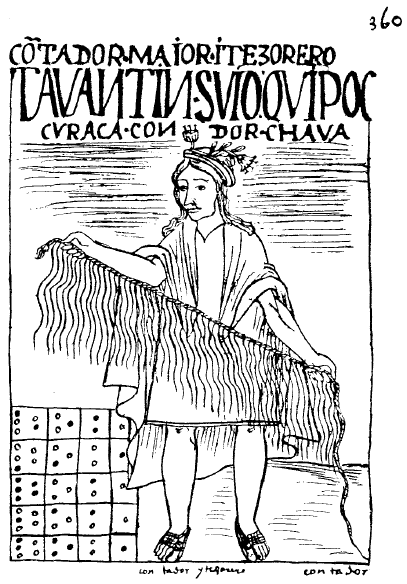
Felipe Guaman Poma de Ayala, manuscript page 360, reproduced in the 1936 facsimile of Nueva corónica y buen gobierno. Public-domain image record. The Royal Danish Library holds the original manuscript; its digital page numbering places this drawing at 362.

The grid is usually identified as a yupana, a counting board. The drawing shows a configuration, not a sequence of moves. If we want to infer an algorithm from it, we have to supply steps that the static image does not itself display. Several arrangements of counters can look systematic; that alone does not establish which operation was being performed.
The cord record also resists being read from this image. The pendants are clear enough to convey their multitude and arrangement. The drawing does not provide the close, measured transcription needed to recover a table like Locke’s. Guaman Poma was presenting a person and an office within a much larger account of Andean society and colonial rule.
The Royal Danish Library’s description places the manuscript around 1615. It was addressed to King Felipe III and combined historical narrative, criticism of colonial exploitation and proposals for government. Its Spanish text includes substantial passages in Quechua. The work’s intended destination should not be confused with proof that the king read it.
Look again at the two hands. The figure is actively holding the record open. A khipu displayed flat in a case can conceal that practical relation between an arrangement of cords and the person responsible for presenting it. The drawing makes room for the reader of the record as well as the record itself.
A later object puts names and cords into direct physical contact.
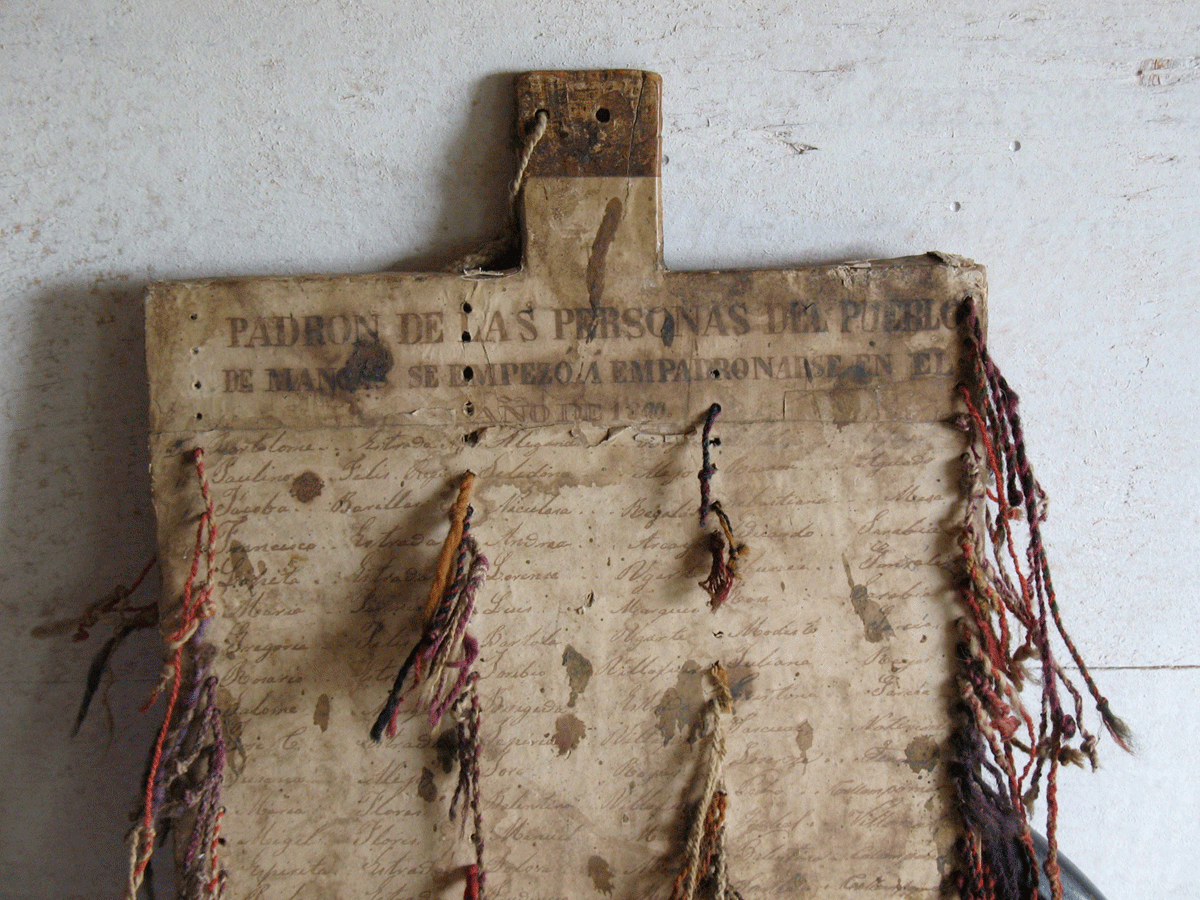
The Mangas khipu board. Photograph by Sabine Hyland, Figure 2 in Hyland, Bennison and Hyland’s 2021 study, used unchanged under CC BY 4.0.
The nineteenth-century Mangas board combined written names with attached cords recording contributions of labor and goods. Sabine Hyland, Sarah Bennison and William P. Hyland report 181 holes, of which 87 retained cords when studied. Their research also examines the Entablo, a ritual manuscript from San Pedro de Casta, where khipu boards were used in canal-cleaning ceremonies into the twentieth century. The Mangas object is a related surviving board, not a recovered Casta board.
The photograph makes the join between media visible. A hole sits beside a written entry. Cord passes through the surface that carries the name. Paper and fiber occupy the same working object.
The holes without cords are visible too. A transcription of the surviving names alone would preserve one part of the board and lose another. A list of surviving cords detached from their positions would have the opposite problem. The join is part of the record.
CHAPTER 10
Two lists that might belong together
Finding a written list and a set of khipus from the same region creates an unusually tempting problem. Perhaps one can supply names for the other. But a possible match must survive comparison with alternatives.
Manuel Medrano and Gary Urton’s 2018 study of six Santa Valley khipus proposed connections with a 1670 revisita, a colonial population review, concerning San Pedro de Corongo. Their analysis considered social groupings and cord features, including attachment. In a 2024 reanalysis, Mackinley FitzPatrick revisited details omitted or confused in that interpretation and proposed a different alignment with moieties, the paired social divisions under discussion. His account proposes that recto attachment explicitly signals a category while verso serves as an unmarked form within that system.
These are arguments about particular records and a particular historical setting. They do not produce a universal rule that a recto cord always names one social group throughout the Andes. Nor do they make the later analysis immune to further testing.
Here is an invented matching problem small enough to solve by hand. A paper list has three groups of four entries. The group sizes are therefore four, four and four. A cord record also has three groups of four. How much have we learned?
We have found a structural compatibility. We have not identified which cord group matches which paper group. There are six possible one-to-one assignments of three distinct groups: three choices for the first, two for the second and one for the last. If their internal order is also uncertain, the possibilities multiply.
Add a distinctive quantity. The paper groups total 23, 41 and 58, and the cord groups carry those same three totals. The matching becomes much more constrained. But we should ask whether we chose this paper list only after trying many others, whether the totals were read independently, and whether the ordering agrees with additional evidence.
A second check is particularly valuable when it was not used to construct the first match. Suppose the proposed correspondence predicts that an unusual entry should occupy the second position of the group totaling forty-one. If that feature was withheld during the matching and appears where predicted, it adds evidence. If we rearranged the group until it appeared there, it adds less.
This is the practical meaning of testing a decipherment proposal. The question is not whether someone can tell a coherent story after seeing all the clues. The question is which observations the proposal explains, which it leaves troublesome, and which new observations it would lead us to expect.
The six Santa Valley objects are especially useful for a reader with a computer because descriptions of their cords are available in the Open Khipu Repository. We can inspect a limited claim ourselves: how the recorded attachment types are distributed among their first-level cords.
That exercise will not reproduce either historical interpretation. It will give us a visible piece of the evidence on which such interpretations depend. We can count the categories, preserve the entries that do not fit the two main labels and see whether the six objects have identical distributions. We do not need to assign a personal name to any cord to do that much.
CHAPTER 11
Eight hundred and twenty-four rows
The Open Khipu Repository contains a SQLite database that can be inspected without installing a specialized analysis package. For this book, the data were examined at commit 4039ca51f4de661d80d0160596309c983a62a9c7. The version matters: a repository can grow or be corrected after a table is published.
Our query selects six khipus, keeps cords whose recorded level is one, and counts attachment codes separately. R and V are defined in the database’s attachment dictionary as recto and verso. The selected rows also contain U, which that dictionary does not define. We retain U as its own category rather than silently merging it with either of the others.
| Khipu | Older identifier | R | V | U | Level-one total |
|---|---|---|---|---|---|
| KH0323 | UR087 | 290 | 0 | 16 | 306 |
| KH0324 | UR088 | 0 | 53 | 1 | 54 |
| KH0325 | UR089 | 0 | 204 | 2 | 206 |
| KH0326 | UR090 | 40 | 68 | 0 | 108 |
| KH0327 | UR091 | 0 | 90 | 0 | 90 |
| KH0328 | UR092 | 55 | 0 | 5 | 60 |
| Total | 385 | 415 | 24 | 824 |
Original count from the repository snapshot named above. These are recorded cords at one selected level, not a count of people in the colonial document. U is preserved as an unclassified code in this analysis.
The table answers a narrow question quite clearly. KH0326 contains both R and V at level one. Each of the other five has only one of those two codes among its classified first-level cords. Some also contain U. Saying that all six use just one attachment category would be false; saying that each individual khipu is uniform would also be false.
The denominator changes the next calculation. Among the eight hundred cords recorded as R or V, 385 are R: 48.125 percent. Among all 824 selected rows, R accounts for about 46.7 percent. Both calculations are arithmetically correct. They answer different questions because the second includes the twenty-four U entries.
Neither percentage tells us the proportion of a population belonging to a moiety. That would require a demonstrated relation between cord entries and people, as well as a justified treatment of the unclassified entries. A numerical result can be precise to three decimal places while its historical interpretation remains unsettled.
The level restriction also matters. Including level-two cords adds 254 rows, bringing these six objects’ combined count in the selected levels to 1,078. The extra cords have relationships to other cords that a flat list would conceal. They cannot automatically be treated as another 254 independent people or another 254 equivalent observations.
For reproduction, the companion script opens the database read-only and joins its cord table to the khipu identifiers. It writes a CSV with the six groups and the attachment counts. The source version, query and license travel with the output. Download the worked examples if you want to check or alter the selection.
A useful alteration is to remove the level restriction and compare the result. Another is to print every distinct attachment code before deciding which labels to show. Both changes make assumptions visible. Neither needs a claim that the script has deciphered a khipu.
The small table is already enough to complicate a simple story about two categories. One object is mixed, twenty-four entries are unclassified, and the result depends on which cords we count. Those details belong beside the percentage, not in a file that nobody opens.
CHAPTER 12
Three cords at the end
In 2015, community leaders at San Juan de Collata invited Sabine Hyland to examine two khipus kept with local manuscripts. Community accounts identified them as eighteenth-century letters connected with rebellion. The objects had 288 and 199 pendants. Their distinctions included color, animal fiber and ply direction; neither carries the ordinary numerical knots of our exercise. Their end knots are stoppers.
Hyland’s 2017 paper identified ninety-five distinct combinations of color, fiber and ply across the two objects. She proposed that three cords at the end of one encoded the lineage name Alluka through a rebus principle, and used that proposal in interpreting the ending of the other. These are proposed phonetic readings supported by local context, not complete translations of both letters. Ninety-five combinations should not be reported as ninety-five established letters of an alphabet.
The last distinction deserves an experiment. Take three shapes, two colors and two textures. You can make twelve combinations if every choice can occur with every other: three times two times two. You now have twelve distinguishable tokens. You have not yet made a language.
You might assign those tokens to twelve people, twelve months, twelve instructions or twelve sounds. You might use some as labels and others as quantities. A count of available combinations cannot decide among those uses. It tells us something about possible distinctions, not what the distinctions mean.
Now suppose only seven combinations actually appear in a collection. The unused five may have been impossible under the rules, unnecessary for the surviving messages, or merely absent from the sample. Treating every theoretical combination as an attested sign would exaggerate the evidence. Treating the seven observed combinations as a complete inventory would risk the opposite error.
A rebus adds a different operation. In a familiar modern example, a drawing of an eye can stand for the English sound “I” rather than for an anatomical eye. The sound value depends on language. A drawing that works in English may fail entirely in another language. The picture itself does not carry an English label by nature.
For a cord proposal, the corresponding questions are specific. Which material or color name supplies the sound? In which language or local variety? What portion of that name is being used? Does the same proposed value recur consistently elsewhere? Are the word boundaries independently supported, or adjusted to obtain a desired name?
A short name at the end of a message can be a promising place to begin because position may constrain what is expected there. It can also be a dangerous place to become overconfident: a researcher may have a small set of anticipated names and many possible ways to segment the material. The proposal becomes stronger when it predicts readings beyond the examples used to devise it.
The Collata objects also expose a weakness in the question “Can we read khipus?” It asks for one answer about several different tasks. We can read numerical values in many records. We can describe construction in others. We can test proposed linguistic correspondences in a particular pair of letters. Those achievements do not have to be collapsed into either “solved” or “nothing is known.”
The three proposed name cords remain worth studying while the rest of the letters remain unread.
CHAPTER 13
Below the units
An introductory rule can become an obstacle after it has been learned too well. We have used the units position as the bottom of a numerical sequence. What should we do when a cord has another knot below it?
Sabine Hyland’s 2024 study of “netherknots” examines knots below the units place. She reports them in more than a fifth of the Open Khipu Repository sample she considered, includes a radiocarbon-dated Late Horizon example and develops an interpretation through comparison with later practices. Their position does not make them ignorable, and the proposed interpretation should not be turned into an established value for every such knot.
A reader trained on our simple decimal exercise might make either of two mistakes. One is to count the additional knot as another unit. The other is to remove it from the transcription because it falls outside the expected registers. Both approaches make the object conform to the lesson before asking what the extra feature does.
The repository’s knot dictionary is already more varied than the three introductory types. Alongside codes for long, figure-eight and single knots, it includes entries for double forms and other constructions. A data field that permits only three values would not merely simplify the vocabulary. It would be unable to preserve some of the distinctions the repository records.
This problem is familiar when designing a form. Suppose a form asks how someone arrived at a meeting and permits “walk,” “bicycle” or “car.” A person who took a train and then walked must either choose an incomplete answer or use a note elsewhere. If the analyst later counts only the three main boxes, the form’s limitation becomes an apparent fact about how people travel.
For an object description, an “other” category is useful only if it leads somewhere. “Other knot” without a drawing, photograph or written description may preserve the existence of an exception while making it impossible to study. A richer record can retain its position, construction and relationship to neighboring features even before it has a settled name.
Here is a concrete change to our exercise sheet. Beneath the decimal bands, add a region called “additional features.” Draw a loop there on one cord and a tuft on another. Do not give either a numerical value. Ask the next reader to copy the sheet.
If the reader omits them, the copying instructions were incomplete. If the reader adds them to the total, the interpretation was too eager. If the reader records them separately and asks what they mean, the record has survived the encounter without acquiring an invented answer.
You can also test a parser with this sheet. A parser that returns a number should return its status alongside it: a clean reading under the specified rules, an incomplete reading, or an unsupported feature requiring review. Producing an integer for every input is not necessarily success. Some inputs should make the program decline to reduce the whole object to one integer.
A useful program can still compute the recognizable numerical portion. It might report “604, plus an unclassified feature below the units.” That output is less convenient for sorting than a bare 604. It is more faithful to the sheet.
The additional knot stays in the record for the next person to examine.
CHAPTER 14
The potato on the cord
One of the most direct labels in this book is an actual piece of food.
Sabine Hyland and Christine Lee’s study of khipus from the Island of the Sun examines five records from the Yumani hacienda, dated in accompanying notes to 1948–49. Antonio Sempere sent them to the Smithsonian in 1955. Some carry pieces of freeze-dried potato or a fava bean pod. His notes distinguish larger knots worth ten from smaller ones worth one and describe longer and shorter strands in relation to production and sales. The authors read one potato-bearing section as seventy-three units produced and another object as fourteen produced and two sold. Their study places the practices within the distinct histories of the island’s haciendas; these are twentieth-century working records, not unchanged Inka documents.
The material label changes the problem of identifying a subject. Instead of guessing that a color means potato, an observer can examine the attached potato and the accompanying account. Even so, the label does not answer every question. What was the unit? Which harvest or transaction did the quantity concern? Did the surviving note describe this exact section or a general convention?
Use the fourteen-and-two example for a little arithmetic, keeping it separate from any further claim about the historical object. If fourteen units were produced and two units sold, twelve units remain after that sale only if those are the only relevant movements. Consumption, gifts, spoilage, earlier stock and other transfers would alter the balance.
This is a limitation of the information supplied, not of the material carrying it. A modern spreadsheet with a production column and a sales column has the same problem. Subtracting sales from production gives a difference. Calling that difference current stock requires additional assumptions.
Write an invented stock account with four entries: opening stock five, new production fourteen, sales two, household use three. The closing quantity is fourteen. If you had subtracted only two from fourteen, you would have obtained twelve, missing the opening stock and use. Add one unit lost to spoilage and the closing quantity becomes thirteen.
The example can be recorded on paper, represented by counters or tied under a scheme you devise yourself. In every case, someone must know which quantity belongs to which category. The arithmetic cannot supply the categories afterward.
A physical sample is a particularly interesting way to label one of them. It preserves a material relation between the thing counted and the record. But samples have their own vulnerabilities. A piece can detach. Similar crops can be confused after deterioration. A label placed on the wrong branch can misidentify an otherwise accurately recorded quantity.
Imagine finding our invented account years later with its potato label loose in the box. The label still tells you that potatoes were associated with the record. It no longer securely identifies one particular cord. A photograph made before the detachment could recover that relation. A catalog note saying only “potato included” could not.
The dated Yumani records also make an ordinary historical point easy to see. People can continue using a material while changing conventions, purposes and working arrangements. An old technology does not become motionless because a newer one exists nearby. To understand a record made in 1949, we need its 1949 circumstances.
There is room in the same museum for an imperial account, a colonial letter and a hacienda record. Putting them in one case should invite comparison without removing their dates.
CHAPTER 15
Hair in the primary cord
The material can yield evidence that has little to do with reading a knot.
In 2025, Sabine Hyland, Kit Lee, Hannah Koon, Sanna Laukkanen and Luke Spindler published an isotope study of human hair in khipu KH0631. The object’s precise Andean provenance is unknown; it had reached Munich by the early twentieth century. Camelid fiber from it had been radiocarbon dated to the Late Horizon. Analysis of carbon, nitrogen and sulfur in the hair supported a diet dominated by terrestrial plant foods, with little meat or maize. The authors argued for a commoner as its maker, using comparative dietary evidence and the proposition that the hair represented the person responsible for the record. That last connection is an inference. Measuring hair composition does not directly identify the maker’s social rank or prove that the hair donor and maker were the same person.
The chain of reasoning is worth laying out because each step asks a different question. First, what material was sampled? Second, what measurements were obtained? Third, what diets are consistent with them? Fourth, how did those diets relate to social groups in the relevant setting? Fifth, whose hair was incorporated into the object?
A strong measurement at the second step does not automatically settle the fifth. Conversely, uncertainty at the fifth does not make the chemical result useless. It changes what can responsibly be inferred from it.
Consider an invented example unrelated to the reported measurements. In a particular setting, suppose eighty out of a hundred people in group A have a dietary marker, while twenty out of a hundred people in group B have it. A person with the marker is more likely under A than under B if the two groups are equally common. But the relative sizes of the groups matter.
If A has one hundred members and B has nine hundred, the expected marker counts are eighty in A and 180 in B. Among the 260 people with the marker, only eighty belong to A: about thirty-one percent. A marker that is four times as common within A can still occur more often among members of B because B is much larger.
The arithmetic does not provide those population sizes for an archaeological case. It shows why a dietary association cannot be read as a personal identity without examining the surrounding assumptions. Real isotope interpretation is also more complicated than one marker with two fixed frequencies. This toy calculation is a lesson about inference, not a model fitted to KH0631.
There is a further distinction between the date of a material and the date of an action. A fiber’s age can constrain the history of an object that contains it. It does not by itself date every knot, attachment or repair. If an old strand were incorporated into a later object, the strand would retain its older material history.
For that reason, the sample’s position and the object’s construction belong in the argument. A measurement without a clear account of what was sampled can acquire an unwarranted precision when it reaches a museum label.
The hair study brings a person’s diet into the discussion of a cord record. That is unusual evidence, and it deserves its specificity. We need not turn it into a recovered biography. The individual’s name, occupation and exact relationship to the khipu remain beyond what the measurements alone can tell us.
CHAPTER 16
Six hundred and nineteen is not seven hundred and two
At the repository version used here, the SQLite database contains 619 rows in its main khipu table, 54,403 cord rows and 110,677 knot rows. The master list of KH identifiers contains 702 rows. These counts were computed directly for this book.
The difference between 619 and 702 is not evidence of eighty-three missing objects. The repository explains that the database preserves a body of published records through 2017, while additional archives and identifiers have been added subsequently. The database and the current master list cover different stages of the collection. Neither number should be advertised as the total number of khipus surviving worldwide.
A reader can reproduce the database counts with three queries:
SELECT COUNT(*) FROM khipu_main;
SELECT COUNT(*) FROM cord;
SELECT COUNT(*) FROM knot;
The simplicity is deceptive. A count has a unit even when the program does not print one. The first query counts table rows. The second counts recorded cords, including subsidiary levels. The third counts knot records. Calling all 54,403 cords “pendants” would lose the distinction between cords attached to a primary line and cords attached farther down the structure.
Joining tables can create another counting trap. Suppose an invented khipu has three cords, with two, four and five knots. A query joining each cord to its knots produces eleven rows. If we count those joined rows and call the result “cords,” we have overcounted. The same cord appears once for each matching knot.
The cure depends on the question. To count cords, count the cord table or distinct cord identifiers after an appropriate join. To count knots by cord, group the joined rows by cord identifier. To retain a cord with no knot record, an ordinary inner join is insufficient; a left join can preserve it, but the count must then distinguish an absent knot from the row retained for the cord.
You do not need to memorize SQL syntax to see the issue. Put three index cards on a table, one for each cord. Place two counters on the first, four on the second and five on the third. There are three cards and eleven counters. Making one line in a notebook for every card-counter pair gives eleven lines. The notebook’s line count has not changed the number of cards.
Identifiers help preserve these relations across publications. A 2024 proposal by Brezine and colleagues introduced a naming convention using KH numbers rather than privileging researchers’ initials. Older identifiers remain necessary for finding earlier literature. In our six-object table, KH0323 and UR087 are aliases for the same object, not two objects to add to an inventory.
The companion download retains both identifiers. It also includes the repository commit, the MIT license and the exact extraction script. Those items make the table revisitable. If the database is corrected later, someone can determine whether a changed result comes from new data or a changed query.
A screenshot of a result is useful for a talk. It is a poor substitute for this small bundle. It may omit a filter, round a value or crop away a category. A reproducible count needs the selection that produced it.
Before comparing two published totals, write down what each counted, which version it used and which records it excluded. Sometimes the disagreement is substantive. Sometimes one author counted cards and another counted counters.
CHAPTER 17
The people who keep them
The Rapaz conservation project began with a community’s concern for objects it already cared for. In their 2007 account, Renata Peters and Frank Salomon describe work at San Cristóbal de Rapaz that kept khipus in place and accommodated their ritual use. Conservation was negotiated with community authorities. Local materials, practical limits and the ceremonial calendar shaped the work. Community members were trained to continue care; the project did not end by treating the objects as available for unrestricted removal or handling.
This changes the usual ending of a discovery story. An outside researcher has not simply found something that nobody remembered. There are people with responsibility for it, expectations about access and reasons for keeping it in a particular setting. A research question enters those existing arrangements.
The distinction affects what evidence can be gathered. A photograph may be permitted where sampling is not. An object may be available on one occasion but needed for another purpose afterward. A researcher may obtain enough information to describe its construction without obtaining permission to take it apart. Those are actual conditions of work, not missing steps to be dismissed as inconvenience.
Ownership and interpretation are also different questions. A community’s authority over access does not mean every historical proposition about an object is automatically settled. A researcher’s ability to test one proposition does not confer ownership of the object. The two can be recognized together without pretending they are the same kind of claim.
The open dataset used in this book is one route to studying recorded features. The physical objects and their keepers are another, and access to the first does not imply access to the second. A downloadable row can be copied in a moment. The work that produced it may have required travel, negotiation, skilled examination and decisions about what should be recorded.
There are quieter histories of custody too. The Smithsonian holds a copy of Locke’s 1923 book inscribed to Dorr E. Felt, inventor of the Comptometer. Its catalog record connects the volume to a donation from the Victor Comptometer Corporation. A book about cords entered a collection through the history of a calculating machine. The association documents a reader’s interest; it does not prove that a khipu and a Comptometer performed the same operations.
Such paths matter because they affect what later readers encounter together. An object beside a calculator invites one comparison. The same object beside textiles invites another. Beside a community manuscript, it may raise questions about names and obligations. None of those arrangements is neutral, and none exhausts the object.
The title of this book uses “library” as an invitation to consider records made in cord. It should not imply that every khipu is a bound volume waiting for an English translation, or that every collection was organized like a modern public library. The actual objects give us more varied arrangements than that.
For Rapaz, the published conservation account records a continuing responsibility in a particular place. The people who keep the cords belong in the story before a visiting researcher arrives and after the report is finished.
CHAPTER 18
Give it to someone else
You can finish with a record of your own. Use paper, ordinary yarn and a pencil. This is a modern exercise in making information recoverable, not a claim to reproduce an Andean practice exactly. Do not use or alter a historical object.
Choose a small subject with quantities you can check: books on three shelves, for example. Suppose the shelves contain fourteen, twenty-three and eight books. The total is forty-five. Make three paper pendants for those quantities and a separate total. Use the decimal bands from the earlier exercise, or write the numbers if knot construction would distract from the test.
The first decision is how a reader will identify the shelves. Left-to-right order may seem obvious while you stand in front of them. It may cease to be obvious when the record is carried to another room. Add a drawing of the shelves and mark which end of the primary line starts the sequence. You have just supplied context that the numbers lacked.
Now give the record to someone who did not watch you make it. Ask them to tell you the quantity on each shelf and the total. Do not explain the order aloud until they have tried. Their hesitation will reveal which parts of your system depend on knowledge you forgot to include.
If they read the shelves in reverse order, the total will still be forty-five. The sum cannot detect that error. Add a distinctive shelf label and repeat the exchange. If the reader can now assign the quantities correctly, the label has done work that arithmetic could not do.
Next, change the middle shelf from twenty-three books to twenty-four. Update its entry but leave the total at forty-five. Ask the reader to check the record. The discrepancy is one. They can identify the inconsistency, but unless they inspect the shelves or know which entry was changed, they cannot be certain whether the total or a component is wrong.
Restore the total to forty-six. Then move one book from the first shelf to the second. The quantities become thirteen, twenty-five and eight. The total remains forty-six. A reader checking only the aggregate will find nothing wrong with the old distribution of fourteen, twenty-four and eight. To test the distribution, they need evidence at the shelf level.
Finally, remove the bottom of the third paper pendant so its units are missing. Keep the total and the other entries. Thirteen plus twenty-five makes thirty-eight; forty-six minus thirty-eight gives eight. Label that result “eight inferred from the total,” not “eight observed on the surviving pendant.” You have recreated the logical distinction in Locke’s fragmentary group e without claiming to know what its missing cord once carried.
Make a short record of the exercise itself. Preserve the original quantities, the changes, the reason for each change and the moment at which part was removed. A later reader can now tell a corrected entry from an original one. Without that history, the final neat copy would conceal most of what happened.
The companion files include the arithmetic examples, the six-khipu attachment count and instructions for reproducing the database queries. The original source photographs remain in the book with their credits. They are evidence from different dates, not illustrations generated to resemble an imagined past.
After the exercise, return to the 1912 table. The exact sums are satisfying. The parenthesized readings are more interesting than they first appeared. The blank fragmentary entry no longer looks like a space that ought to be filled for neatness. It is a place where the surviving evidence stops.
Give your homemade record back to its reader. Ask which shelf they would check first. Let them point before you explain.
Sources & edition note
First full edition: eighteen chapters, original historical images and a reproducible data companion. Numerical readings, proposed interpretations and modern exercises are distinguished throughout.
- L. Leland Locke · The Ancient Quipu (1912) ↗
Original public-domain paper, plates and page 331 table. B8713 arithmetic audited, including first readings, proposed readings, damage and the erroneous units sum in group b.
- Ashok Khosla · Reading Khipu ↗
Modern guide to common decimal conventions. The book’s paper exercises are original demonstrations, not exact reconstructions of historical tying methods.
- Open Khipu Repository ↗
MIT-licensed data. Original counts use commit 4039ca51f4de661d80d0160596309c983a62a9c7; repository tables, master list and cord levels have different coverage.
- Open Khipu Repository · archival DOI ↗
Repository citation and provenance. Extraction script, source version and license included in the companion download.
- Jeffrey Splitstoser · Wari khipu research presentation (2019) ↗
Researcher’s account of wrapped Wari cords, including the Dumbarton Oaks example. Earlier origins and relationships remain research questions.
- Dallas Museum of Art · Khipu, 1983.W.2169 ↗
Museum object record: Inka, 1400–1570; cotton, plant fiber and indigo.
- Urton and Chu · Accounting in the King’s Storehouse (2015) ↗
Inkawasi archive of 34 khipus, stored crops, paired records and proposed accounting units. Archaeological association is not a complete commodity translation.
- Urton and Brezine · Khipu Accounting in Ancient Peru (2005) ↗
Primary paper abstract: numerical hierarchies in the 21-object Puruchuco archive. The book’s three-row aggregation example is invented.
- Royal Danish Library · Chronicle of Guaman Poma ↗
Original manuscript context, languages, criticism of colonial government and intended royal addressee. Intended delivery does not establish royal readership.
- Guaman Poma · Accountant drawing, manuscript 360 ↗
Public-domain 1936 facsimile of c. 1615 drawing. Image used unchanged; digital library pagination [362] differs from manuscript 360.
- Hyland, Bennison and Hyland · Khipus, Khipu Boards, and Sacred Texts (2021) ↗
Mangas board and Casta Entablo research. Figure 2 photographed by Sabine Hyland, reused unchanged with attribution under CC BY 4.0.
- Medrano and Urton · Santa Valley khipus (2018) ↗
Proposed links between six khipus and a 1670 colonial revisita. Treated as an interpretation, with the later reanalysis beside it.
- FitzPatrick · Cord Attachment and Social Categorization (2024) ↗
Reanalysis of the Santa Valley correspondence, proposing a different moiety alignment and marked/unmarked attachment distinction.
- Hyland · Writing with Twisted Cords (2017) ↗
Collata letter khipus, community context and proposed phonetic lineage-name readings.95 material combinations are not95 established alphabetic letters.
- Hyland · Netherknots (2024) ↗
Research on knots below the units place, including their occurrence in a repository sample and a Late Horizon example. Their interpretation remains a proposal.
- Hyland and Christine Lee · Indigenous Record Keeping and Hacienda Culture (2021) ↗
Yumani 1948–49records, accompanying notes, attached crops and differing hacienda traditions on the Island of the Sun.
- Hyland and colleagues · Stable-isotope evidence (2025) ↗
KH0631 human-hair analysis. Dietary measurements distinguished from inferences about social rank and the identity of hair donor and maker.
- Brezine and colleagues · A New Naming Convention for Andean Khipus (2024) ↗
KH identifier convention and continuity with older researcher-based identifiers.
- Peters and Salomon · Patrimony and partnership (2007) ↗
Community collaboration and in-place conservation at Rapaz, preserving ritual use and continuing local responsibility.
- Smithsonian · Locke’s 1923 book, inscribed to Dorr E. Felt ↗
Museum record of the book and its route through the Victor Comptometer Corporation gift.
- Tokenheimer · Worked examples and data extraction ↗
Original arithmetic checks, six-khipu attachment CSVs, read-only extraction script, exact source version, image credits and licenses.