CHAPTER 01
The specimen with the missing legs
The female was carrying eggs, but several of her legs were missing. Most of the others had come away from the body. She had been collected off the northern end of New Zealand by the Terra Nova expedition, and in 1916 Lancelot Alexander Borradaile set out what he could learn from the damaged specimen.
He thought she probably belonged to Porcellanopagurus edwardsi. The qualification matters: he put a question mark against the identification. Two male specimens of a related species from the Kermadec Islands gave him something to compare her with. His report ran to sixteen pages, with thirteen drawings. It began with an animal that had survived collection badly and ended with a theory about the recurrence of crab-shaped bodies.
The phrase for which the paper is remembered comes near the beginning. Porcellanopagurus, Borradaile wrote, was “one of the many attempts of Nature to evolve a crab.”
Nature was not literally attempting anything. The sentence was a compact way of describing a resemblance that troubled the usual categories. Here was a hermit crab whose front end had widened and hardened, while its abdomen had become comparatively small. Some of its anatomy looked ordinary for a hermit. Other parts seemed to be approaching the arrangement of a crab.
Borradaile called the process carcinization. The word is still used, although contemporary researchers disagree about some of the boundaries of the condition it describes. The spelling carcinisation means the same thing.
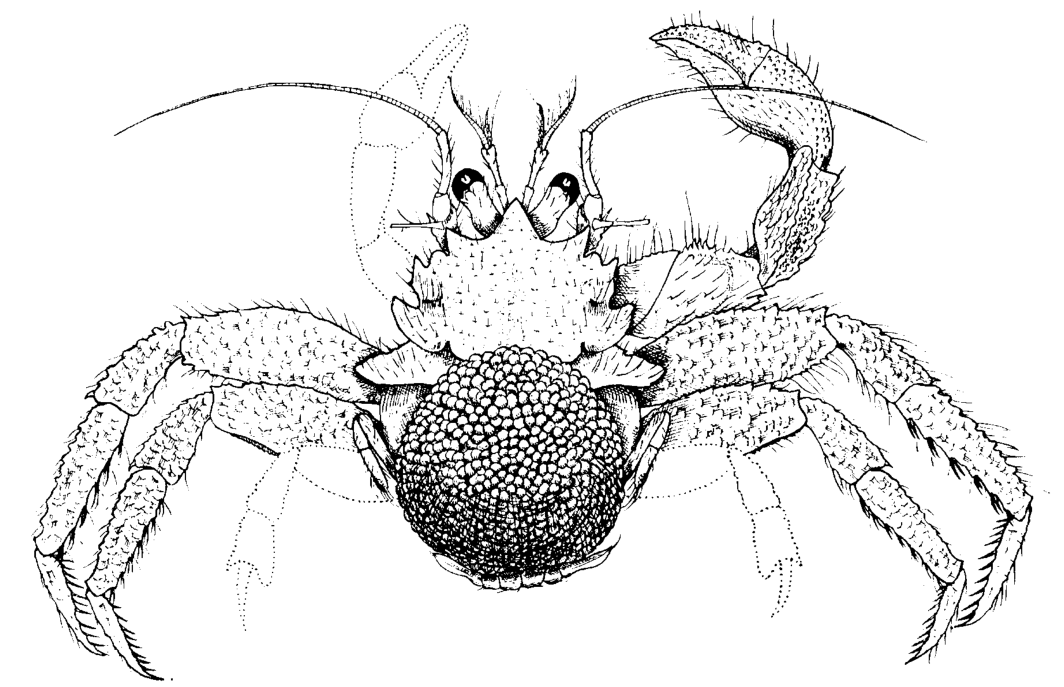
The egg-bearing female illustrated in Borradaile's 1916 report, figure 1. Original drawing in the public domain; cropped from the digitized report held by the Natural History Museum of Los Angeles County. The report gives the identification provisionally.
The drawing rewards a longer look than the famous sentence. The front of the body spreads into pointed lobes. The antennae extend well beyond it. The claws are conspicuous, but the central shield is more useful for understanding what Borradaile meant. Its edges project sideways, increasing the breadth of the back. Behind it, the body narrows abruptly. The large rounded cluster in the lower centre is the egg mass, not an enlarged carapace.
He described the hard surface as slightly translucent, with short ridges and rows of hairs. Beneath the projecting edges, however, the sides remained relatively soft. On the underside, the bases of the legs stood farther apart than in a more familiar hermit crab. The plates between them had widened too. This was a change involving several neighboring structures, with some parts altered more than others.
A photograph taken only from above would conceal much of that arrangement. So would an illustration showing nothing but an outline. Borradaile drew the animal from the side and underneath, and drew small parts separately. His subject required turning over.
An old question in a new feed
The internet version is usually shorter: everything becomes a crab.
It works well as a joke. Put a lobster at one end of an arrow, a crab at the other, and repeat. Add a person, a computer or a starship if the joke needs another panel. The humor depends on an absurdly determined universe, forever correcting its work toward a preferred crustacean.
The actual question is more local and more interesting. Within a particular part of the crustacean family tree, a broad body with a folded-under abdomen has appeared in several lineages. Some descendants subsequently departed from that shape. These animals share ancestors, but their nearest relatives do not always look most alike.
Borradaile had already noticed the restricted distribution. Near the end of his report he asked why crab-like forms occurred repeatedly in one branch of decapods while other crustaceans living alongside them retained different bodies. A shared habitat, he reasoned, could not be the whole explanation. Lobsters and crab-like animals could be collected in the same locality.
His proposed answer gave great weight to an internal disposition toward the form. Some of his language now sounds too certain, particularly when he discounted past environmental differences and imagined particular ancestral habits. His specimens could reveal anatomical relationships; they could not supply a film of ancient animals changing their way of life. The observations and the historical explanation need to be read separately.
Yet his central difficulty remains recognizable. Similar surroundings do not produce identical animals. Related animals can respond differently to similar conditions. A body is inherited with its joints, developmental processes and working parts already connected. Evolution changes that arrangement through the lives and reproduction of organisms, rather than ordering a fresh design from an empty page.
This book follows several of those arrangements. There are crabs that sweep food from passing water, crabs that cut themselves a covering, and crabs that bury themselves by coordinating their legs in a different sequence. There is a fossil with eyes so large that its maturity was initially difficult to interpret. There are living animals whose misleading names turn out to be less informative than the direction of an artery.
Borradaile's report is available to read in its original scan. It contains uncertainty, close observation and speculation within a few pages of one another. The missing legs do not prevent the animal from being useful. They do set a limit on what anyone can honestly claim to have seen.
CHAPTER 02
What is folded underneath
A lobster's conspicuous rear section contains a series of muscular segments. In a typical crab, the corresponding region is reduced and tucked against the underside. It has not simply disappeared.
That rear region is the pleon, often called the abdomen. The large shield over the front of the animal is the carapace. Under it lie the joined head and thorax, or cephalothorax. These names are directions for looking. You can understand the broad change without memorizing a complete anatomical vocabulary: the front becomes wider and flatter, the rear becomes smaller and bends underneath, and the underside changes to accommodate the altered arrangement.
The familiar claws belong to the first pair of walking-leg appendages, or pereiopods. Decapoda refers to five pairs of these appendages. Their present jobs vary. A pair may carry claws, another may be reduced, and another may hold something over the back. Ten appendages need not mean ten obvious feet in a photograph.
The red king crab illustrates the problem. NOAA's species account describes three pairs of walking legs and a pair of claws. One claw is suited to crushing, the smaller one to more delicate food handling. Its abdominal flap differs between the sexes: triangular in males, rounded in females. These are useful details when examining an identified specimen or a clear set of photographs. They are not a universal key to every creature called a crab. NOAA's red king crab account includes photographs and an identification drawing.
Shape and ancestry
Biologists use Brachyura for the group commonly called true crabs. King crabs, porcelain crabs and the hairy stone crab belong to another group, Anomura, which also contains hermit crabs and squat lobsters. Brachyura and Anomura are close relatives, together forming the group Meiura.
“True” can sound like a judgment of authenticity. It is a taxonomic convenience. A king crab is a perfectly real animal, and its common name is not a fraud. The distinction becomes useful when asking who is related to whom.
Suppose you have three labeled pictures: a king crab, a shell-dwelling hermit crab and a common shore crab. Sorting by overall appearance will tend to put the king beside the shore crab. Sorting by ancestry gives a different result. The shell-dwelling animal and the king belong on the anomuran side of the split; the shore crab belongs among Brachyura.
Neither sorting task is inherently silly. A designer comparing body profiles may care about the first. An evolutionary biologist reconstructing descent needs the second. Confusion begins when the result of the first is treated as evidence for the second.
Gerhard Scholtz examined this distinction in a 2014 account of crab evolution. The same everyday word can identify a branch of the family tree or describe a recognizable body type. Those uses overlap without being identical. A descendant remains a member of its lineage even when its body becomes less typical of that lineage.
A body has more than one measurement
Imagine two flattened boxes, one long and narrow, the other short and broad. Both are flat. Only the second resembles the usual shorthand for a crab. Now give the broad box a long, exposed rear section. It still has a broad front, but the combined outline has changed again.
This simple exercise is why a single ratio cannot capture the whole subject. Carapace width divided by length describes one feature. Depth describes another. The position and size of the pleon describe others. A broad animal may be quite deep; a thin animal may be long. A photograph can exaggerate either property if the camera is tilted.
Researchers therefore inspect several structures, including the ventral plates called sternites, rather than assigning crab-likeness from a glance. The detailed boundaries differ among studies. In a comparison, the practical question is which characters were scored, on which specimens, under which definition.
There is no need to imagine an intermediate animal as half-finished. A shell-bearing hermit crab must function as a shell-bearing hermit crab. A squat lobster must feed, move and reproduce with its own proportions. Calling one structure “intermediate” describes its position in a comparison; it does not imply that the animal spends its life waiting for a later evolutionary improvement.
An anatomical comparison also has to account for what each part does. Once the pleon is tucked away, space is available elsewhere and some movements become more restricted. Once a leg is used for carrying, it is less available for ordinary walking. Bodies contain such exchanges everywhere. A recognizable outline is the combined result, and it leaves many of those exchanges out of sight.
CHAPTER 03
The small shell at four hundred metres
In 2009 a dredge off Moorea, in French Polynesia, collected an unusual male hermit crab at a depth of 400 metres. Arthur Anker and Gustav Paulay described it in 2013 as Patagurus rex. Its carapace was broad, hard and extended into wing-like lobes. A small bivalve shell covered its reduced abdomen.
The genus commemorated Patsy McLaughlin, a specialist in hermit crabs who had helped discuss the animal before her death in 2011. The sole specimen became the holotype, the reference specimen attached to the new species' name. Some observations remained unavailable: the authors did not count its gills because reaching them would have seriously damaged the only specimen. Female characters were unknown. The paper compared it with Porcellanopagurus and Solitariopagurus, while leaving questions about their relationships open. Anker and Paulay's description includes detailed photographs and drawings.
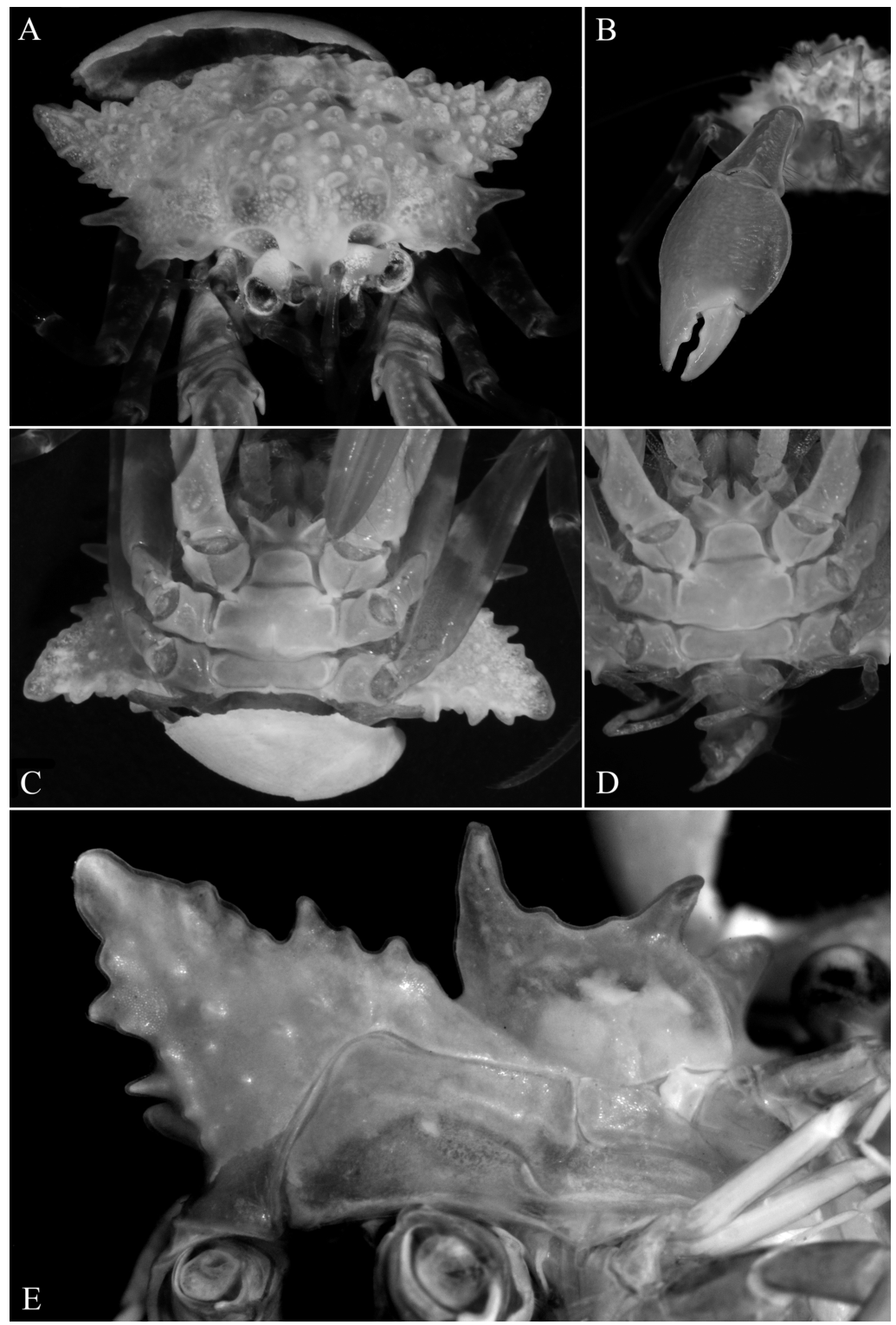
Patagurus rex, holotype UF 23548, figure 4 from Anker and Paulay (2013), CC BY 3.0. A: front and upper surface; B: right claw; C: underside with shell; D: underside without shell; E: side. Plate cropped; panel letters retained. License.
The paired underside views make a particularly good comparison. In panel C, the pale curved shell sits behind the hard central plates. In D, that covering has been removed. The top view alone would tell a different, incomplete story: a heavily armored front with an irregular edge, eyes projecting beneath it and a large claw at one side.
A shell is an external object. The hard carapace is part of the crab's own body. Both can provide coverage, but they have different histories and different costs. An animal must obtain a suitable empty shell from its surroundings. Its own exoskeleton develops with its body and must be replaced during growth. “Has armor” compresses those differences too far.
Why did a particular lineage reduce its dependence on a borrowed shell? Answering that requires evidence about shells, predators, movements, growth and ancestry. A small covering is not proof that a species is about to abandon coverings altogether. Present-day species are not arranged along a conveyor belt leading to king crabs.
A shell can benefit more than one tenant
Shell use also connects one hermit crab to others. When an animal moves into a newly available shell, it leaves its previous shell vacant. Another animal may take that one, releasing a smaller shell in turn. The empty dwelling moves through a sequence of occupants.
A 2012 study of Pagurus longicarpus used this vacancy-chain framework to investigate how shell quality and ecological context affect shell decisions. Field conditions and laboratory choices were considered together. The subject was not simply an isolated crab choosing the largest object available. Its choices occurred among other crabs and among resources of unequal usefulness. The study is a useful introduction to the ecological side of shell dependence.
For a simplified example, suppose three animals occupy shells with usable capacities of three, five and eight arbitrary units. A suitable twelve-unit shell becomes available. If the largest animal takes it, the middle animal can take the eight-unit shell, and the smallest can take the five-unit shell. One new shell has allowed three changes of residence. There are still only four shells and three animals. Nothing has been created by the transfers except a different allocation.
Real shells do not come with a single capacity score. The opening, shape, weight and damage matter, as do the animal's body and the presence of competitors. Some transfers happen quickly, while others are separated in time. The numerical example only shows why the effect of one vacancy can extend beyond its first occupant.
A lineage that relies less on a borrowed shell changes its relationship with this supply. Its own covering can grow with it through successive molts, while an external shell has to be replaced by finding another suitable object.
CHAPTER 04
The king and its relatives
A large king crab and a small hermit crab seem an unlikely pair of relatives if you begin with their silhouettes. One spreads an armored body over long legs. The other carries an object made by a mollusc. Their relationship has nevertheless been tested with anatomy and molecular evidence for decades.
In 1992 Clifford Cunningham, Neil Blackstone and Leo Buss published molecular evidence placing king crabs within hermit-crab ancestry, specifically within Pagurus in their analysis. They also estimated a timescale for the transformation. The date estimate depended on the information and methods then available; it should not be repeated as an exact stopwatch reading. The central contribution was evidence about the direction of descent. The original abstract states the hypothesis clearly.
The inference was contested. Patsy McLaughlin and Rafael Lemaitre's 1997 examination of adult morphology argued against the proposed hermit-to-king route. The disagreement involved how structures could be transformed and which character states should be treated as ancestral. It was a disagreement over evidence, not a contest between people who believed appearances and people who had discovered DNA.
A broader 2013 analysis led by Heather Bracken-Grissom combined molecular and morphological information from 137 species. It supported king crabs within hermit-crab ancestry and recovered three independent acquisitions of crab-like form within Anomura. The study also tested diversification: becoming crab-like was not a universal trigger for a surge in species numbers. A repeated body form and a repeated burst of diversification are different proposed patterns.
The useful asymmetry
A coiled shell can impose an asymmetrical living space. A hermit crab's rear anatomy is adapted to that space. If a descendant becomes externally more symmetrical, some internal features may retain evidence of its ancestry.
Keiler and colleagues investigated this in a 2013 study of hermit and king crab internal anatomy. They compared the vascular system and adjacent structures. Among the correspondences was a posterior aorta that divided near its origin and followed an asymmetrical course in the pleon. Internal anatomy supplied another set of characters alongside the conspicuous outer shell. It also showed why an evolutionary comparison cannot be reduced to matching body outlines.
An artery is not a preserved miniature ancestor. It is a functioning part of the living animal. Its arrangement can still be informative because descent does not require every structure to change at the same rate or in the same direction.
Biological evidence is messier than drawings with recorded revision histories. Gene sequences can disagree, structures can be lost, and similar demands can produce similar modifications. Researchers therefore build and compare explicit trees. A branch arrangement must account for a collection of observations rather than a single resemblance selected because it tells an attractive story.
Ancestors are not smaller contemporary species
“The king crab evolved from a hermit crab” is easily misunderstood as a statement that a familiar living hermit species turned into a familiar living king species. Evolutionary trees generally make a different claim: the lineages share ancestors, and the lineage leading to king crabs arose within a larger assemblage of hermit-crab relatives.
Living species have continued evolving since those splits. A modern shell-dwelling animal is not necessarily an unchanged version of the relevant ancestor. It may have acquired specializations of its own, including features that were absent from the ancestral population.
This is why a procession of contemporary animals can mislead. Put a small shell-bearing hermit, a broad-bodied hermit and a king crab in a row and the arrangement looks like a sequence. It may be useful for comparing structures. It does not by itself establish parentage, direction or timing.
Draw the branches first, then place the observed features on them. Some features will fit a simple history. Others will require repeated gains, losses or a different tree. The disagreement is often where the interesting research begins.
CHAPTER 05
A meal passing through the water
The large claws of a porcelain crab are easy to notice. The feeding apparatus is finer: appendages near the mouth spread fans of bristles into the water. Food arrives in suspension, and the animal collects it.
A crab cracking a mussel obtains food differently. The meal is distributed among particles passing through a small volume of water. The current, the position of the animal and the movements of its fans affect how much of that volume it can sample.
Geoff Trager and Amatzia Genin tested Petrolisthes leptocheles in a flow tank. In their 1993 study, increasing current induced a change from actively sweeping the fans to holding them for passive collection. Under the tested steady flows, feeding was exclusively active below 1.5 centimetres per second and exclusively passive above 4.5. Between those speeds the animals switched modes. Passive feeding involved a lower activity rate. The findings describe a flexible response to flow, rather than a creature permanently assigned to one feeding technique.
The units are small enough to make the experiment easy to picture. A current of four centimetres per second travels forty centimetres in ten seconds. To a person looking into a tank, that may appear gentle. To a small animal exposing delicate structures, it is a substantial and continuous movement of its immediate surroundings.
Consider a simplified calculation, separate from the experiment. Imagine a collector facing a stream with a cross-sectional area of one square centimetre. At two centimetres per second, two cubic centimetres of water pass through that imaginary window each second. At four centimetres per second, the volume doubles. If particle concentration and collection efficiency stayed fixed, potential encounters would double too.
Those conditions need not hold in an animal. The collector can bend, the flow can pass around it, particles can escape and the animal can change its posture. Still, area multiplied by speed tells us why current is part of the feeding problem. A drawing of the crab's body alone leaves out the moving medium from which it obtains food.
Small tenants
Porcelain crabs also occupy places that a broad category such as “reef” barely describes. In 2019 Bernd Werding and Alexandra Hiller named Polyonyx socialis from Vietnam. It lived in tubes built by Chaetopterus worms, often sharing them with a larger porcelain crab, Polyonyx heok, and sometimes with a nudibranch. The new species' small size and flattened limbs suited movement against the tube's inner wall while larger occupants used more of the cavity. The description presents the animal within this crowded, particular home.
A tube has an inside surface, an open passage and a builder whose own activities affect conditions within it. Two animals can live at the same mapped location while occupying different parts of that small space. At the scale of a coast map, their habitat is identical. At the scale of their bodies, a few millimetres can distinguish a usable margin from an occupied corridor.
Another 2019 paper by Hiller and Werding described Petrolisthes virgilius from the Colombian Caribbean. Material previously treated as P. tonsorius proved distinct through morphological and molecular comparison. The crabs occurred in formations made by vermetid gastropods. Color and an unusual habitat had helped draw attention to the problem, but the description did not rely on color alone. The original paper includes comparative images.
The names are close enough to blur on a quick read. Their circumstances are not: one animal lives along the wall of a worm's tube; another among structures built by gastropods. Both belong to the porcelain crabs, but their immediate surroundings differ in who builds the shelter, who shares it and where each animal fits.
CHAPTER 06
Hair, hooks and a covering to carry
The hairy stone crab, Lomis hirta, lives along southern Australia. Museums Victoria describes a flattened grey body, hairs, blue antennae and a carapace reaching about three centimetres across. The animal clings under rocks on exposed shores. Three pairs of walking legs are conspicuous beside its claws. The museum's account provides several views, including the animal against the sort of background in which its appearance is useful.
Hair can conceal an edge, retain material or carry sensory information, depending on the structures involved. It is therefore worth resisting the urge to give every bristle the same function. “Hairy” is an adequate first description and a poor final explanation.
The classification of Lomis has been difficult. Christopher Tudge examined the fine structure of its sperm in a 1997 study, using reproductive material from a male collected at Flinders Reef in Victoria. Those microscopic characters supported its distinct taxonomic placement within Anomura. The study is a reminder of how far an investigation may travel from the features in a field photograph: a crab recognized by its muddy coat was also compared through structures visible only under much greater magnification.
Decoration need not be purely visual
Some crabs attach organisms to their own surfaces. John Stachowicz and Mark Hay studied juvenile Libinia dubia that selected the brown alga Dictyota menstrualis for decoration. The alga's chemical defenses deterred potential fish predators, while the crab treated it as a low-preference food. The protective material and the preferred meal were therefore separable. Their 1999 experiments tested a form of camouflage with a chemical component.
The same researchers subsequently compared populations across the crab's range. Northern animals, where Dictyota was absent, decorated differently from animals in southern locations. Even when offered the alga, northern crabs did not show the same strong selection for it. The 2000 study found geographic variation within one species, rather than a single decorating rule that applied everywhere.
An animal carrying an unpalatable material might be protected after a predator gets close enough to inspect or taste it. An animal matching its background may reduce the chance of being noticed in the first place. Both effects can occur together, but they are not equivalent. A photograph can show resemblance to a background; it cannot directly show what a fish will accept as food.
The attachment mechanism can be more elaborate than a set of hooks. A 2016 study of Tiarinia cornigera examined clusters of structures on the carapace that the authors compared to haystacks. Their geometry created small regions of reduced flow where microorganisms could settle. The study connected physical attachment with adhesion associated with the developing biological coating. A decorated surface can be an interaction among the crab, water movement and organisms growing on it.
A sponge fitted to the wearer
Sponge crabs use another method. They can hold a covering over the body with specialized rear legs. Keita Harada, Naoki Hayashi and Katsushi Kagaya investigated cap-making in Lauridromia dehaani, offering artificial sponges in three sizes. Their 2020 study recorded choices, trimming, the hollow made for the body and the time taken. Body size helped explain several features of the finished caps; the analysis also examined repeatable differences between individuals.
The artificial material allowed the researchers to compare construction under controlled conditions. It did not mean a natural crab encounters a standardized choice of three manufactured blocks. The experiment isolated some of the decisions involved in making a covering.
A carried cap also changes how a photograph should be read. The apparent upper surface may belong to the covering. Some legs may be occupied holding it. If the animal drops the object, both the silhouette and the number of visible appendages can change at once, without any anatomical transformation.
These are working bodies with additions, coatings and objects. A comparison of body shapes needs to distinguish these additions from the body itself.
CHAPTER 07
Sideways, forward, and into the sand
A crab can face one direction and move in another. Watching the body travel across a screen is not enough to establish whether it is moving forward or sideways; the direction must be measured relative to the animal's own front-to-back axis.
In a 2008 anatomical comparison, Andrés Vidal-Gadea and colleagues studied the forward-walking spider crab Libinia emarginata, the sideways-walking shore crab Carcinus maenas and the crayfish Procambarus clarkii. Joint ranges, leg proportions and stance differed in ways associated with preferred movement direction. The study connected the visible gait with the geometry of the skeleton. A crab's joints do not offer identical freedom in every direction.
In August 2026, Junya Taniguchi and colleagues published a comparative study of 50 living species, including a hermit crab used as an outgroup. One individual represented each species. Thirty-five were classified as predominantly sideways movers and fifteen as forward movers. The index compared forward and sideways movement bouts, excluding backward bouts. Their phylogenetic analysis supported an early origin of sideways locomotion near the base of Eubrachyura, with later reversions and some returns to sideways movement. The result depends on the sampled animals and reconstructed tree; it is not a claim that each sideways step has one historical origin.
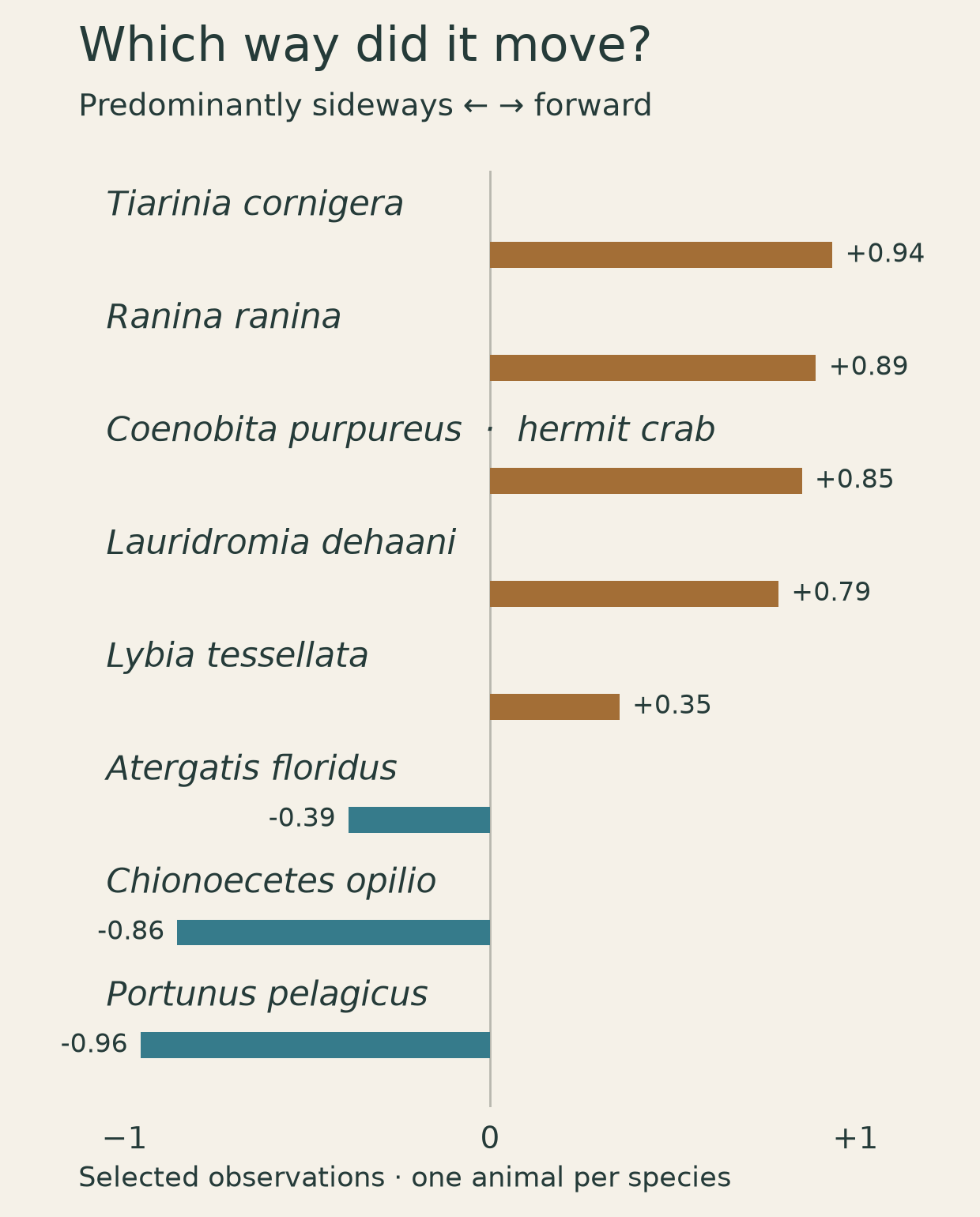
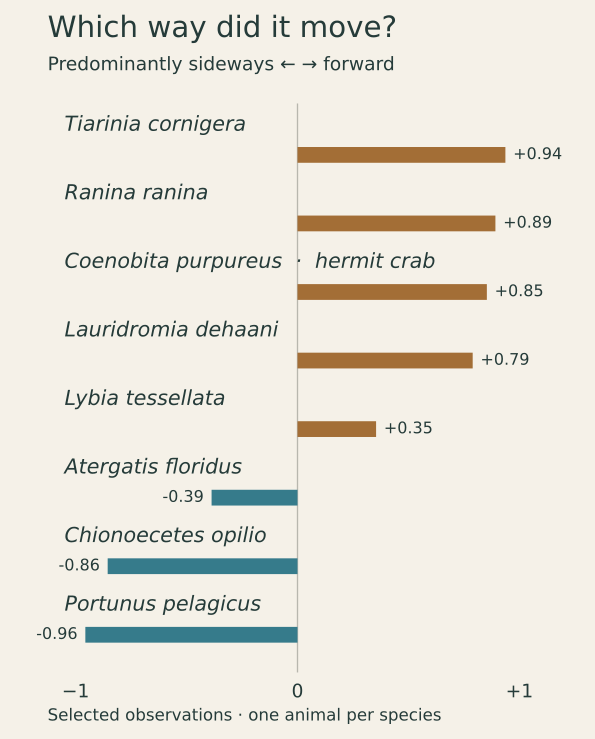
Selected values replotted from Taniguchi and colleagues' open dataset. One individual per species; this is a descriptive subset, not a new evolutionary analysis. The comparison hermit crab is marked separately. Publisher’s full data, downloadable CSV, and the chart as SVG.
An index you can check
The index is calculated as forward bouts minus sideways bouts, divided by their sum. Consider what that calculation preserves and what it discards.
Suppose a recording contains thirty forward bouts and seventy sideways bouts. The index is minus forty divided by one hundred, or −0.4. If another recording contains three forward bouts and seven sideways bouts, it produces exactly the same index. The balance is identical; the amount of observation is not.
Neither value supplies a speed. A slow sideways shuffle and a fast sideways run both contribute to the sideways category. Nor does the index tell us how far the animal traveled overall, how much time it spent stationary or how much energy it used. Those would require additional measurements.
This is not a defect in the calculation. A compact measure is useful because it answers a limited question. Trouble begins when a reader silently gives it extra meanings.
The distinction between body shape and behavior is equally useful. A lineage can retain a broad body while changing how it moves. Repeated evolution of an outline does not require identical histories for every associated behavior. The anatomy and the behavior need their own observations.
Going below the surface
The spanner crab Ranina ranina has a more elongated appearance than a typical shore crab. Its legs can move it into sand. Zen Faulkes filmed and analyzed its movements in a 2006 study. Some legs shoveled sand forward from beneath the body while another pair worked in the opposite direction, helping the rear descend. As the crab entered the sand, the coordination between paired legs changed from alternation to synchrony. It could also move forward over the surface by punting with its legs.
Digging creates a different problem from walking over a hard floor. A foot can displace the material that is supposed to support it. Material moved out from beneath the body changes the next movement's starting conditions. The animal must coordinate the removal of grains with its own descent.
A crab that is effective at this task need not be the fastest runner on a flat surface. There is no single locomotion score against which all its movements can be judged.
CHAPTER 08
A machine that walks like a crab
The robot was called Sebastian. It had six legs and eighteen degrees of freedom, and its designers used it to compare forward and sideways gaits.
Yang Chen, John Grezmak, Nicole Graf and Kathryn Daltorio reported the work in 2022. They tested locomotion in simulation and with the physical robot, including a hard floor and dry play sand. With the leg design and gaits they studied, sideways movement performed better: the reported comparison included higher speed and lower cost of transport. The paper describes how stride and frequency were selected. It does not establish that every legged machine, or every living crab, should move sideways.
For a reader who builds things, the interesting detail is that a change in travel direction can change the usable range of an existing mechanism. No extra leg is required. The geometry already present may support one path better than another.
What does efficient mean here?
Imagine two hypothetical battery-powered walkers of equal mass. Machine A travels one metre using ten joules. Machine B travels one metre using six. Under those conditions B uses forty percent less energy per metre. If it takes twice as long, however, it may still be a poor choice for a task with a strict deadline.
Now imagine A can cross a rough patch that stops B completely. Averaging energy use only over the easy part of the course would hide the decisive difference. A useful comparison has to state the task and the ground.
Cost of transport normalizes the energy needed to move a weight through a distance. In dimensionless form it is energy divided by mass times gravitational acceleration times distance. Equivalently, at steady speed it can be expressed as power divided by mass times gravitational acceleration times speed. This makes comparisons across sizes more informative, although it does not remove every difference between animals and machines.
For a numerical example, suppose a two-kilogram robot consumes ten joules while moving one metre on Earth. Using 9.81 metres per second squared for gravitational acceleration, its dimensionless cost is approximately 10 divided by 19.62, or 0.51. If the same robot consumes six joules, the value becomes about 0.31. Those figures describe only the invented example.
What energy has been counted also matters. Is the measurement taken at the battery, at the motors or estimated from mechanical work? Does it include the computer and sensors? Has the standing power been subtracted? A comparison can be internally fair while still answering a narrower question than “which robot uses less battery over a whole mission?”
Feet and ground
A leg must exert forces through contact. A foot can slip, sink or rotate. An arrangement that is stable on a laboratory floor may behave differently in loose grains, and differently again under moving water.
This is where copying the visible shape of an animal becomes insufficient. A robot with a crab-shaped shell and conventional feet may have little in common with the mechanics of a crab. Conversely, a machine with no convincing animal silhouette can test a specific biological idea about limb orientation or contact.
The same point applies to biological interpretation. Recreating a useful mechanical effect demonstrates that the effect is possible under the tested conditions. It does not reveal the exact sequence of events by which a lineage evolved, or prove that the effect supplied the historical selective advantage.
An engineering experiment can still make a biological question sharper. If one leg arrangement offers a larger useful stroke in one direction, researchers can ask whether the relevant animals have that arrangement, use that stroke and gain a measurable advantage in their normal surroundings. Each link can be examined separately.
Sebastian's six legs also provide a useful interruption to a familiar assumption. A machine need not reproduce an animal's entire anatomy to learn something from it. The test concerns a specified mechanism. A convincing animal silhouette is unnecessary for that test.
CHAPTER 09
A crab with very large eyes
The fossils came from Cretaceous rocks in Colombia and Wyoming. When Javier Luque and colleagues described Callichimaera perplexa in 2019, they had an animal that fitted poorly into the usual picture of an adult crab: an elongated body, conspicuous unprotected eyes and paddle-like limbs.
The specimens were roughly 95–90 million years old. The study included 64 individuals across a range of sizes. Features associated with mature males and females helped show that the unusual shape was not simply an ordinary larva misidentified as an adult. The authors interpreted the retention of juvenile-like features as part of its evolution. Their description places the animal within the wider history of crab forms and their departures from familiar proportions.
Pedomorphosis is the term for an evolutionary result in which descendants retain features associated with earlier developmental stages of their ancestors. It does not mean an individual refuses to grow up. Different aspects of development can change their relative timing, and reproductive maturity need not arrive only after every structure has acquired the proportions familiar from another species.
What an eye can preserve
A subsequent study published in 2022 examined Callichimaera's visual system. Preservation included external lens structures and internal optic tissues. Comparison with living crabs supported unusually rapid eye growth relative to body size. The researchers interpreted the animal as a visually active swimmer in well-lit water. Its likely way of life was inferred from the preserved equipment; no stomach full of a witnessed hunt was required, and no fossil can supply a direct observation of its behavior.
The eye is a compound eye. Its surface contains many repeated optical units, rather than one camera-like aperture. The size and arrangement of those units affect what information can be gathered. A large eye can mean several things depending on its construction: more sampling units, larger light-collecting units, a different field of view, or a combination.
That is why “big eyes” is a starting observation rather than a complete account of vision. To infer performance, researchers need dimensions and geometry. To infer ecology, they then have to consider what that performance would allow under plausible conditions.
Fossils impose additional problems. A structure may be compressed, tilted or incompletely preserved. A reconstruction has to distinguish the original arrangement from changes caused after death. A beautifully preserved surface is valuable partly because it reduces some of those uncertainties, not because it removes them all.
A lineage can move away from the familiar form
A broad carapace and tucked pleon are useful for recognizing one recurring arrangement. An animal can remain a true crab by descent while acquiring proportions that no longer fit that arrangement comfortably. Such departures are discussed as decarcinization.
The term does not imply that evolution has run backward. A descendant that becomes more elongated is not automatically recreating its remote ancestor in every detail. Other structures may continue changing, and the resulting combination can be new.
Callichimaera is useful because it makes the consequences of that erasure visible. Its large eyes and paddle-like limbs form a particular combination whose functions can be investigated, even while details of its ancestry remain unsettled.
CHAPTER 10
Two anemones, one in each claw
A boxer crab can carry a sea anemone in each claw. The tentacles make the animal look as though it is holding two small brushes. The arrangement is stranger when watched closely: the carried objects are living animals with feeding needs of their own.
Yisrael Schnytzer and colleagues studied Lybia leptochelis and its associated Alicia anemones. In a 2013 feeding experiment, the crabs limited the anemones' access to food and removed much of what they caught. Anemones separated from the crabs and fed independently grew substantially. Carrying therefore affected the size of the carried animal. The relationship could not be understood simply as two partners receiving equal benefits.
In a 2017 experiment, the researchers removed one anemone from a crab. Crabs could divide the remaining anemone, producing two pieces that regenerated. They also observed anemone theft during encounters between crabs. The paper's supplementary videos show the handling, including stretching an anemone between the claws and working on it with the front walking legs. These were observed behaviors under experimental conditions, not an imagined account of what a crab must do.
A useful question to ask while watching is which appendage performs each part of the action. The claws hold; other legs can assist. “Walking leg” names an anatomical category without restricting the limb to a single occupation. The same animal can redistribute tasks among appendages during a sequence.
There is also a distinction between the evolution of the crab's body and a change the crab induces in another organism. The anemone's size can change because of its feeding conditions. Its division is reproduction by the anemone, initiated through the crab's behavior. The resulting scene contains more than one organism's biology, even if the crab attracts most of the attention.
A large claw can be a weak claw
The male fiddler crab's enlarged claw supplies a different example of appearance concealing performance. It can be used in display and in contests, but its length does not always tell an opponent how strongly it can close.
Patricia Backwell and colleagues studied regenerated claws in the species then called Uca annulipes. Their 2000 paper reported that replacement claws could be lighter and less effective weapons than original claws of comparable length. Rivals and prospective mates did not simply reject the regenerated form. A visually large signal could therefore convey an exaggerated impression of performance.
Simon Lailvaux and colleagues investigated a related problem in Uca mjoebergi. Their 2009 study compared claw-closing and pulling performance and the outcomes of contests. Regenerated claws could function as effective bluffs, but residents with them did worse when defending burrows. The consequences depended on the social situation, including whether an animal could choose an opponent.
“Dishonest signal” is the technical phrase in this work. It need not imply that a crab considers a rival's beliefs and decides to lie. The measurable point is a mismatch between a visible signal and the performance it usually predicts, together with the receiver's response.
A long claw has room for several independent differences. The amount of muscle can vary. The lever arms can vary. The joint and the location at which force is applied can vary. Measuring the outer length records only one of these properties.
For a simple mechanical comparison, use ordinary pliers without squeezing anything living. Pressure applied near the hinge and pressure at the far end of the jaws act through different lever arms. The same handle force need not produce the same force at every point on the jaws. A living claw is more complicated, but the elementary geometry explains why length alone cannot serve as a complete strength measurement.
The anemone-holding claw, the enlarged display claw and the crushing claw are all recognizable as claws. Their uses make them different objects of study. A book about recurring crab bodies has to leave room for this variation within the recurring form.
CHAPTER 11
Leaving the old shell
Growth under a rigid exterior requires an interruption. A crab prepares a new cuticle beneath the old one, sheds the old covering and expands before the new exterior hardens. The shed exoskeleton can preserve a convincing outline of the animal that left it.
This makes an empty molt worth distinguishing from a dead crab. A transparent or hollow-looking shell on a shore may be the remains of growth. A photograph alone may not settle the identification, especially if the object is damaged or partly buried. The sensible record is “possible molt” until the relevant features can be examined.
NOAA's account of red king crab biology emphasizes the vulnerability of newly molted animals while the covering is soft. The large adult that is difficult for many predators to tackle is temporarily in a different physical state. Its species and basic anatomy have not changed, but the effectiveness of its protection has.
Preparation takes place inside
Donald Mykles's 2021 review of the crustacean molting gland describes a regulated sequence involving the Y-organs and ecdysteroid hormones. Preparations include producing new cuticle, breaking down and resorbing parts of the old covering, changes to claw muscle and growth of regenerating limbs. Shedding is the visible part of a longer physiological process.
A 2023 study of the Chinese mitten crab examined interactions between the ecdysone receptor and retinoid X receptor, including their effects on gene transcription. The experiment approached molting at the level of molecular signaling. That does not make the visible animal less relevant: the signaling helps coordinate changes that must work together when the body leaves its old exterior.
Imagine trying to remove a tightly fitted, jointed glove without tearing the hand inside it. Now extend the problem to multiple limbs, appendages and a whole external skeleton. The analogy is imperfect, but it explains why “break the shell and grow” leaves out so much. The animal must be physiologically ready for the movement, and the new covering must develop at the right time.
A hard outer case also complicates casual estimates of condition. Two animals with similar carapace dimensions need not contain the same reserves or be at the same point in the molt cycle. An outline can remain similar while the tissues inside change.
A larva has its own work to do
The young of many marine crabs spend part of their lives in the water column before taking on a bottom-associated juvenile form. Describing them as miniature adults would conceal changes in appendages, movement and feeding.
Coconut crab larvae offer a closely studied example. Mio Sugizaki and colleagues reared larvae at five temperatures in a 2010 experiment. Temperature affected growth and the relative development of structures, including appendages. Separate mass cultures in two 500-litre tanks near 29°C successfully reached the megalopal stage. These were rearing results under specified conditions, not a timetable that every wild larva follows.
A developmental diagram is usually drawn as a sequence of tidy stages. The individual animal has to live through each one. It must obtain energy, avoid injury and respond to its surroundings while its proportions and abilities change.
This is one reason the evolutionary change to an adult form cannot be understood from adults alone. A proposed alteration that works well in the final stage may affect earlier stages, and those earlier stages have their own requirements. Selection can act on the whole life cycle.
At the same time, development is not a reenactment of a lineage's evolutionary history. A larva is not a preserved ancient species. Its features can themselves evolve, and its present environment may be quite unlike that of the adults. The presence of a long rear section in a larva does not by itself tell us the exact anatomy of a remote ancestor.
The useful sequence to keep in mind is concrete: an animal hatches, feeds, changes stage, survives further growth and eventually reproduces. Any account of a body plan must fit inside that continuing sequence.
CHAPTER 12
A forest animal with a sea-going beginning
An adult coconut crab, Birgus latro, no longer carries the conspicuous gastropod shell used by a small terrestrial hermit crab. Early juveniles do use shells. As they grow, their own body covering becomes sufficient for a different way of life.
A 2010 review by Drew and colleagues describes this transition and the species' marine larval phase. The large land animal begins life in the sea; females return to the shore to release their young. The review also identifies gaps in population and recruitment evidence. A remarkable adult does not automatically come with a well-understood demographic history.
Its common name encourages an image of a coconut and a pair of powerful claws. Its sensory equipment supplies another reason to pay attention. Marcus Stensmyr and colleagues investigated olfaction in 2005 and found physiological, behavioral and morphological similarities with insect olfactory systems. Moving from water to air changes how chemical signals are encountered. Here was convergence in sensory function within an animal already prominent in discussions of body shape.
The resemblance does not mean the crab has become an insect. It means aspects of a sensory system can acquire similar properties under comparable demands while the organisms retain very different evolutionary histories.
Air and water impose different conditions on a chemical sensor. Molecules travel through them differently; exposed surfaces also face different risks of drying. A sensor's geometry, position and behavior can therefore matter alongside its molecular receptors. The animal has to bring usable signals into contact with sensitive tissue.
Nor should the coconut crab's solution be assumed for every land crab. A 2015 comparative study of terrestrial brachyuran olfactory systems found reduced antennae and olfactory processing structures in the examined true crabs, contrasting with the prominent system of terrestrial anomurans. Similar access to land can be accompanied by different sensory arrangements.
A life cycle that stays inland
Primary freshwater crabs provide a different route away from the sea. Their young develop inside relatively large eggs and emerge as juveniles, without a free-living marine larval phase.
Wu Huixian, Xue Junzeng and Neil Cumberlidge examined development in Sinopotamon yangtsekiense in a 2010 paper. They followed development from egg-laying to hatching over 77 days under their study conditions. An additional stage inside the egg, which they called the egg-juvenile-crab stage, followed the enclosed megalopa. The study does not describe a free-swimming larva outside the egg. The broader point is that an animal can complete its life cycle in freshwater through a developmental arrangement quite different from a coastal crab with planktonic larvae.
A river, a damp bank and a forest floor are not interchangeable settings. Neither are the requirements of adults and embryos. “Lives on land” can mean foraging above water while remaining tied to the sea for reproduction, or living inland with a life cycle that does not require seawater.
Joanna Wolfe and colleagues addressed that range in a 2024 study of terrestrial adaptation in true crabs. They analyzed habitat as a gradient and reconstructed repeated departures from marine environments, estimating between seven and seventeen depending on the inference. They also inferred returns to the sea. The range is part of the result; a single confident count would conceal the uncertainty in reconstructing these changes.
Compare two hypothetical life cycles. Consider one hypothetical species whose adults spend daylight under damp vegetation but whose larvae must develop offshore. Consider another whose adults remain beside a stream and whose young hatch as juveniles there. The first may look more terrestrial during an afternoon observation. The second is less dependent on marine habitat over its complete life cycle.
Which is “more terrestrial” depends on the criterion. Researchers can avoid that ambiguity by recording the separate traits: adult location, respiratory requirements, water balance, egg development and where the young live. A single label may still be convenient, but it should be built from those observations.
The adult's silhouette tells us very little about these dependencies. A crab can walk across dry ground and still need an ocean at another stage of its life.
CHAPTER 13
The parts have to fit together
A carapace cannot broaden in isolation from everything beneath it. The limbs attach around the thorax. Muscles need space and attachment surfaces. Nerves and vessels must reach their destinations. Changes in one region can alter the available arrangements in another.
Keiler, Wirkner and Richter examined such relationships in their 2017 synthesis of carcinization, using micro-computed tomography and three-dimensional reconstructions. They found corresponding relationships between external and internal structures across independently crab-like lineages, alongside substantial internal differences. Their explanation emphasized structural dependencies rather than an undefined evolutionary drive toward becoming a crab.
A dependency can constrain the combinations that are physically workable. It does not require a future target. If a passage narrows, structures passing through it must still fit. If attachment points move apart, the tissues spanning them are affected. Similar changes can follow from similar local relationships even when the lineages have separate histories.
A candidate gene is a beginning
Genomic comparisons add another scale. Werner Veldsman and colleagues assembled genomes for the coconut crab, red king crab and ornate spiny lobster in a 2021 study. They investigated gene-family changes associated with terrestrial life and crab-like form. One tempting candidate, caudal, was expanded in the coconut crab but also in the long-tailed spiny lobster. That distribution prevented a simple claim that its expansion explained carcinization. The paper proposed leads for further work, rather than a single switch that makes a crab.
A gene's name can make an association sound more decisive than it is. If a gene is involved in posterior development in one animal, a difference in that gene family elsewhere is worth investigating. It does not immediately establish the direction or size of its effect in another species.
There are several distinct questions. Is the gene present? How many copies are there? Where and when are they expressed? What do their products do in those tissues? What happens if their activity changes? A sequence comparison can answer some of these and suggest others. It cannot substitute for all of them.
The same caution applies to an apparent absence. A gene missing from an assembly may be biologically absent, or it may have been difficult to assemble or recognize. Repeated sequences, incomplete data and annotation choices complicate the inventory. Comparing genomes requires attention to how the lists were produced.
Several changes can travel together
Imagine a population in which a slight widening of one plate changes the positions at which adjacent structures develop. Individuals inheriting the wider plate also tend to develop a different spacing of those structures. If that combination works well, both features can become more common. An observer much later might record two associated traits even though the historical changes were not independent.
Now imagine the spacing can vary separately, but only certain combinations allow the muscles to work effectively. Selection could favor those combinations even without a direct developmental link between the traits. Similar adult correlations could arise through different processes.
Distinguishing those possibilities requires more than a list of adult measurements. Developmental observations, genetic evidence and functional tests can help. The point is not that every explanation is equally plausible. It is that a visible correlation leaves specific alternatives to investigate.
Borradaile's 1916 report reached for an internal disposition because the same broad form recurred within a restricted set of relatives. Modern research can break that vague proposal into smaller questions about structures, developmental relationships and gene activity. Some can now be measured. Others remain unresolved.
CHAPTER 14
How many times is again?
“At least five” is a widely repeated answer to the number of times a crab-like body has evolved. It is a summary of a reconstruction, not a count made by watching five events.
Joanna Wolfe, Javier Luque and Heather Bracken-Grissom's 2021 review described at least five acquisitions and at least seven losses across Meiura. Their discussion identifies three acquisitions within Anomura—porcelain crabs, the hairy stone crab and king crabs—while allowing one or two within Brachyura. Even this breakdown shows why “five” should not be treated as a settled, closed list. The authors explicitly treated the reconstruction as a hypothesis rather than the only possible history. The uncertainties concern both the family tree and how particular forms are classified.
The count cannot be obtained by listing every animal with “crab” in its common name. Nor can each unusual species automatically be counted as another independent origin. Its relatives may share the relevant features through descent from the same ancestor.
Four invented species
A small exercise shows why the branches matter. The species and trait below are invented. They are not a proposed crab phylogeny.
Suppose species A and B have a broad shield, while C and D have a narrow shield. An independently established tree places A and B together as one close pair, and C and D together as another. If the ancestor had a narrow shield, a single widening on the branch leading to A and B can explain their shared condition.
Now change the tree. A is paired with C, and B with D. The observed tips are unchanged: A and B broad, C and D narrow. With a narrow ancestral state, two separate widenings can explain the pattern. A different account could involve one earlier widening followed by two narrowings. That history requires more changes, but it is still logically possible.
The examples can be written compactly:
| Close pairs in the tree | Broad species | A simple history from a narrow ancestor |
|---|---|---|
| A with B; C with D | A and B | One widening before A and B split |
| A with C; B with D | A and B | Two independent widenings |
Choosing the history with the fewest changes is one method, commonly called parsimony. It is an assumption about reconstruction, not a law requiring evolution to use the shortest available route. Statistical methods can instead model transition rates and branch lengths. Different assumptions may produce different support for the possible histories.
Now suppose the ancestral state is unknown. A broad ancestor followed by losses becomes another possibility. An outgroup can help: a related lineage outside the group under study supplies evidence about earlier states. Fossils may add observations nearer the relevant parts of the tree. Neither automatically resolves every ambiguity.
A missing branch can matter
Imagine the first tree again, with A and B forming a pair. A newly discovered species E is closely related to A and has a narrow shield. Its position could favor a loss in E, a later gain in A, or another reconstruction depending on the rest of the tree. The discovery changes the information available; it does not mean the earlier researchers failed to count a visible animal.
The trait definition can alter the score too. Perhaps all five species have broad shields, but only A and B have a tightly folded pleon. Or perhaps A has a folded pleon and B only a partly flexed one. Treating these as one binary “crab-like” character hides the difference. Scoring them separately may reveal that the components changed at different times.
This is why a precise list of five independent crab transformations can be less honest than a qualified number. Some lineages are well-supported examples. Others depend on definitions or relationships still being examined. The scientific result consists of the tree, observations and reconstruction together.
CHAPTER 15
A successful shape in warmer water
More than ten billion snow crabs disappeared from the eastern Bering Sea between 2018 and 2021, according to the estimates examined in a 2023 study led by Cody Szuwalski. The collapse followed the marine heatwave of 2018–2019. Calculated food requirements, contraction of the occupied area and poor body condition supported starvation as an important mechanism.
The distinction is sobering. Water need not become hot enough to kill an animal directly to make its environment unlivable. A change in temperature can increase energy requirements while the available food and usable area fail to keep pace.
NOAA's 2024 account of subsequent research placed the event within a broader shift from Arctic toward sub-Arctic conditions. Sea ice, bottom temperature and biological communities changed together. The analysis linked those conditions to human-caused climate change. A body well suited to one ecological setting can be exposed to another without its outline changing at all.
Reserves inside a hard case
Erin Fedewa and colleagues investigated energetic condition during and after the heatwave. NOAA's December 2025 report describes measurements of the hepatopancreas, an organ involved in digestion and energy storage. Its percentage dry weight was associated with fatty-acid concentration, offering a practical way to monitor reserves. Juvenile condition declined around the collapse and subsequently improved, alongside signs of population recovery through 2024. Improvement did not remove vulnerability to another heatwave.
The measurements return us to a limitation of the silhouette. A carapace can tell a survey team about size while concealing a loss of stored energy. The external form that made the animal recognizable remains in place even as its prospects deteriorate.
For a simplified energy budget, suppose an animal can obtain twelve arbitrary units of usable energy per day and requires ten for maintenance and ordinary activity. Two remain for growth, reserves or reproduction. If its requirement rises to fourteen while intake stays at twelve, it must use reserves or change its intake and expenditure. A store of twenty units would cover ten days of that two-unit deficit if every rate stayed fixed.
Those are invented units and fixed assumptions. Wild animals can move, alter feeding, experience variable prey and incur additional costs. The calculation only shows why a moderate change in ongoing requirements can consume reserves without an immediately lethal temperature.
A stream can contain an entire range
A different scale of vulnerability appears in Johora singaporensis, the Singapore freshwater crab. Singapore's National Parks Board describes it as endemic to the country, with demanding stream-habitat requirements. Conservation work has included habitat studies, captive breeding and translocation. Young crabs observed after a translocation provided evidence of reproduction at the receiving site. The working group's account describes the practical work behind that result.
A widespread group can contain narrowly distributed species. The existence of thousands of other true crabs does not provide this one with another suitable stream. Evolutionary success measured across a large lineage is a poor substitute for the conditions needed by a particular population.
The two cases also warn against a convenient ending in which ancient recurrence becomes a promise of future persistence. Crab-like bodies have appeared repeatedly and supported many ways of life. They do not exempt animals from food shortages, altered water, lost habitat or failures of recruitment.
CHAPTER 16
Before the animal moves away
If you have access to a shore, a freshwater observation site or a good aquarium, there is a small exercise worth trying. Choose one animal and watch it long enough to see an action completed.
Do not begin with the name. Begin with the front of the body. Where are the eyes? Which way is the animal facing? Does it travel along that axis or across it? Does the same direction persist when it turns, feeds or reaches cover?
Next, follow the appendages. Count only what you can see, and distinguish an absent limb from a limb hidden by the body or an object. Notice whether a claw is opening, carrying, displaying or simply held still. A rear leg that appeared useless in one view may be occupied with something above the back.
If the animal is feeding, watch the route to the mouth. The most conspicuous appendage may not be the one collecting food. In a video, slow playback can help; an edited sequence may conceal pauses or changes of position, so keep the source's time scale in mind.
For a live shore visit, keep the observation gentle. Follow local access rules and tide advice, leave animals in their habitat and avoid disturbing the rock or shelter around them. The National Park Service's tidepool guidance is a useful starting point. A photograph taken without handling is often enough for an interesting question.
A record another person can use
A small notebook entry can contain the date, place at an appropriate level of detail, habitat, approximate size and a description of one action. Add a photograph or a short clip if you can do so without disturbance. Keep an uncertain identification marked as uncertain.
Separate what was visible from what you think it means. “Held a fragment above its back for two minutes” records an action. “Used camouflage” proposes a function. Both can belong in the same notebook, provided they are not confused.
You can repeat an observation without turning it into a formal experiment. Does the same animal use the same movement when undisturbed? Does a second individual differ? Does a change in current coincide with a change in feeding? Such notes may remain casual natural history. They still become more informative when the circumstances are recorded.
A museum specimen allows other questions. Look for the collection locality, date, identification history and whether it is a type specimen. A name on a label connects to an actual object with a particular history. The damaged female in Borradaile's report and the male from deep water off Moorea were both useful because someone retained the material, described its limitations and made comparisons possible.
There is no requirement to end an observation with an explanation. Sometimes the accurate note is that a leg disappeared beneath a covering and you could not see what it did next. Another view, another recording or another specimen may resolve it later.
The eye turns. A fan opens. One pair of legs keeps hold while another pair changes position. The outline remains recognizably crab-like, and almost everything worth watching happens within it.
Sources & edition note
First full edition: sixteen chapters, credited historical and specimen plates, an original replot of published walking data, and clearly hypothetical numerical examples. No interviews, field visits or experimental results are invented.
Kit Venn is a fictional editorial pen name. This book was researched and written with AI assistance. Linked sources distinguish observations, historical hypotheses and current reconstructions.
- Borradaile (1916), Porcellanopagurus ↗
Original sixteen-page report; damaged egg-bearing female, provisional identification, comparative drawings and historical hypothesis. Figure 1 reproduced from the public-domain original.
- NOAA, red king crab ↗
Identified anatomy, life history and post-molt vulnerability; account updated June 2026. No fishing recommendation is made.
- Scholtz (2014), Evolution of crabs ↗
Distinguishes crab as a body type from Brachyura as a lineage.
- Anker and Paulay (2013), Patagurus rex ↗
Original description of the single male holotype from 400 m off Moorea; shell, anatomical limits and McLaughlin dedication. Figure 4 reused under explicit CC BY 3.0.
- Edquist and Rotjan (2012), shell vacancy chains ↗
Pagurus longicarpus field/laboratory study of shell quality and ecological context. The book's numerical shell-allocation example is invented.
- Cunningham, Blackstone and Buss (1992), hermit to king ↗
Original molecular hypothesis; historical time estimate is not treated as an exact current date.
- McLaughlin and Lemaitre (1997), adult morphology ↗
Historical argument against hermit-to-king transformation, presented as a scientific disagreement rather than the current consensus.
- Bracken-Grissom and colleagues (2013), Anomura phylogeny ↗
Combined morphological/molecular reconstruction,137 species; crab-like origins and diversification test.
- Keiler and colleagues (2013), internal anatomy ↗
Vascular correspondences and retained asymmetry in hermit and king crabs.
- Trager and Genin (1993), porcelain crab feeding ↗
Flow-tank experiment on active/passive feeding; reported thresholds are specific to tested conditions.
- Werding and Hiller (2019), Polyonyx socialis ↗
Original description of a porcelain crab living along the inside of a shared worm tube.
- Hiller and Werding (2019), Petrolisthes virgilius ↗
Morphological/molecular distinction and vermetid-associated habitat in the Colombian Caribbean.
- Museums Victoria, Lomis hirta ↗
SouthernAustralian natural history, appearance and specimen photographs. Museum photographs are linked, not copied.
- Tudge (1997), Lomis sperm morphology ↗
Ultrastructural characters from a male collected at Flinders Reef; historical taxonomic evidence.
- Stachowicz and Hay (1999), chemical camouflage ↗
Experimental separation of decorating preference and food preference in Libinia dubia.
- Stachowicz and Hay (2000), geographic variation ↗
Population differences in selection of chemically defended algae for decoration.
- Tiarinia cornigera surface architecture (2016) ↗
Microscopic structures, flow and attachment; does not establish one mechanism for all decorator crabs.
- Harada, Hayashi and Kagaya (2020), sponge caps ↗
Artificial-sponge choices, trimming and individual behavioral differences; controlled experiment rather than standardized natural materials.
- Vidal-Gadea and colleagues (2008), walking anatomy ↗
Three-species comparison of joints, proportions and stance. Historical ancestry claims in the abstract are not adopted.
- Taniguchi and colleagues (2026), sideways locomotion ↗
Version of record 27 August 2026, DOI version 3;50 species include an anomuran outgroup, one observed individual each. Ancestral inference includes reversions.
- Taniguchi and colleagues, source data ↗
Unmodified publisher workbook; book chart replots eight records and downloadable CSV preserves all 50. No new phylogenetic analysis.
- Faulkes (2006), Ranina locomotion ↗
Filmed digging, gait changes and surface punting.
- Chen, Grezmak, Graf and Daltorio (2022), Sebastian robot ↗
Simulation and physical hexapod tests; findings apply to tested geometry/gaits/ground, not all animals or robots.
- Luque and colleagues (2019), Callichimaera ↗
Original fossil description, mature anatomy and interpretation of retained juvenile-like features.
- Luque and colleagues (2022), fossil vision ↗
External lenses and internal visual tissues; likely ecology inferred from preserved equipment.
- Schnytzer and colleagues (2013), anemone growth ↗
Feeding experiment: crab-held anemones deprived of food compared with independently fed anemones.
- Schnytzer and colleagues (2017), splitting and theft ↗
Experimental anemone removal, splitting and encounters; supplementary videos available.
- Backwell and colleagues (2000), regenerated fiddler claws ↗
Weapon/display mismatch in the species named Uca annulipes in the paper.
- Lailvaux and colleagues (2009), claw performance ↗
Uca mjoebergi closing/pulling performance and context-dependent contest results.
- Mykles (2021), molting gland ↗
Review of coordinated physiological preparations and signaling; no intervention protocol.
- Chinese mitten crab receptor study (2023) ↗
Ecdysone/retinoidX receptor interaction and transcription during molting.
- Sugizaki and colleagues (2010), coconut crab larvae ↗
Temperature-dependent development and tank rearing; experimental conditions are not universal wild schedules.
- Drew and colleagues (2010), coconut crab biology ↗
Shell use, terrestrial adult/marine larval life cycle and demographic evidence gaps.
- Stensmyr and colleagues (2005), aerial olfaction ↗
Physiological, behavioral and morphological convergence with insect olfaction.
- Krieger and colleagues (2015), true-crab olfaction ↗
Reduced peripheral/central pathways in examined terrestrial brachyurans; contrasting routes to land.
- Wu, Xue and Cumberlidge (2010), development inside the egg ↗
77-day observed sequence and additional embryonic egg-juvenile stage; not an extra-embryonic free-living larva.
- Wolfe and colleagues (2024), terrestrial adaptation ↗
Graded habitat states, repeated marine departures and returns; uncertainty in counts retained.
- Keiler, Wirkner and Richter (2017), structural dependencies ↗
Micro-CT/3 D comparison of external and internal arrangements; abstract-level synthesis, not a claim to reproduce the full analysis.
- Veldsman and colleagues (2021), comparative genomes ↗
Coconut/king/spiny-lobster genomes; caudal expansion not a specific explanation of carcinization.
- Wolfe, Luque and Bracken-Grissom (2021), recurring body plans ↗
At least five gains/seven losses as a working reconstruction; definitions and alternative paths acknowledged.
- Szuwalski and colleagues (2023), snow crab collapse ↗
Survey-based population loss and energetic evidence after 2018–2019 heatwave; starvation supported as a mechanism.
- NOAA (2024), ecological shift in the Bering Sea ↗
Institutional account of climate attribution and associated ecosystem changes.
- NOAA (2025), snow crab energetic condition ↗
Fedewa team's hepatopancreas measurements and recovery evidence through 2024; no claim of complete recovery.
- NParks, Singapore freshwater crab ↗
Conservation, habitat work, translocation and evidence of reproduction at a receiving site.
- National Park Service, tidepooling ↗
Observation etiquette and site-specific safety/access guidance. Follow the rules for the place visited.