CHAPTER 01
The question nobody thought to ask
Ask someone what color Tuesday is. They may look for a reason to choose: blue for the working week, yellow because the word sounds cheerful, perhaps no color at all. Someone else may answer immediately and find your question oddly elementary. Tuesday has had that color for years.
The answers can sound similar while describing different events. One person has just invented a comparison. Another is reporting an experience that arrives without being invited. The difference is easy to miss because conversation gives us the same words for both.
Synesthesia is the name researchers use for a family of experiences in which a particular trigger brings an additional, characteristic experience with it. Letters may evoke colors. Words may evoke tastes. Ordered sequences may have positions in space. The University of Sussex research group describes these variations and the considerable differences between people who share a label.
The trigger is often called the inducer; the accompanying experience is the concurrent. Those terms are useful when ordinary sensory labels become awkward. A day of the week is a learned concept, not a sense organ. Describing every case as a crossing of the five senses leaves a large part of the subject unexplained.
A color with no paint
There is no official color for Tuesday. This book's jacket chooses a palette for a design; it does not report a universal synesthetic calendar. Another person's Tuesday may be different, and many people have no such experience.
Even the verb see needs care. Some people describe color as located in the external scene. Others describe it internally, without mistaking the actual ink for colored ink. A 2004 study by Mike Dixon, Daniel Smilek, and Philip Merikle examined this distinction under the terms projector and associator. These descriptions give a researcher something to ask about; they should not become a demand that every account fit neatly into one of two boxes.
Consider an invented example. A reader recognizes the printed numeral 4 as black and nevertheless experiences a particular blue with it. Asked the ink color, they can answer black. Asked the associated color, they answer blue. Reporting both is not a contradiction: the questions concern different properties of the encounter.
A diagram can show a blue 4, but that changes the stimulus for everybody looking at it. It cannot place you inside the reader's experience. Keep that limitation in mind whenever an illustration promises to show exactly what synesthesia looks like.
What a report can establish
A person's account is where an investigation begins. It provides the triggers, the qualities to ask about, the circumstances in which the experience occurs, and the person's own history. It also contains the ordinary uncertainties of recollection and language.
Someone may remember having colored letters for as long as they could read. That does not tell us which associations were present at six, whether they changed during childhood, or what happened before literacy. To answer those questions, researchers need observations made at different times, not only a confident adult memory of early life.
The same care applies to someone who has just discovered the word synesthesia. Learning a name can make an old experience discussable. It can also prompt new attention to it. A research interview should leave space for both possibilities rather than treating the date of discovery as the date of onset.
Throughout this book, named studies are linked so that their methods and limits can be checked. Unnamed examples are constructed explanations, not interviews or disguised biographies. No single person's colors, tastes, or calendar will stand for everyone else's.
The ordinary conversation
If someone gives Tuesday a color, ask what they mean by color. Does it happen when you read the word, hear it, think about the day, or some combination? Is the shade specific? Does it feel chosen? Is it in the room, in the mind, or difficult to describe that way?
Allow no as an answer. A question that assumes everyone must find a color can produce answers even from people who have never experienced one. Likewise, an enthusiastic audience can make uncertainty uncomfortable to admit. Nobody needs to supply a vivid answer.
CHAPTER 02
Ask again, later
Suppose two people give you twenty-six letter colors. Both lists are detailed. Both people sound certain. You cannot look directly at the experience either one reports, but you can preserve the answers and ask again.
A month later, one person chooses almost the same shades. The other remembers a few broad categories and improvises the rest. That difference would give you a reason to investigate further. You would still need to ask about the experience and how each person approached the task.
Consistency has been central to synesthesia research because it turns a private report into a pattern that can be measured across occasions. The comparison belongs within the person. If one person's A is green and another's is red, disagreement between them does not make either person's own pattern inconsistent.
A test needs a procedure
David Eagleman and colleagues introduced a standardized test battery in 2007. It combined questions with computerized tasks and numerical scoring, allowing researchers to compare results collected using the same procedure. In a typical grapheme-color task, letters or digits appear repeatedly in randomized order and the participant selects the associated color.
The repeated presentations matter. The random order reduces the usefulness of simply repeating a sequence of responses. A color picker allows distinctions finer than a short list of color names. The resulting record can show whether repeated choices for a particular letter cluster closely together.
Now imagine designing a much cruder test with only four buttons: red, green, blue, and yellow. Someone who remembers the broad category can appear perfectly consistent. A richer palette asks a more demanding question. Changing the interface changes what a score means.
Matching a color on a screen still requires interpretation. A screen has a limited range, and a person may find it difficult to match a color they experience. The task measures a set of responses under stated conditions. A good report describes those conditions instead of presenting the number as if it arrived independently of the equipment.
The wrong color can cost time
Another approach asks whether the association interferes with a task. In an illustrative experiment, suppose a person's 4 evokes blue. Print 4 in blue on some trials and in a conflicting color on others, then ask the person to name the actual display color. Differences in response time or errors may reveal that the associated color is being activated even though it is irrelevant to the instruction.
This family of tasks is related to the Stroop effect, where a competing response makes a simple naming task harder. For synesthesia, the details must be tailored to the participant's associations. Agreement and conflict depend on the individual palette.
Interference shows that an association affects performance under the tested conditions. It does not tell you exactly how the experience feels, and learned associations can also interfere with responses. Later training studies will make that distinction especially clear.
Measure errors as well as speed. A person can respond quickly by making more mistakes, or slowly by being unusually cautious. Repeating enough trials and using an appropriate comparison helps separate the pattern of interest from an accidental hesitation.
Check the test itself
A widely used test still needs validation. In a 2015 study, Duncan Carmichael and colleagues recruited 2,847 participants and found a grapheme-color prevalence of 1.2 percent using the Synesthesia Battery. That broadly agreed with earlier estimates obtained through conventional longer-term testing.
Agreement in prevalence supports the method's usefulness, but it is not the same as proving that two methods classify every individual identically. A population total can match even when some individual classifications differ. Read what was compared before deciding what has been validated.
For the same reason, a score from a casual online quiz should not become a verdict about every form of synesthesia. A letter-color task addresses letter-color associations; spatial calendars, word tastes, and touch require suitable methods of their own.
CHAPTER 03
Twenty-two out of five hundred
A research group that advertises for people who taste words will hear from people who taste words. It will also hear disproportionately from people who noticed the advertisement, recognized themselves in its language, wanted to participate, and had time to reply.
That is a useful way to find participants. It is a poor way to estimate how common the experience is among everyone who did not reply.
The distinction changed estimates of synesthesia. In their 2006 prevalence study, Julia Simner and colleagues used recruitment that did not depend on people referring themselves as synesthetes, together with behavioral testing. In the screened sample of five hundred students, twenty-two were identified with one of the examined forms: 4.4 percent. Colored days were more common than the heavily studied letter-color form. The study also found no strong imbalance between the sexes, challenging an earlier impression that synesthesia was overwhelmingly female.
The estimate belongs to the study’s sample and the forms it assessed.
Keep the denominator
Twenty-two divided by five hundred is 0.044. Multiplying by one hundred gives 4.4 percent. The arithmetic is exact for that count; the estimate of a wider population remains uncertain.
An invented comparison makes the point. If a different sample of five hundred produced eighteen qualifying participants, its observed proportion would be 3.6 percent. If it produced twenty-six, it would be 5.2 percent. These examples are not additional research results. They show why a percentage written to one decimal place should not be mistaken for a universal constant.
The sample also has a location and a recruitment setting. Five hundred students are not a random selection of all ages, languages, and cultures. A result can be valuable while leaving those extensions open.
When an article says one person in twenty, ask what was counted and where. Was the claim about colored letters, all tested variants, self-reported experience, or a broader category that includes spatial sequences? Were participants selected because they already suspected they had it?
Keep the denominator beside the percentage when passing the finding on.
Count people and experiences separately
A person can report more than one form. If someone has colored letters and a spatial calendar, adding the totals for those categories may count them twice. A prevalence estimate for people therefore needs a rule for overlap.
Imagine a small teaching example with one hundred participants. Eight report experience A, six report experience B, and three report both. Eleven people report at least one, because eight plus six minus the three counted twice equals eleven. None of these figures describes an actual synesthesia sample; they illustrate the bookkeeping.
Classification can change the total too. If a study examines only experiences involving color, it will miss someone whose relevant experience involves taste or space. Expanding the definition can increase the count without any change in the underlying population.
A careful comparison between studies therefore begins with the questionnaire and inclusion rules. Two different totals need not mean one research team made an error. They may have asked different questions.
Who recognizes the description?
A person can answer no to a vague question and yes to a concrete one. “Do your senses mix?” may not sound like the experience of knowing that September occupies a particular place. “When you think of the months, do they have a stable spatial arrangement?” gives the person something more specific to consider.
But specificity can turn into suggestion. A long, vivid description may invite someone to imagine the experience while answering. Researchers have to balance clarity with neutral wording and, where suitable, follow-up tasks.
The same issue applies to sex differences, age differences, and cultural comparisons. A difference in who volunteers or recognizes the terminology can look like a difference in the trait itself. Recruitment helps determine what the result can tell us.
CHAPTER 04
An alphabet takes time
A child has to learn what a letter is. The marks on a page belong to a system: they have names, sounds, shapes, and positions in an ordered set. Uppercase and lowercase forms can look quite different while counting as the same letter. Fonts add further variation.
That makes letter-color synesthesia a developmental question from the outset. Whatever predispositions a child brings to learning, the particular writing system is encountered in a particular environment. An explanation has to account for both the learner and the learned material.
Adult recollection cannot supply the whole history. A stable association at thirty does not prove that the same association was stable at six. To see development, researchers needed to return to children they had already tested.
Following the same children
In research published in 2009, Julia Simner and colleagues screened 615 children aged six or seven from twenty-one UK primary schools. Individual behavioral assessments and follow-up a year later allowed the team to study developing letter-color consistency. The comparison included children without synesthesia, including those with strong performance on the matching task.
This design addressed a problem that an adult survey could not. A child with a good memory might reproduce choices well, so a high score alone needed context. The investigators could compare patterns as they developed, rather than simply selecting the most consistent adult volunteers after development was complete.
The later longitudinal follow-up by Simner and Angela Bain, published in 2013, extended observation to age ten or eleven. Across the reported trajectory, the proportion of fixed letter and digit associations rose from 34 percent at six or seven to 48 percent at seven or eight and 71 percent at ten or eleven. Some children followed a different course, with slower development or apparent loss of the earlier pattern.
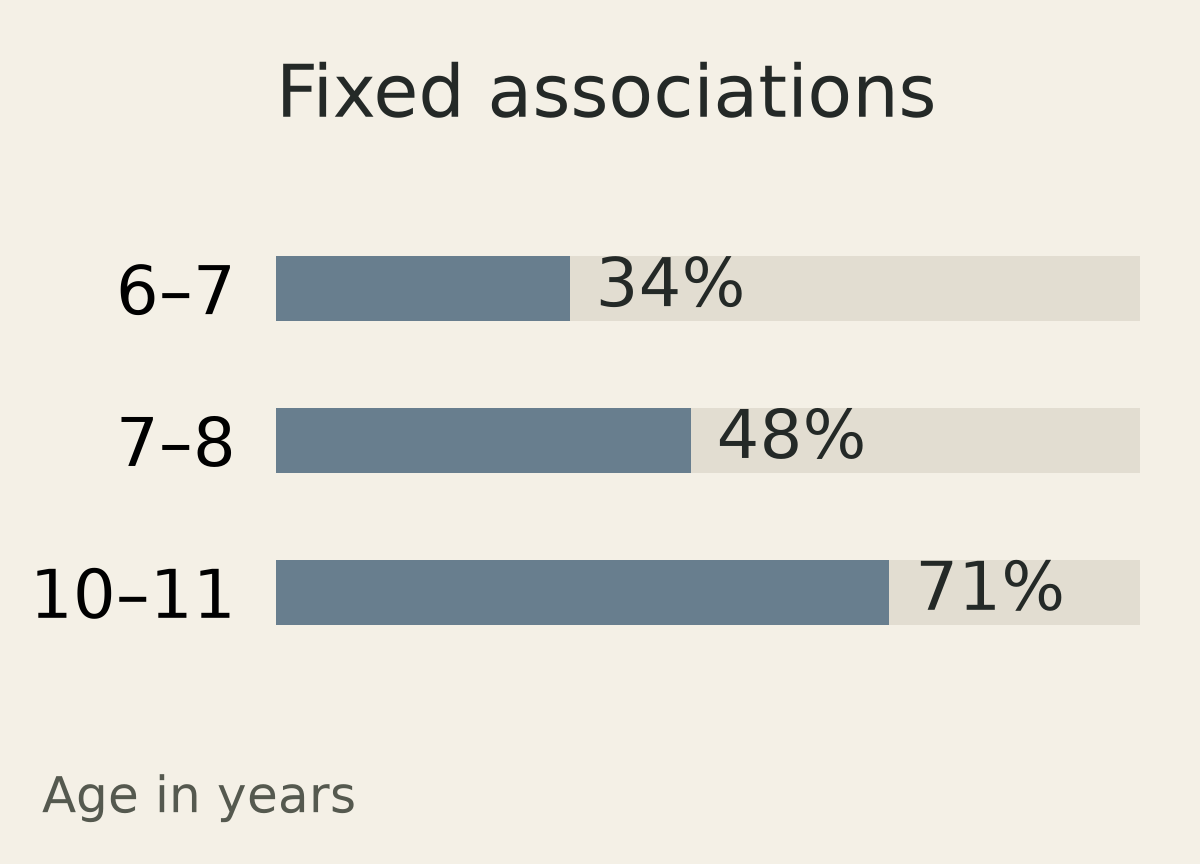
The chart redraws the three reported percentages from Simner and Bain’s longitudinal account. It shows the group trajectory, with individual variation discussed in the paper.
These percentages describe the study's measurements, not a timetable that every child must meet. They show that adult-like consistency can emerge gradually. The observed changes leave a substantial role for development after literacy begins.
What does stable mean?
Imagine a child who gives the same color for A repeatedly but changes the color for R between sessions. Another child may have stable digits but less stable letters. An overall score combines those different patterns of stability.
The overall score allows group comparisons; the individual records show where development differs. A researcher may want to know which associations changed, whether the child's recognition of a symbol changed, and whether the task was understood in the same way at each visit.
This is a general feature of developmental measurement. The person taking the test is changing alongside the trait being studied. Attention, familiarity with computers, language, and willingness to answer can all affect what a task records. Suitable comparisons help, but no number makes those questions disappear.
There is also a difference between failing to demonstrate an experience and demonstrating its absence. A young child may lack the vocabulary or task skills to describe something reliably. That possibility calls for a better method; it does not justify assuming that the experience must be present.
Reading supplies more than shapes
Consider a new symbol introduced to an adult reader. At first it is an unfamiliar mark. After learning, it may stand for a sound, a number, or a word. The physical strokes can remain identical while the reader's understanding changes.
This gives researchers several possible influences to separate. Does an association follow the visual shape? The sound? The meaning? The position in a sequence? Different tasks can hold some features constant while changing another.
For an invented example, a symbol might resemble a familiar letter but have a different sound in a newly learned script. If its associated color follows the familiar shape, that suggests one influence. If it follows the learned sound, that suggests another. Neither result would establish a complete explanation of synesthesia on its own.
When talking with a child, listen without insisting on an adult level of precision or repeatedly testing them for an audience. If colors matter to their use of a school material, ask how. A report of a mismatch is information about that child's experience, not an instruction to assign the same palette to the entire class.
CHAPTER 05
The letters on the refrigerator
Plastic alphabet magnets are made in batches. A manufacturer chooses colors, repeats them across letters, and sends the sets into many different homes. For most children, those choices are part of a toy. For some synesthetes, they appear to have become part of the alphabet itself.
Nathan Witthoft and Jonathan Winawer's 2013 paper reported eleven grapheme-color synesthetes with strikingly similar letter-color patterns traceable to a childhood letter toy. Ten remembered owning it or still owned it. Their associations were assessed with repeated matching, and most also completed a speeded congruency task.
The group was not a random population sample. Several participants contacted the researchers after seeing earlier work; others came through research contacts. The result demonstrated a route by which specific pairings could be learned. It did not tell us that every child with the toy would become a synesthete.
A pattern is stronger than one match
A red A is not very distinctive evidence by itself. Many people might select red for A for unrelated reasons. A long pattern of matches across an alphabet is more informative, especially when it resembles a particular external set rather than merely sharing common color preferences.
Think of an invented analogy: two notebooks contain the same unusual sequence of spelling errors. One shared error might be coincidence. A detailed shared pattern gives a stronger reason to investigate a common source. It still does not tell you exactly how the copying or learning occurred.
The magnet finding raises two separate questions. Where did these particular letter-color pairings come from? And why did they become synesthetic experiences for these people? Evidence about the first can be strong while the second remains open.
A theory that treats every association as independent of experience has trouble with the shared toy pattern. A theory that says exposure alone is sufficient has to explain the many children who encountered colored letters without reporting synesthesia. The observations constrain an explanation without completing it.
Look in a larger sample
Witthoft, Winawer, and David Eagleman then examined 6,588 English-speaking grapheme-color synesthetes in an online sample. Their 2015 paper identified four hundred participants—at least six percent of the sample—whose matches indicated learning from the widely available letter toy.
Birth cohort mattered: the pattern was associated with the period when exposure to the toy was plausible. This was an estimate within a selected online sample of synesthetes, not the fraction of all children who owned magnets and developed synesthesia. Nor did the other participants' lack of that particular pattern show that their associations had no learned influences.
An absent match to one known toy is a limited negative result. There are other toys, books, classrooms, names, and language regularities. Some possible sources may no longer be available to examine. The relevant book or toy may have been discarded years earlier.
Language leaves traces too
A 2021 study of seven languages examined how letter-color associations relate to language. The authors found both language-dependent and more general influences, including relationships involving color words, sound, and meaning. A palette can therefore be individual without being statistically unstructured.
This is easier to understand if we separate two scales. At the individual scale, a particular letter may evoke a precise color. At the group scale, some choices occur more often than others. A tendency across a group does not turn the most frequent choice into the correct answer for each member.
Imagine a classroom in which several children connect a letter with the first letter of a familiar color word. Another child connects it with a name or object. These are illustrative routes, not a reconstruction of any participant's childhood. They show how a shared environment can create tendencies while leaving room for distinct histories.
The refrigerator magnets are valuable because their history is unusually recoverable. They offer something more specific than a general claim that experience matters. Researchers could compare a remembered palette with a physical product and then search for the pattern in a much larger set of records.
The manufacturer chose a palette for a toy. In some readers, much of that palette remained attached to the alphabet into adulthood.
CHAPTER 06
The answer before the digit
A printed 7 is one way to encounter seven. So is hearing its name, counting a group of objects, or working out an arithmetic problem. If a color depends only on the visible shape, those routes should not all be equivalent.
In Five plus two equals yellow, published in 2000, Mike Dixon and colleagues investigated a digit-color synesthete identified as C. Their experiment showed that activating the concept of a digit could be sufficient to evoke the associated color even without presenting that digit externally. The result challenged an account requiring the inducing symbol to be visible on the page.
The researchers’ conference abstract from the same month describes the task: C saw an arithmetic problem, followed by a patch whose color she had to name. Naming was slower when the patch conflicted with her color for the answer. The answer’s digit had not been displayed. The report concerned one person, demonstrating a possible route without establishing how every synesthetic color is triggered.
One mark, several interpretations
An ambiguous mark can be read differently depending on its neighbors. Put it among letters and it may be treated as a letter; put it among numbers and it may be treated as a number. Even before designing a synesthesia experiment, this creates a useful distinction between the marks on a display and the identity a reader assigns them.
Dixon and colleagues did investigate this in a 2006 study of a synesthete identified as J. They placed ambiguous graphemes in digit strings or words, then left one target on the display and changed its physical color. J named that color. A target could agree with her synesthetic color in one context and conflict in the other, although its shape remained the same. Her response times supported an effect of the interpreted identity on the accompanying color.
For J, 5 was pink and S was green. A mark read as 5 in a numerical sequence could be read as S within MUSIC. The surrounding string appeared for one second before the other characters vanished. The same pink target could therefore agree with the digit interpretation and conflict with the letter interpretation.
J’s response differed with the identity assigned to the mark, although the mark itself had not changed. Its shape alone could not explain the difference.
The distinction also prevents a misleading picture of letters simply leaking color into a neighboring brain area. A learned symbol can participate in several kinds of processing. Its shape, name, place in a sequence, and meaning may be related without being interchangeable.
A word can have a taste
Color is only one kind of accompanying experience. In a 2003 case study, Jamie Ward and Julia Simner described JIW, whose speech-induced tastes were experienced in the mouth. The relationships had structure: combinations of speech sounds and semantic associations influenced which tastes occurred. Environmental sounds did not evoke the same phenomenon in this case.
The paper gives a concrete semantic example: blue evoked an ink-like taste. It also reports that sounds occurring in the word mince could help trigger the corresponding food sensation. The relationships involved the words’ sounds and associations, rather than a matching rule based simply on the letters’ appearance.
Words themselves contain several kinds of information. A person can know what they mean without retrieving their sound, recognize a sound without knowing its meaning, or read a familiar spelling in silence. Those partial separations give researchers ways to investigate what triggers a taste.
Another listener, another boundary
JIW’s lack of tastes from environmental sounds was a feature of his case. In a 2013 study by Olympia Colizoli, Jaap Murre and Romke Rouw, the participant SC reported tastes, smells and other physical qualities from words and some nonlinguistic sounds, including music and environmental noises. Languages she did not understand did not evoke the experiences.
Her associations were more consistent over time than those of controls. A priming task, however, did not significantly distinguish her performance from that of trained controls. The different tests supplied different evidence about the case.
SC also reported that the relationship generally worked in one direction. Experiencing a taste did not reliably produce the words associated with it. Asking which words tasted like potatoes was therefore different from presenting a word and asking what accompanied it. The order of the question mattered.
On the tip of the tongue
Simner and Ward used a familiar failure of retrieval in a 2006 study: knowing the word you want while being temporarily unable to say it. In the lexical-gustatory synesthetes they tested, a taste could arrive while the word was still unavailable for spoken production.
The finding supported a role for conceptual access rather than a requirement to hear or pronounce the complete word first. It did not erase the phonological relationships found in other work. Different parts of language can contribute, and a short report should not be expanded into a universal rule about every person's tastes.
Consider what the experiment makes available to an observer. The participant reports the taste and the retrieval difficulty; the researcher records the target and the eventual response. The private experience remains private, but its timing can be related to an observable task.
Anyone who has paused mid-sentence searching for a name knows the retrieval problem. A synesthetic taste adds another reported event whose presence or absence may help distinguish stages of that process.
CHAPTER 07
A sound has more than one property
A musical note can be played softly or loudly, briefly or at length, on a flute or a piano. Calling all of those events the same note is useful for some purposes and inadequate for others. A study of sound-induced color has to decide which part of the sound it is varying.
Pitch, timbre, loudness, and the structure of a passage offer different questions. So do a sung vowel, an instrument, and a spoken letter name. An answer about one of them should not quietly become an answer about music as a whole.
In a 2006 study, Jamie Ward, Brett Huckstep, and Elias Tsakanikos compared sound-color synesthetes with controls. The synesthetes selected more precise, more internally consistent colors for sounds varying in pitch, timbre, and composition. Both groups nevertheless showed some similar matching tendencies, including a relationship between pitch and lightness. Other tasks found interference from synesthetic pairings and effects on attention.
The shared matching tendencies did not account for the synesthetes’ more precise, consistent responses and the additional task effects.
A matching choice is not the whole experience
Suppose you are asked to match a high tone with either a pale or dark patch. You can make a choice even if you do not ordinarily experience any color when the tone occurs. The task supplies the alternatives and asks you to connect them.
Now suppose another person reports a particular color whenever that sound occurs, including when nobody is asking about color. That report concerns something more than willingness to choose between the two patches. The researcher needs questions and tasks that distinguish the situations.
This distinction is relevant to the familiar bouba/kiki exercise. People are shown rounded and pointed shapes and asked to pair them with the two invented words. A large cross-language study examined this sound-shape correspondence in 917 participants speaking twenty-five languages. The overall pattern supported a robust association across diverse languages and writing systems, with variation between groups.
Choosing the expected pairing does not diagnose synesthesia. It demonstrates a kind of correspondence that can be shared much more broadly. Researchers still have to explain how the broadly shared correspondences relate to synesthetic experiences.
Keep the dimensions separate
A small invented experiment illustrates the design problem. You play two recordings, one low and quiet, the other high and loud. A participant chooses a brighter color for the second. Was pitch responsible, loudness, both, or something else in the recordings?
To find out, vary the properties more carefully. Compare high and low sounds at suitable matched conditions, or examine several combinations. Record the exact stimuli so another person can repeat the comparison. A playlist selected for dramatic contrast may be a good performance but a poor controlled experiment.
The color response has dimensions too. Hue distinguishes colors such as red and green; lightness concerns how light or dark a color appears. Two responses can share a hue while differing in lightness, or share lightness while differing in hue. A report that says only brighter may leave the intended dimension unclear.
Ask the participant rather than supplying the vocabulary you hope to hear. A person may describe movement, texture, shape, or spatial extent as part of the experience. If the task records only a single color square, acknowledge what that choice leaves out.
Listening together
Two listeners can hear the same performance without having the same accompanying experience. Their disagreement does not require a defective recording or an incorrect response. Nor does one person's detailed description establish what the composer experienced while writing the piece.
For an artist translating a private response into a public work, selection is unavoidable. A moving shape has to become marks, light, animation, or some other material. The audience then encounters that new object. They may find it compelling without sharing the source experience.
A clear description can preserve the distinction: this work interprets the artist's response to a sound. It need not promise to install that response in the audience. Music already supports different listeners, memories, and interpretations; synesthesia adds particular questions about what else arrives during the listening.
CHAPTER 08
Where is November?
A printed calendar usually places the months in a familiar grid. It is a tool designed to be shared. A spatial sequence can be much more personal: the months may occupy a stable arrangement that appears when the person thinks about the year, without a calendar being placed in front of them.
To understand such a report, the question is not merely whether the person can draw a year as a circle. Almost anyone can make that diagram when asked. The questions concern whether the arrangement is already there, how specific it is, what evokes it, and whether it affects other tasks.
A drawing helps begin the conversation. It may also flatten an experience that has depth, orientation, or a viewpoint that changes with context.
The direction can depend on the route in
Michelle Jarick and colleagues studied a person with time-space synesthesia in research published in 2009. Visually presented and spoken month names elicited different mental vantage points on the person's spatial form. The associated positions could influence visual attention. The finding concerned a particular individual, but it showed why a single static diagram might miss an important property of the experience.
The participant, identified as L, placed January on her left when she saw its written name and on her right when she heard it. In the attention task, a month name appeared or was spoken centrally before a target appeared to one side. Her faster responses followed the side predicted by the corresponding vantage point. The researchers also found the visual–auditory difference when using hours of the day.
An interviewer who asks only for a drawing after reading a month aloud may obtain a different description from one who shows its written name. That difference need not indicate that the person has invented a new answer. The way the sequence is evoked may itself belong in the explanation.
This is also a reason to record the question alongside the response. A drawing without the eliciting instruction loses part of the observation. The diagram may be accurate for one situation while being incomplete as a general map.
Numbers need not run left to right
In another 2009 study of number forms, Jarick and colleagues tested two synesthetes whose number arrangements included a vertical organization. Low and high numerical cues facilitated target detection at corresponding lower and upper positions. The same effect did not appear for left-right targets misaligned with their forms.
The task connected a reported arrangement with performance. It was more informative than simply asking whether numbers seemed spatial, because the predicted direction came from the individual's form.
For a hypothetical contrast, imagine one person's numbers rising from bottom to top while another's run along a bent path. Testing only left and right could be poorly suited to both. A null result on that particular task would not exhaust the question of whether their reported forms influence attention.
Individual tailoring creates its own challenge. If every participant receives a different task, comparison becomes harder. Researchers have to retain the relevant personal geometry while explaining which features remain comparable across participants.
Draw the uncertainty too
If you sketch your own experience, begin with what you actually report rather than borrowing a striking diagram. Mark whether the shape is flat or has depth, whether you occupy a position relative to it, and which parts are difficult to put on paper. No spatial form is an acceptable entry.
A person may know where a month belongs without having a sharply bounded picture of it. Another may report a vivid arrangement. The drawing should not force both accounts into a polished map with crisp lines and equal spacing.
Repeat the description only if you want to, and preserve the first version without studying it beforehand. A casual observation exercise can help you ask better questions, but it is not a validated assessment. Practicing a diagram can make the diagram easier to reproduce even if the original experience was uncertain.
The distinction between a chosen representation and a recurring one matters outside the laboratory too. A teacher can introduce a number line to solve a problem; a synesthete may already have a different arrangement. Those two facts can coexist. The practical issue is how the learner uses the representation in the task at hand.
A date still has public consequences
A private calendar does not change the meeting time. People coordinate through shared dates and clocks even when those concepts have different accompanying qualities for them.
Two people can book the same appointment and never discover that one of them locates the year around their body while the other does not.
CHAPTER 09
A touch, a personality, a boundary
Some reports do not fit comfortably into a diagram of one sense feeding another. Letters and numbers can have personalities. Watching a person being touched can evoke a tactile experience in the observer. Researchers have investigated both, while debating how broadly the category synesthesia should extend.
The labels remain debated. The reported experience and the evidence for it can still be described precisely.
When seven has a disposition
Julia Simner and Emma Holenstein's 2007 study of ordinal linguistic personification examined recurring, involuntary person-like qualities attributed to ordered linguistic units. The researchers reported consistency, co-occurrence with other synesthetic forms, transfer from letters to words, and interference in a Stroop-type task. They proposed personification as a variant of synesthesia on the basis of those shared characteristics.
A child's story in which numbers go on an adventure is not, by itself, the same observation. Nor is an adult deliberately describing a typeface as stern or friendly. The study examined recurring qualities and their effects on performance.
In an invented example, a person might report one numeral as impatient and another as reserved. Those descriptions do not mean that the person believes printed digits are living organisms. Attributing a characteristic within an experience and making a literal claim about an object's biology are different acts.
A listener can easily impose that literal reading and then dismiss the report as absurd. Asking what the person means avoids an argument about something they never claimed.
Watching touch
Michael Banissy and Jamie Ward's 2007 report investigated mirror-touch synesthesia, in which observing touch to another person evokes a conscious tactile experience. Their work provided behavioral evidence and reported an association with aspects of empathy.
The word empathy needs as much care as the word see. It can refer to several abilities and dispositions, including recognizing emotion, sharing an emotional response, or understanding another person's perspective. A result on one measure does not establish excellence in every aspect of social understanding.
A later study by Banissy and colleagues found an advantage in facial-expression recognition in the tested mirror-touch group, but not in recognizing identity. The advantage was specific to the expression task.
It would be a further, unsupported leap to infer kindness, honesty, or moral judgment from such a result. Those judgments require evidence of behavior in the relevant circumstances. Equally, a person who does not share these experiences should not be described as lacking concern for others.
How much should one label contain?
A category can gather phenomena with shared features while their mechanisms remain under investigation. Consistency, automaticity, a reported additional experience, and co-occurrence may provide reasons to compare cases. They do not automatically prove that the same neural process explains all of them.
There is a practical cost to both extremes. A definition so narrow that it admits only the best-known letter-color form may exclude informative phenomena. A definition that includes every association or metaphor may become too broad to explain much.
Researchers therefore need to state their working definition. If one paper includes mirror-touch and another does not, their counts and conclusions cannot be compared as though the category were identical. Readers should not have to discover that difference in a footnote after the headline has already merged the results.
The person describing an experience does not need to solve the taxonomy before being heard. A useful conversation can record the trigger, the accompanying quality, the circumstances, and any practical effects while leaving the classification open.
The same restraint helps when a report is uncomfortable or hard to describe. Curiosity does not require demonstrating it repeatedly for an audience. Ask whether the person wants to explain, accept the limits of the explanation, and avoid turning a research term into a complete account of who they are.
CHAPTER 10
What the scanner can tell us
A colored brain image can look like an answer. A region glows, a line connects two places, and the caption names an experience. It is easy to forget that the colors on the image were chosen to display measurements. They are not the synesthete's colors photographed inside the skull.
Brain imaging asks questions that behavioral tasks cannot answer alone. It also introduces different measurements, assumptions, and limits. To understand the result, begin with what the instrument recorded.
Structure and activity
The U.S. National Institute of Biomedical Imaging and Bioengineering explains MRI as a family of methods using magnetic fields and signals from tissue to construct images. Functional MRI can examine changes associated with activity during tasks. The commonly used blood-oxygen-level-dependent signal is an indirect measure; it is not a recording of each neuron firing or a direct picture of a thought.
Diffusion imaging uses information about water movement in tissue. Patterns of directionality can help investigate white-matter organization. A tract shown in a reconstructed image is an inference from measurements and a model, not a bundle of individually counted synapses.
In a 2007 study, Romke Rouw and H. Steven Scholte compared eighteen grapheme-color synesthetes with matched controls using diffusion tensor imaging. They reported differences in anisotropic diffusion consistent with differences in white-matter organization, including relationships with reported projector and associator experiences. The findings supported investigation of structural connectivity in synesthesia.
A group association does not establish which feature caused which. A difference may contribute to an experience, develop alongside it, or reflect some related factor. The study design determines how far the causal interpretation can go.
Several routes to an extra experience
One broad hypothesis emphasizes unusual connections or cross-activation between systems involved in recognizing an inducer and representing its concurrent. Another emphasizes how existing connections are regulated, including feedback that may contribute differently to conscious experience. Learning-based accounts ask how stable associations are acquired and retrieved. These proposals need not be mutually exclusive at every level.
A developmental predisposition could affect how learning proceeds. Repeated learning could affect neural organization. Attention could influence when a learned association becomes experienced. The proposed relationships need testing at each level.
The challenge is to turn each proposal into predictions that differ. If two explanations predict the same result for a task, that task cannot decide between them merely because one explanation has a more memorable name.
For an invented example, two models might both predict interference when a letter is printed in a conflicting color. One might additionally predict a particular effect when the letter is not consciously recognized. Testing that difference would require a reliable way to establish recognition, rather than assuming that a briefly flashed stimulus was unseen.
A critical reading of the pictures
Jean-Michel Hupé and Michel Dojat's 2015 review and reanalysis of the imaging literature questioned how firmly published results established particular neural explanations. They identified problems involving small samples, statistical analysis, inconsistent findings, and the difficulty of separating synesthetic experience from attention or related processes.
Their criticism concerns the strength of particular neural inferences. It does not erase the behavioral evidence or demonstrate that participants have no experience. A phenomenon can be well worth explaining while a favored explanation remains inadequately tested.
For the reader, three questions help. What comparison produced the image? How many participants contributed? Was the reported pattern predicted in advance or selected after examining many possible results? The answers affect how surprising and reproducible a finding is likely to be.
The comparison is especially important. If one group attends closely to letters while another performs a different task, a difference in activity may reflect the task as well as synesthesia. A control condition should address the alternative explanation that matters, not merely provide another group to subtract.
Leave room for the result to change
When a new imaging paper appears, read it alongside the behavioral work and the earlier methodological criticisms. Ask what it resolves. Does it replicate a previous pattern, test a new prediction, or measure a different aspect of the experience?
The scanner can help constrain an explanation. It cannot replace the need to know what the participant experienced, what task they performed, and how the analysis connected the two. With those details, the reader can interpret what the image shows.
CHAPTER 11
What runs in a family
Relatives can share a tendency toward synesthesia while experiencing different colors, tastes or spatial arrangements. To investigate synesthesia genetically, researchers need to define the trait being tracked and distinguish a shared predisposition from the particular colors or tastes a person has learned.
The refrigerator-magnet findings already make a purely predetermined palette implausible for those cases. They do not rule out inherited differences that affect how such associations develop. Genes and learning answer different parts of the question.
Three families, several candidates
Amanda Tilot and colleagues examined three multigenerational families with sound-color synesthesia in a 2018 study. Sequencing identified rare variants that tracked with the trait within each family, implicating thirty-seven genes of interest. No variant was shared across all three families. An analysis of gene functions highlighted six associated with axonogenesis, the development of neuronal projections.
The work pointed toward candidate developmental pathways and genetic heterogeneity. It did not identify a single gene that determines synesthesia or a genetic test that can read a person's palette. Variants that co-occur with a trait in a family require further investigation before they can be assigned a causal role.
A family contains many shared features. Related people share stretches of DNA, environments, and opportunities to learn from one another. A sequencing study uses the pattern of inheritance to narrow the possibilities, but narrowing a list is not the same as completing the explanation.
A gene is not a color code
Imagine trying to explain why two relatives both become skilled readers of music. Some relevant differences might affect hearing, attention, learning, or motivation; the particular pieces they know still depend on experience. This analogy is not a genetic model of synesthesia. It illustrates why a predisposition need not encode the final learned content.
Likewise, a hypothetical inherited tendency could influence the likelihood of developing stable additional associations without specifying that a certain letter must be green. Different writing systems and childhood materials would then have something to contribute.
Evidence of learning also leaves biological questions open. The question is which differences affect the process and how experience interacts with them.
Avoid assigning a percentage of one person's experience to genes and the remainder to environment. Population estimates of heritability concern variation under the studied conditions. They do not divide an individual's Tuesday into a genetically produced half and an environmentally produced half.
What a twin comparison asks
Twin research offers another way to examine patterns of resemblance. Comparisons between identical and non-identical twin pairs can inform models of genetic and environmental contributions, subject to the assumptions and measurements used.
In a 2025 study, Janina Neufeld and colleagues analyzed 2,572 complete twin pairs assessed at age eighteen. They examined self-reported synesthesia and several neurodevelopmental and psychiatric features. The measures were associated, and the modeling suggested shared genetic contributions to many of those associations. The authors emphasized the correlational design and the limits of self-report and measurement error.
This finding does not mean that synesthesia is itself a psychiatric diagnosis, or that a particular synesthete has any of the conditions studied. A relationship between measured traits across a sample does not determine an individual's clinical history.
It also does not establish that one feature causes another. Shared influences, measurement choices, and other pathways can produce an association. The direction needs evidence of its own.
A family conversation can remain a conversation
If the subject comes up at home, ask about experiences without supplying the expected answer. A relative may recognize a description immediately, report something different, or have nothing similar to report.
Record whose answer is whose if you are comparing them for personal interest. Do not turn one person's confident account into the family standard and mark everyone else against it. Shared vocabulary can make answers sound more alike, especially after a long discussion.
A family tree drawn for curiosity is not a pedigree study with verified classifications. It can suggest questions without settling inheritance. The same applies to discovering that a parent once owned the same colored toy: it is a possible part of the history, not a complete mechanism.
CHAPTER 12
Remembering a number, making a painting
A second route to a memory can be useful. If a sequence has colors as well as digits, the colors might provide another way to notice an error or retrieve part of it. That possibility is easy to imagine and has motivated research. It does not make every synesthete an exceptional memorizer.
Memory is a collection of tasks and abilities. Holding a few items briefly, remembering an event, learning a list, and recognizing a face do not ask precisely the same thing. A broad claim about better memory needs to say which of those were measured.
An advantage with a size
Nicolas Rothen and Beat Meier used a standardized memory scale in a 2010 group study. The grapheme-color synesthetes showed an advantage in episodic memory tasks, but not short-term memory tasks. Their performance remained within the ordinary range. The result was more restrained than the extraordinary abilities described in some individual case histories.
A group result can coexist with exceptional individuals. What it changes is the expectation applied to everyone who shares the label. Selecting a memorable case for a book chapter is not a substitute for measuring the distribution.
An invented score example helps. Suppose two groups overlap broadly, but one has a somewhat higher average. Many members of the lower-average group may still outperform many members of the other. Knowing the group label would provide limited information about a particular person's score.
A 2019 study of aging and memory adds another distinction. Synesthesia and age had independent effects on the tested memory performance; maintaining an advantage did not amount to protection from age-related decline. Starting from a higher level and declining more slowly are different claims.
More cues can also compete
For a hypothetical person, two phone numbers with similar color patterns might be easier to confuse than expected. Another sequence might be memorable because its pattern is distinctive. These examples illustrate possible uses and conflicts; they are not findings about every synesthete's telephone memory.
Ask how the person uses the experience in the task. Do they deliberately consult the colors? Do the colors reveal a mismatch without helping retrieve the correct digit? Does the display's own color scheme interfere? A single statement that colors help can hide several different mechanisms.
An external aid still has value. A person who sometimes remembers through color can also use a calendar, notes, or a password manager. An unusual experience does not create an obligation to perform memory demonstrations or manage everything unaided.
Involvement in art and creativity tests
Artistic activity, creative occupation, and performance on a laboratory creativity test are related questions, not interchangeable measures. A test that asks for unusual uses of an object captures something different from years spent learning an instrument or making paintings.
Research on different synesthesia types and involvement in art found a more complicated pattern than a general creative advantage. In particular, greater artistic involvement among sound-color synesthetes did not translate into significantly higher divergent-creativity scores in that group. The form of synesthesia and the chosen measure mattered.
Musicians in a recent study
Linden Williamson, Scott Bailey, and Jamie Ward's study published online in 2025 and in a 2026 journal issue found synesthesia more prevalent among musicians in their sample, with an odds ratio of about four. The association extended across the three tested forms—grapheme-color, sequence-space, and sound-color—rather than being confined to experiencing color from music.
The result supports an association with musical engagement. It does not establish whether synesthesia leads people toward music, whether musical experience contributes to the measured traits, or whether other influences contribute to both. The authors offered interpretations, but the study was not a randomized assignment of people to lifelong musical histories.
Odds and probability use different denominators. Here is a worked example with invented figures, separate from the musician study. If ten people out of one hundred have a trait, its probability is ten percent and the odds are ten to ninety, or one to nine. Multiplying those odds by four gives four to nine. The corresponding probability is four divided by thirteen, about thirty-one percent, rather than forty percent.
The size of the difference depends on the starting probability. This is why a report should preserve the statistic the researchers used. An odds ratio can summarize a comparison, but estimating a probability for another group requires additional information about that group's starting rate and whether the comparison applies. The arithmetic alone supplies neither.
For some artists, synesthesia supplies a subject or a way of organizing material. Others may have the experience without wanting to make it the subject of their work.
CHAPTER 13
Learning the pairings
If some letter colors can be traced to childhood materials, a natural question follows: what can adults acquire through training? The answer depends on what counts as success.
Learning which color was paired with a letter is one outcome. Responding automatically to that pairing is another. Reporting an accompanying color experience is a third. Persistence after training ends adds a fourth question. A study can produce different answers for each.
Nine weeks of practice
Daniel Bor and colleagues investigated these possibilities in a 2014 training study. Fourteen adults selected partly for high self-reported imagery and motivation practiced thirteen letter-color associations over nine weeks, using adaptive tasks and reading material. After training, many reported experiences resembling those described in grapheme-color synesthesia, alongside behavioral changes.
At the three-month follow-up, much of the reported phenomenology had faded, while a color-naming Stroop effect remained. The authors explicitly stopped short of equating the trained participants with developmental synesthetes. The selected, small sample also limits any prediction about what an arbitrary person would acquire from the same program.
The separation at follow-up is especially informative. A learned association could continue affecting a naming task after much of the reported color experience had disappeared. Behavioral interference and conscious experience were related measurements with different trajectories.
An existing association finds a new symbol
A different kind of learning was examined by Aleksandra Mroczko and colleagues in a 2009 study. Grapheme-color associations transferred to newly introduced graphemes after a brief writing exercise of about ten minutes. Stroop-task evidence accompanied the transfer. Here, the participants already had synesthesia; the experiment examined new inducers rather than creating the entire phenomenon in people without it.
The contrast with adult training is instructive. One task asks a learner to establish a set of color pairings. The other gives an already meaningful item a new written form and asks what carries across. Both involve learning, but they begin with different resources.
Consider an ordinary analogy: learning a new abbreviation for a familiar name is different from learning who the person is. The abbreviation can become meaningful quickly because there is already something for it to refer to. That analogy explains the distinction between tasks; it does not claim to reproduce the neural process underlying the reported transfer.
The speed of the transfer makes the starting conditions essential to the report. A headline promising synesthesia in ten minutes would omit the fact that the relevant participants already experienced it.
What did the learner acquire?
Imagine an educational app that pairs six symbols with colors. After a week, users answer matching questions more accurately. That establishes learning on the task. If the app advertises the result as acquiring a new sense, it has added a claim the score does not establish.
The hypothetical app could gather additional observations, but each needs a method. Reports should distinguish remembering the assigned color from experiencing it automatically. Follow-up should examine whether a change lasts. A comparison group can help estimate effects of practice, expectations, or repeated testing.
The questions also affect the instructions. Telling participants that vivid color experiences are expected may influence how they interpret an ambiguous sensation. Neutral wording and a chance to report no change help preserve the range of answers.
Color on the page behaves differently
A second set of experiments asks whether synesthetic color has all the effects of an actual display color. In a 2006 visual-search study, Jessica Edquist and colleagues compared fourteen grapheme-color synesthetes with fourteen controls. A target distinguished by its physical color could be found efficiently. When all digits were black, the different synesthetic colors did not produce the same efficient search pattern in the tested group.
This matters when judging an illustration that shows a colored digit standing out among black ones. The picture has supplied real color to the display. It may create an effect that the synesthetic experience does not reproduce under the relevant task conditions.
The result also helps refine a mechanism. If an association depends on attending to or recognizing a symbol, it may not guide an early search in the same way as a physical feature already present throughout the display. Researchers can test that account with further tasks rather than treating the illustration as evidence.
Similarity needs several descriptions
Two experiences can resemble each other in one respect and differ in another. A trained association may be precise but recent, automatic in one task but absent in another, or accompanied by imagery that fades. Developmental synesthesia itself contains variation, so comparison requires a set of features rather than one dramatic threshold.
A useful record separates the measures: association learned, consistency observed, interference observed, experience reported, and persistence assessed. It also keeps the dates and procedures. This gives later work a chance to explain where the similarities stop.
CHAPTER 14
A description worth keeping
A personal description can preserve details that a label leaves out: the exact trigger, the accompanying quality and the circumstances in which it occurs.
Begin with an ordinary occasion. A person reads a name, hears a sound, thinks about next month, or sees a particular event. Ask what happens. Leave room for a brief answer and for uncertainty. A detailed account offered willingly is more useful than a performance extracted by persistent questioning.
Keep the trigger in the sentence
Write the observation in a form that preserves its conditions. “When I think about the sequence of months, they have this arrangement” carries more information than “I see time.” “This spoken word evokes this taste” is more specific than “words are food.” The fuller sentences preserve the details another person needs to understand the observation.
Record whether the experience occurs with reading, hearing, thinking, or another route. Describe its location and quality in the person's terms. If a drawing helps, keep the explanation beside it. If the drawing feels misleading, say why.
A simple personal record might contain the following fields:
| Field | What to record |
|---|---|
| Occasion | Date, context, and what prompted the observation |
| Trigger | The particular word, symbol, sound, sequence, or event |
| Experience | The accompanying quality, using your own description |
| Route | Seen, heard, thought about, or otherwise encountered |
| Uncertainty | What is vague, variable, or difficult to represent |
The record is optional. Its purpose is to preserve a description, not produce a diagnosis or a score to compare with strangers. You can stop after a few observations, keep it private, or decide that writing changes your attention to the experience too much to be useful.
Notice what helps and what gets in the way
If the experience matters in daily work, describe the task. A color scheme in a learning tool might agree or conflict with a person's own associations. A spatial arrangement might help them organize dates. Another person may find the subject interesting without needing any accommodation or special technique.
Ask about the actual effect before changing the material. A proposed improvement should solve the user's problem rather than demonstrate the designer's theory of synesthesia. The person may prefer plain text, adjustable colors, or their current arrangement.
This is particularly relevant to shared software. A developer can let users choose colors without claiming a universal neurological palette. Labels, readable contrast, and alternative ways of conveying information remain useful because users differ in many ways, including whether color carries the intended meaning for them.
Read the next claim with its method attached
A new paper may report a prevalence, a brain difference, an association with another trait, or a training effect. Each belongs to a different kind of question. Before combining them into one explanation, identify what was measured.
For prevalence, keep the sample and definition. For a case study, keep the individual's scope. For a group comparison, look at the overlap and effect size as well as the average. For a training result, ask what changed and whether it persisted. For a brain image, ask what signal and comparison produced it.
Look for the original article when a headline makes a large promise. The abstract can reveal a selected sample or a narrow task that the headline omitted. The methods and discussion may add further qualifications. Those details often make the result more interesting by showing the problem the researchers actually managed to solve.
You can also keep track of an unanswered question without choosing a theory immediately. A source that admits uncertainty may be more useful than one that translates every finding into proof of its preferred mechanism.
Return to Tuesday
The first question was about a day and a color. By now it carries several possible histories: a recurring experience, a chosen metaphor, a learned association, a task response, or nothing at all. The next question depends on which history the person is describing.
A good conversation leaves those possibilities open long enough to hear the answer. It can end with a drawing, a disagreement about shades, a research link, or the discovery that neither person had ever thought to ask.
If the answer is blue, ask which blue. If the person wants to continue, ask whether hearing the word brings the same color as reading it.
Sources & edition note
Revised September 5: tightened the prose and chapter endings; added specific task details from the C, J and L studies and the contrasting lexical/sound-gustatory case SC. Study limitations and the distinction between observed cases and hypothetical examples are retained.
First edition, researched and edited 4 September 2026. A factual introduction to synesthesia drawing on primary studies and institutional sources, including recent work on twins and musicians.
Named research findings are linked. Unnamed examples and numerical exercises are constructed explanations, not interviews, participant data or diagnostic tests. Individual findings are distinguished from population claims and established observations from proposed mechanisms.
Mara Senn is a fictional editorial pen name used by Tokenheimer. This book was produced with AI assistance and edited for accuracy and readability. No clinical review is claimed.
- Sussex · Synesthesia research FAQ ↗
Primary research or institutional background linked in the relevant chapter. Consulted 4 September 2026.
- Dixon, Smilek & Merikle · Projector and associator experiences (2004) ↗
Primary research or institutional background linked in the relevant chapter. Consulted 4 September 2026.
- Eagleman et al. · A standardized test battery (2007) ↗
Standardized questions, repeated color matching and behavioral measures.
- Carmichael et al. · Validating the Synesthesia Battery (2015) ↗
2,847 participants; prevalence agreement supports validity but is not individual classification agreement.
- Simner et al. · Prevalence of atypical cross-modal experiences (2006) ↗
Non-self-referred recruitment and behavioral testing; estimates depend on sample and included forms.
- Simner et al. · Childhood markers (2009) ↗
Primary research or institutional background linked in the relevant chapter. Consulted 4 September 2026.
- Simner & Bain · Longitudinal childhood development (2013) ↗
Developmental measurements, including the gradual stabilization of letter/digit associations.
- Witthoft & Winawer · Learning, memory, and synesthesia (2013) ↗
Eleven selected participants with pairings traceable to a childhood toy; author-hosted paper.
- Witthoft, Winawer & Eagleman · Learned pairings in an online sample (2015) ↗
400 of 6,588 selected online synesthetes matched the known toy pattern; not a population incidence estimate.
- Root et al. · Letter colors in seven languages (2021) ↗
Primary research or institutional background linked in the relevant chapter. Consulted 4 September 2026.
- Dixon et al. · Five plus two equals yellow (2000) ↗
Single-case evidence for a conceptually evoked digit color.
- Dixon et al. · Meaning and ambiguous graphemes (2006) ↗
Single-case experiment varying the interpretation of an ambiguous symbol.
- Ward & Simner · Lexical-gustatory synesthesia (2003) ↗
Primary research or institutional background linked in the relevant chapter. Consulted 4 September 2026.
- Simner & Ward · Taste and tip-of-the-tongue states (2006) ↗
Primary research or institutional background linked in the relevant chapter. Consulted 4 September 2026.
- Ward, Huckstep & Tsakanikos · Sound-color synesthesia (2006) ↗
Primary research or institutional background linked in the relevant chapter. Consulted 4 September 2026.
- Ćwiek et al. · Bouba/kiki across languages and scripts (2022) ↗
Crossmodal correspondence across languages; this task does not diagnose synesthesia.
- Jarick et al. · Different vantage points on time (2009) ↗
Primary research or institutional background linked in the relevant chapter. Consulted 4 September 2026.
- Jarick et al. · Spatial number forms (2009) ↗
Primary research or institutional background linked in the relevant chapter. Consulted 4 September 2026.
- Simner & Holenstein · Ordinal linguistic personification (2007) ↗
Primary research or institutional background linked in the relevant chapter. Consulted 4 September 2026.
- Banissy & Ward · Mirror-touch and empathy (2007) ↗
Primary research or institutional background linked in the relevant chapter. Consulted 4 September 2026.
- Banissy et al. · Expression and identity recognition (2011) ↗
Primary research or institutional background linked in the relevant chapter. Consulted 4 September 2026.
- NIBIB · How MRI works ↗
Primary research or institutional background linked in the relevant chapter. Consulted 4 September 2026.
- Rouw & Scholte · Structural connectivity (2007) ↗
Diffusion-imaging group comparison; association is distinguished from causal proof.
- Hupé & Dojat · Critical review and reanalysis of imaging (2015) ↗
Methodological criticisms and reanalysis of published neural findings.
- Tilot et al. · Rare variants in three families (2018) ↗
Three families and candidate developmental pathways; no single diagnostic gene.
- Neufeld et al. · Twin study of associated traits (2025) ↗
Self-reported traits in 2,572 twin pairs; correlational modeling and measurement limits.
- Rothen & Meier · Memory performance in a group study (2010) ↗
Primary research or institutional background linked in the relevant chapter. Consulted 4 September 2026.
- Synesthesia and age-related memory loss (2019) ↗
Primary research or institutional background linked in the relevant chapter. Consulted 4 September 2026.
- Lunke & Meier · Creativity and artistic involvement (2019) ↗
Primary research or institutional background linked in the relevant chapter. Consulted 4 September 2026.
- Williamson, Bailey & Ward · Synesthesia in musicians (2026) ↗
Online publication October 2025; journal issue April 2026. Association across three tested synesthesia forms.
- Bor et al. · Adult training and reported experience (2014) ↗
Nine-week training in 14 selected adults, with three-month follow-up; not equated with developmental synesthesia.
- Mroczko et al. · Transfer to a novel inducer (2009) ↗
Existing synesthetic associations transferred to new symbols; participants already had synesthesia.
- Edquist et al. · Synesthetic colors in visual search (2006) ↗
Physical display color and synesthetic color had different effects in the tested search task.
- Dixon and colleagues · July 2000 conference abstract ↗
Experimental Psychology Society programme, PDF page 74: arithmetic problem followed by color-patch naming for participant C.
- Colizoli, Murre and Rouw · A taste for words and sounds (2013) ↗
Participant SC: lexical and nonlinguistic sound inducers, consistency, priming results and generally unidirectional experiences.