CHAPTER 01
Under the microscope
A woman in white gloves bends over a microscope. In front of her lies a large silver disc. There is a jar of cotton swabs nearby, and other people are working farther along the bench. The room has furniture, cables and a picture on the wall. It could be a place where almost any small, exacting job gets done.
The photograph is dated July 28, 1977. NASA identifies the job as an inspection of the center engraving on a nickel-plated mother record, one stage in making the records for Voyager. It is easy to look at the photograph and remember a gold object instead. Gold is what we expect from the name. Here the disc is silver, and someone has to examine it before the work can move on. NASA’s archival photograph
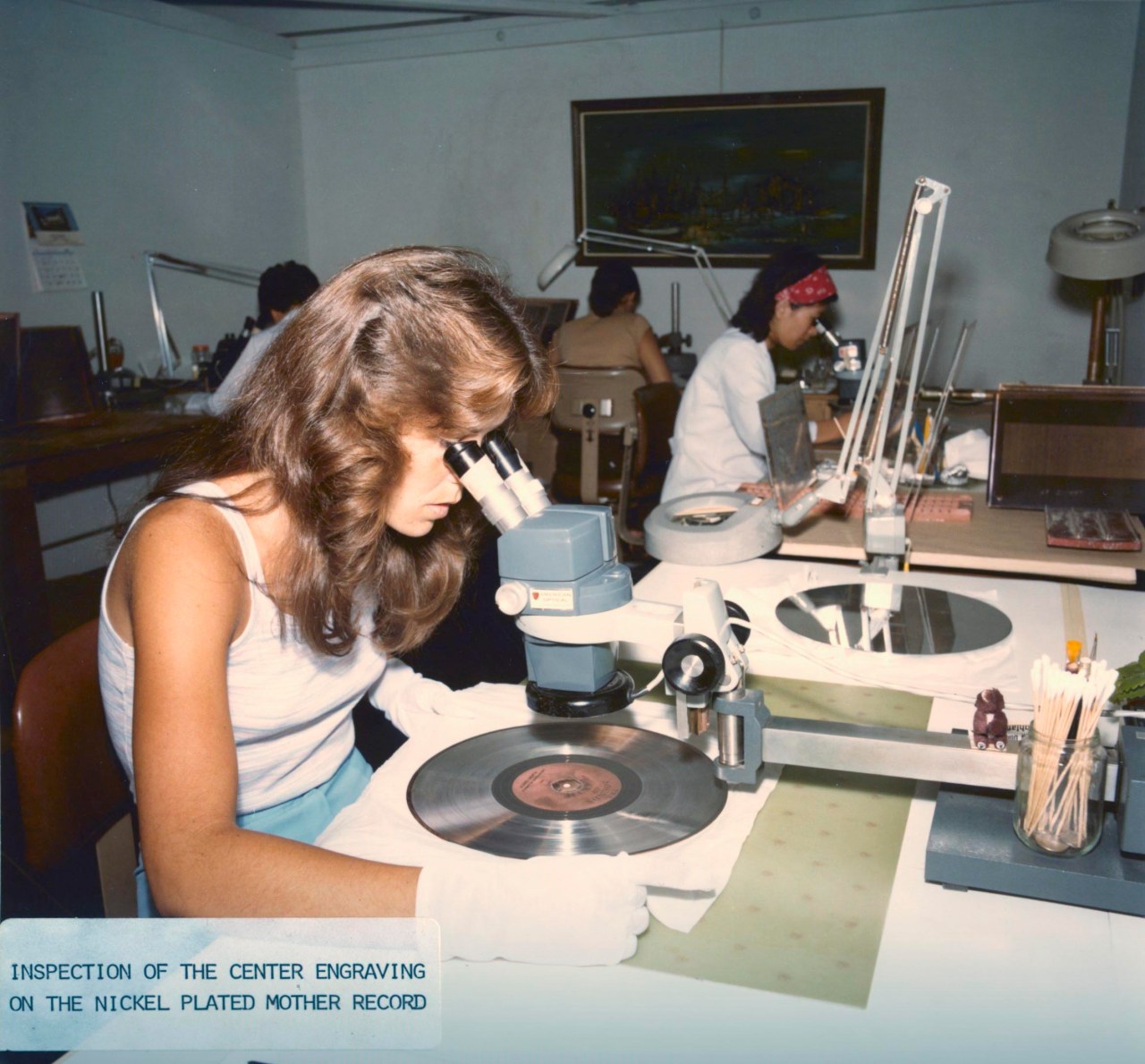
Inspection of the center engraving on a nickel-plated mother record, July 28, 1977. Courtesy NASA/JPL-Caltech.
The Golden Record usually appears alone in reproductions: a luminous circle against black, with enough empty space around it to suggest the distance it will travel. This photograph gives it neighbors. The microscope belongs to the same story as the stars. So does the jar.
Making a message that might survive its makers involves a sequence of ordinary transfers. Someone chooses a sound. Someone obtains a usable recording. Someone puts it in the agreed order. A signal reaches equipment that cuts a physical surface. That surface helps produce another. The finished object has to fit its cover and its mounting. Each transfer gives an error somewhere to enter.
The photograph does not tell us what the worker found, or what she thought about the project. Her name is not supplied in the image description. It would be convenient to give her a thought about eternity. The visible work is enough: the disc is being checked.
This book follows the record through several kinds of checking. Some concern metal and motion. Others concern the choices of people working with a finite amount of space. A greeting can be recorded perfectly and still leave the listener unable to recognize a greeting. A photograph can retain every intended variation in brightness and emerge as stripes if its lines are assembled incorrectly.
There is a small experiment later in the book. It contains no Voyager music and none of the photographs stored on the flight records. It is an original circle with a mark in one corner, reduced to a sequence of numbers. All the numbers survive. Recovering the picture still takes work.
That exercise is deliberately modest. We cannot conduct a trial with an extraterrestrial listener. We can, however, catch ourselves supplying information that a message never included. We can notice that we already know which way a photograph should stand, how a record normally spins, and what a child's voice is likely to mean.
The people at the bench had a more immediate deadline. On August 1, JPL announced that a record had been installed aboard the first Voyager on July 29. The spacecraft had a planetary mission to begin. The message had to be ready to leave with it. JPL’s contemporary announcement
CHAPTER 02
Copper, lacquer, aluminum
The flight record is a twelve-inch disc of gold-plated copper. Its protective cover is aluminum. Those two pieces often get treated as a single golden object, especially when a photograph of the cover illustrates an account of the music. The etched diagrams belong to the cover. The sound and picture information belongs to the grooves beneath it.
NASA’s manufacturing history names a chain of suppliers: blanks from Pyral in Créteil, France; lacquer cutting at the JVC Cutting Center in Boulder, Colorado, under a CBS contract; processing by James G. Lee in Gardena, California. The finished artifact came through several firms and several kinds of material. NASA’s manufacturing account
A record is an appealing carrier because a groove is a physical variation that can be examined. A finder does not have to guess a password before gaining access to the surface. Yet “physical” does not mean “self-explanatory.” A stone bearing a row of scratches is physical too. Reading it requires a theory of why the scratches differ.
Consider a deliberately simple homemade carrier. Draw a wavy line around a cardboard disc, with larger and smaller departures from a middle path. You have put a pattern on a surface. To recover a time signal, a reader must decide where to begin, in which direction to travel and how fast to proceed. The cardboard does not answer those questions merely by being tangible.
Now add a second copy of the pattern. A reader can compare them and perhaps distinguish a scratch acquired later from a feature present in both. But two identical copies also preserve the same original mistake. Duplication helps with damage; it does not independently certify the content. This is a useful distinction whenever an archive boasts about the number of copies it holds.
For the Voyager project, production also left objects on Earth. JPL archivist Julie Cooper described fourteen-inch lacquer masters held in the archive. She explained that producer Timothy Ferris wanted a handwritten inscription in the area between the label and the grooves. It reads, “To the makers of music – all worlds, all times.” JPL’s archive account
The handwriting presents a curious extra task. The cover attempts to establish instructions through diagrams and physical references. The inscription simply uses English. Its intended readers extend beyond the people who can read it, but its immediate readers were colleagues, technicians and anyone later allowed close enough to inspect the record.
A surface can serve those audiences at once. There is no requirement that every mark solve the same problem. The danger comes when we describe the whole object as if it were one carefully proven universal language. Some of its marks are operating instructions. Some identify the project. Some express a wish in a familiar script.
The distinction is practical when looking at reproductions. A replica of the engraved cover lets you study the proposed instructions. It does not let you play the music. A digital playlist lets you hear the selected performances. It does not reproduce the problem of extracting them from an unfamiliar metal disc. Each is a different route into the artifact.
Even the workbench photograph belongs to a separate archive. It records the making of the carrier, rather than the world the carrier was meant to describe. For a history of the record, that sideways view can be as useful as the finished object.
CHAPTER 03
A very slow turntable
A full revolution takes 3.6 seconds. That is slow enough to count without hurrying: one, two, three, and part of four. In the usual units for a turntable, the speed is sixteen and two-thirds revolutions per minute. A needle and cartridge accompanied the record, and the cover includes a diagram showing playback from the outside inward. NASA’s account of the contents
The arithmetic does not require any knowledge of music. A minute contains sixty seconds. Divide sixty by sixteen and two-thirds and you obtain 3.6 seconds per turn. The calculation is included in the book’s downloadable workbench, along with the other numerical examples.
Suppose we make an imaginary test disc with a pattern that repeats exactly one hundred times around a circular track. At one revolution each second, the repeated pattern passes the pickup one hundred times per second. At one revolution every two seconds, it passes fifty times. At one revolution every four seconds, twenty-five times. Nothing about the stored pattern has changed. Its timing depends on the reader’s motion.
The same dependency applies to more complicated variation. If playback runs twice as fast, all intervals shrink by half and the frequencies double. Familiar speech gives a human listener clues that the speed is wrong. Without familiarity with human speech, a finder loses that convenient correction. A higher voice is not intrinsically a mistaken voice.
There is another speed hiding beneath the turntable setting. At a radius of ten centimeters, a single circuit covers approximately sixty-three centimeters. At five centimeters, it covers about thirty-one. With the same 3.6-second rotation period, the surface farther out moves past a fixed point at twice the linear speed of the surface nearer the center.
These are example radii, not measurements of the recorded area of Voyager’s disc. They show why revolutions per minute do not describe every physical condition at the pickup. For a fixed signal frequency, a slower-moving surface has to fit successive variations closer together along the groove. The geometry changes as the needle works inward.
You can make the distinction visible with two paper circles. Mark twelve equally spaced dots on each, one circle twice the radius of the other. They contain the same number of events per turn. The dots on the larger circle are farther apart. If both circles complete a turn together, a pointer encounters dots at the same rate despite the different spacing.
An unfamiliar reader might recover the groove optically rather than build a turntable exactly like ours. That is a possibility, not an account of a future discovery. An optical reconstruction would still have to assign times to distances. Avoiding a needle does not avoid the speed question.
The record therefore needs a time reference that is more portable than a label saying “seconds.” A second is familiar to us because we have clocks, definitions, instruments and a long habit of using it. The receiver may have all the physics necessary to construct a clock and still have no reason to divide time as we do.
The answer engraved on the cover begins with hydrogen.
CHAPTER 04
A unit that needs no wristwatch
At the lower right of the cover are two small diagrams representing hydrogen in two energy states. Their purpose is to point toward a particular transition, and therefore toward a reproducible physical scale. They are the proposed starting place for converting the surrounding binary numbers into times. NASA’s explanation of the cover
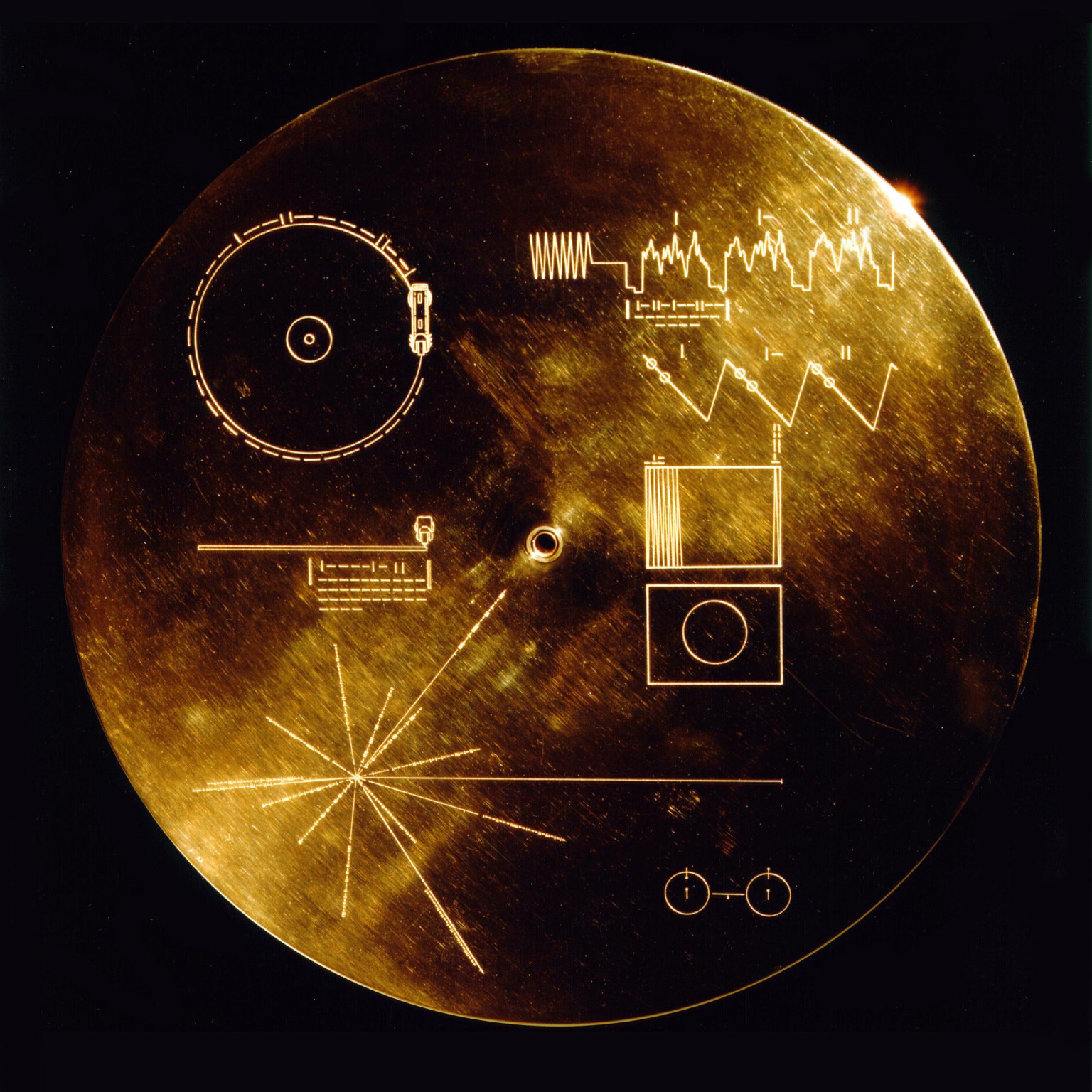
The engraved cover. The diagrams are operating instructions and physical references; the grooves are on the separate disc beneath it. Courtesy NASA/JPL-Caltech.
Neutral hydrogen has a famous radio transition associated with the interaction of the magnetic moments of its proton and electron. A NIST compilation gives its frequency as 1,420.4057518 megahertz. It is commonly called the twenty-one-centimeter line. The period of that radiation is about 0.704 nanoseconds. Wiese and Fuhr’s atomic-data compilation
That last sentence is easy to misread. The period is the duration of one cycle of the radiation. It is not a claim that an individual hydrogen atom repeatedly makes the transition every 0.704 nanoseconds. The reference is a frequency associated with an energy difference, not a microscopic pendulum visibly clicking at that rate.
To obtain the period, write the frequency in cycles per second and take its reciprocal. Roughly 1.420 billion cycles fit in one second, so each lasts roughly seven-tenths of a billionth of a second. Using the cited frequency, our 3.6-second turntable revolution spans about 5.113 billion such periods.
That is an awkward number for a human to count but an acceptable number to write compactly. Binary notation needs only two kinds of marks. For a small example, the pattern 1101 represents thirteen if the positions carry values eight, four, two and one. Eight plus four plus zero plus one gives thirteen.
The marks themselves do not announce that convention. Reading from the opposite direction gives 1011, which represents eleven under the same positional rules. A designer can add diagrams and repeated relationships to make one interpretation more persuasive. The physical reference supplies a scale after the symbols have been interpreted; it does not abolish interpretation.
Imagine sending the number thirteen with a drawing of thirteen dots. The dots provide a cross-check for the numeral. Add a second group of five dots and a different numeral. A reader can test a proposed rule against both examples. A rule that explains only the first could be a coincidence. A rule that explains a hundred varied examples becomes harder to dismiss.
This is an original illustration of the problem, not a description of extra dot patterns on Voyager. The cover has limited room and a specific design. Its choice of hydrogen makes sense because the atom is a physical object a scientifically capable recipient could investigate independently of Earth’s calendars.
The designers do not ask the receiver to accept an Earth authority’s definition by name. They point toward something measurable. Much still depends on recognizing the pointer, finding the intended transition and deciding which nearby numbers use the reference. The cover offers the receiver a place to begin doing experiments.
CHAPTER 05
A photograph in a groove
The picture instructions on the cover include a waveform, a pattern of scan lines and a circle. NASA explains that the images use 512 vertical lines, with roughly eight milliseconds assigned to each line. The first picture is a calibration circle, intended to help the reader establish the proportions of the reconstructed image. The diagram also indicates how staggered lines are interlaced. NASA’s cover guide
This is a different kind of listening. The changing signal is being used to carry brightness information. A receiving device must turn variation over time into variation across a surface. The physical record has a path that can be followed. A picture has two dimensions. Some rule must connect the two.
Start with a very small invented picture: four columns, each containing four positions. Let black be one and white be zero. Reading down each column in turn could produce this sequence:
column 1: 0 0 0 0
column 2: 0 1 1 0
column 3: 0 1 1 0
column 4: 0 0 0 0
It describes a black square of four positions inside a white border. Remove the spaces and column labels and you have sixteen values. They could be laid out as one long line, two lines of eight, four lines of four or eight lines of two. The data alone permits several rectangular arrangements.
A photograph contains far more variation than this square, and Voyager’s encoding is analog, rather than the binary grid in our example. Still, the organizational question remains. The receiver needs to determine where one line stops and the next begins. A correct signal read with an incorrect line period will join unrelated parts of the picture.
Using NASA’s approximate timing, 512 times eight milliseconds gives 4.096 seconds. That calculation estimates the time occupied by the scan lines under those rounded assumptions. It is not an exact specification of a complete frame, including every timing or separation feature. The decimal places come from multiplying numbers; they do not improve the precision of the eight-millisecond input.
A circle supplies a useful check after an image has begun to emerge. If the display stretches the horizontal dimension, the circle becomes an ellipse. The receiver can adjust the proportions until the two diameters agree. A recognizable face might also look stretched, but using it as a calibration target would assume knowledge of what a human face should look like.
A circle has its own omissions. Rotate it by a quarter turn and it looks the same. Reflect it and it still looks the same. Its success as an aspect check comes partly from its simplicity; that simplicity means it cannot certify every choice in a decoder.
One can test this without knowing how an alien would see. Put a coin on paper, trace it and turn the page upside down. The traced boundary gives away no orientation. Write a small letter in a corner and turn the page again. Now there is a visible difference, provided the reader knows which form of the letter was intended.
The next chapter makes those choices adjustable. It replaces a complicated historical signal with an intentionally plain sequence. There are no missing samples to recover and no radio noise to filter. If the image fails, we know exactly which assumptions caused it.
CHAPTER 06
Find the picture
Open the decoding experiment. It begins with a broken-looking figure. The setting marked “Samples per vertical line” reads sixty. Move it slowly. Around the middle of its range, the fragments gather into a ring. At sixty-four, the ring closes and a small uneven L appears near the upper-left corner.
That is the original arrangement. The picture was made for this book on a sixty-four by sixty-four grid. It has 4,096 positions, each black or white. The encoder reads down the first column, then down the second, continuing until it has read the entire grid. The resulting sequence contains exactly those 4,096 values.
The opening setting groups them into columns sixty samples tall. Sixty-eight complete columns consume 4,080 samples, leaving sixteen for a final column. The experiment pads the rest of that last column with forty-four white positions. The padding is reported underneath the picture. It does not discard or silently repeat the remaining data.
At sixty-four samples per column, the arithmetic comes out evenly: sixty-four columns of sixty-four positions. The circular ring reappears because the boundaries fall where the encoder put them. A numerical divisibility test would narrow the possibilities, but it would not uniquely identify this arrangement. Thirty-two by 128 also uses 4,096 positions.
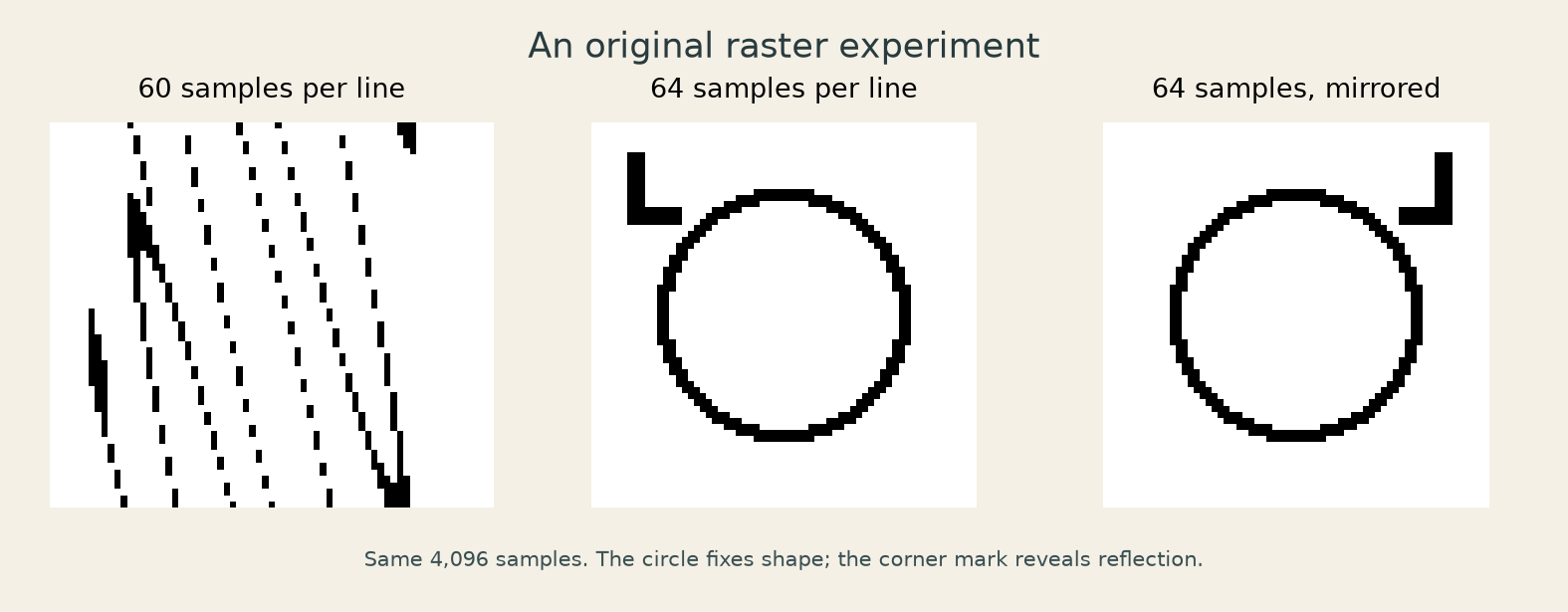
An original teaching figure. These are not images decoded from the Voyager record. Download the vector figure.
Now leave the line length at sixty-four and change the start offset. This control moves the beginning of the stream. Samples passed over at the start are appended at the end, so nothing disappears. At an offset of one, each column begins one sample late. Its last position comes from the next original column. The damage is small near some boundaries and more obvious near others.
Restore the known settings, then change pixel width. The numbers stay put. Only the displayed width of each position changes. A width of 150 percent makes the ring broader. Fifty percent makes it narrow. The circle can help you recover equal horizontal and vertical scales because the intended shape is known.
Restore the settings once more and press Mirror. The circle remains satisfactory. The L moves to the other side and reverses. A decoder judged only on roundness would pass this version. A decoder checked against the whole original would fail it.
This is why a useful test image contains several independent features. A circle checks proportion. An asymmetric mark checks reflection. A pattern near the first sample can help identify a start position. Each supplies evidence about a different decision. Adding ten more concentric circles would not make the orientation check ten times stronger.
The model deliberately leaves out much of Voyager’s engineering: analog waveforms, synchronization pulses, interlacing, grayscale and noise. It demonstrates regrouping and display geometry. It should not be used as a decoder for a recording of the actual disc.
The code and stream are available in the downloadable workbench. Automated checks regroup the samples at every line length offered by the control, with several offsets and both mirror settings, then recover the original sequence. That verifies the mechanism. The image gives you a separate way to inspect the result, which is especially useful when a perfectly intact sequence produces the wrong picture.
CHAPTER 07
The file without its instructions
Try the reverse exercise. Give somebody the experiment’s CSV file but withhold the page that explains it. The file has two columns: a sample index and a value called black. Those names already reveal a great deal. They identify an order and hint at how to interpret each value. The person is solving a partly labeled puzzle.
Remove the headings. Remove the sample indices too. You are left with ones and zeroes separated by commas and line breaks. A reader who recognizes the separators can still find the sequence. A reader who does not may treat the punctuation as part of the information.
Even the statement that there are 4,096 samples depends on knowing what counts as one. In the CSV, the character 1 is a byte represented using a familiar text encoding. In a tightly packed binary file, eight black-or-white values could share one byte. The same picture can occupy very different numbers of bytes depending on the storage convention.
For example, 4,096 individual bits fit in 512 eight-bit bytes. Store each value as one byte instead and the raw values occupy 4,096 bytes. Add indices, commas and line endings and the text file grows further. None of those size differences necessarily changes the picture. They describe the packaging around it.
Now suppose the recipient guesses that the file contains an image but chooses to treat zero as black and one as white. The geometry can be correct while the contrast is inverted. The ring still has the same outline. In this toy picture, inversion may look like a harmless stylistic choice. In a photograph intended to explain bright stars against a dark sky, it changes which areas seem luminous.
A grayscale image adds another question: how should intermediate values be displayed? Three numbers, zero, one and two, tell us an ordering if the convention is understood. They do not by themselves specify whether the middle should look perceptually halfway between the extremes. A display system supplies a relationship between number and emitted light.
We need not solve every such problem in the companion. Leaving them outside the model makes the boundary visible. The experiment contains two tones, square source pixels and a stated column order. It gives a human reader an English explanation and buttons with familiar labels. Those conveniences are part of the experiment, even though they are absent from its little ring.
For a practical archive, this suggests a useful handoff test. Ask somebody to open a copy with only the materials you intend to preserve beside it. Watch which questions they have to ask you. Write down the answers that matter, then repeat the test without supplying them aloud. The resulting instruction sheet will be shaped by actual confusion rather than your memory of what ought to be obvious.
The test cannot prove that the package will remain readable indefinitely. It can reveal a missing dimension, an undocumented encoding or a dependence on software that happens to be installed on your own machine. Those are worthwhile discoveries while there is still someone available to correct the package.
CHAPTER 08
A supermarket belongs here
NASA’s list of the record’s pictures includes a supermarket, children with a globe, an astronaut in space, anatomical diagrams, landscapes and buildings. Ansel Adams’s Snake River and Grand Tetons photograph appears in the selection. So do subjects that a terrestrial visitor could encounter on an ordinary shopping trip. NASA’s picture list
The supermarket is an especially demanding choice. To a human viewer familiar with shops, shelves of goods suggest food production, transport, packaging, purchasing and a household elsewhere that will use the contents. Much of that interpretation is brought to the photograph. The shelves themselves do not state who is entitled to take what, or what the marks on a package mean.
Imagine making a new three-picture explanation of a loaf of bread. This is a proposed exercise, not a reconstruction of Voyager’s selection. Your first picture shows grain growing. Your second shows a loaf. Your third shows someone eating a slice. The sequence suggests a connection, but it leaves out milling, mixing, fermentation and baking. A receiver might identify the loaf as a seed container, a fungus or a material that grows directly from a harvested stem.
Add a picture of a mill. Now you have another machine to explain. Add flour and dough, and you gain intermediate states. Add a cross-section of an oven, and you introduce a drawing convention as well as a process. The explanation improves in one respect while acquiring new things its reader has to understand.
A set of pictures can address this by showing the same object repeatedly, in different settings and at different scales. That creates relationships the viewer can test. A close view of a hand beside a tool may help connect a wider view of someone using it. But the choice of scale, viewpoint and sequence still does editorial work.
A landscape photograph has a different burden. Its maker may value the arrangement of light, river and mountains. A recipient might use it chiefly to infer fluid flow, surface relief or atmospheric conditions. Neither use exhausts the image. The photograph can carry information that its maker did not set out to emphasize.
It is tempting to solve the selection problem by adding everything. With a finite carrier, that is unavailable. Even with enormous digital storage, a recipient needs some way to find a starting point among the files. A large unsorted collection shifts the labor of selection from sender to reader.
The record’s pictures also have a history of ownership on Earth. NASA’s contents page explicitly warns that the images are protected by copyright. Their appearance on a NASA site is not a general permission to reproduce the whole collection. This book therefore links to the list and uses separately credited production photographs, plus original teaching figures.
That separation gives us two views of the project. The selected pictures show a version of Earth offered to a remote recipient. The production photographs show particular people making that offer. A shop, a mountain and an astronaut could help describe the planet. A microscope and a mother record help explain how those descriptions became cargo.
CHAPTER 09
Have you eaten yet?
The English greeting is spoken by a child: “Hello from the children of planet Earth.” The speaker was Nick Sagan, six years old in 1977. In a later NASA interview, he recalled being placed in front of a microphone and asked what he would say to extraterrestrials. The size of the occasion became clearer to him afterward. NASA’s thirtieth-anniversary interviews
His sentence claims a constituency far larger than the speaker. That is normal in a greeting. A person can welcome a visitor on behalf of a family, a school or a town without having collected each member’s signature. On the record, the ordinary convention has an extraordinary scale. A small voice offers a welcome from children across the planet.
The record carries greetings in fifty-five languages. Linda Salzman’s account describes recruiting speakers through Cornell and nearby contacts under time pressure. The organizers tried to include widely spoken languages, then extended the collection as opportunities allowed. Speakers were asked for brief greetings but chose their own words. Salzman also identified omissions, including Swahili. Her account and the recorded greetings
The resulting set does not provide fifty-five exact translations of one sentence. In the Amoy greeting, the English translation includes “Have you eaten yet?” An Earth listener can understand that as an expression of hospitality. A literal reading makes it a question about the recipient’s recent food intake.
Suppose two people who share no language are given a recording of a greeting and a recording of a warning. Both are short utterances directed toward another person. Changes in volume, pitch and rhythm may offer clues, but a listener can also mistake emphasis for anger or softness for uncertainty. The task is easier when there is a visible situation: someone entering a room, someone approaching a hot pan.
The record cannot arrange that situation around its eventual recipient. It supplies fragments of ours. The receiver may hear a range of voices without knowing which utterances perform the same social function. The diversity remains real even when the meaning is inaccessible.
There is also an audience for whom the recognition is immediate. A person on Earth can find a language they speak in the list, hear an accent or notice an absence. The recording becomes a selection that can be discussed by people whose lives it partly represents. This audience has never had to wait for a spacecraft to be found.
Try making a much smaller version with people you know. Ask each person for a five-second welcome, without giving them a script. Then transcribe the results. Some may introduce themselves. Some may offer a place to sit. Some may ask where the visitor has come from. The variation tells you what the speakers think a welcome should accomplish.
If you instead require one identical sentence, comparison becomes easier. You can align its parts across languages. You also lose some of the speakers’ freedom to decide what matters. Neither instruction is neutral; each produces a different collection.
The Voyager greetings preserve that tension in audible form. They are short enough to fit among the other contents, and particular enough to sound like people who had something of their own to say.
CHAPTER 10
Twenty-seven places in the running order
The music begins with Bach’s Second Brandenburg Concerto in a performance conducted by Karl Richter. It ends with the Cavatina from Beethoven’s String Quartet in B-flat, Opus 130, played by the Budapest String Quartet. Between them are twenty-five other selections, including Chuck Berry’s “Johnny B. Goode,” Kesarbai Kerkar’s “Jaat Kahan Ho” and “Flowing Streams,” performed by Kuan P’ing-hu. NASA’s complete music list
A running order is a set of decisions about time. One piece receives several minutes in which to establish itself. Another passes quickly. A listener cannot hear all the selections first, and the beginning and ending gain a prominence that the middle does not share.
It is useful to keep the performer attached to the title. A composition is not a unique sound file. Different performers can give it different pacing, articulation and tone; different recording sessions can preserve different balances between instruments. Naming only the composer conceals part of what was actually sent.
The difference becomes obvious with a song you know well. Compare two performances before reading the labels. You may recognize the melody while responding very differently to the two recordings. The record had to carry one particular version, with one particular duration and recorded sound. It could not carry the abstract category of every possible performance.
For an original selection exercise, imagine that you have twelve minutes and want to include four complete pieces. Your candidates last two minutes, three minutes, four minutes and five minutes. Together they need fourteen. The problem is not solved by wanting all four equally. You must remove something, find shorter performances, use excerpts or increase the allowance.
Using excerpts changes the question. A thirty-second passage may demonstrate an instrumental sound but omit the preparation that makes a later passage effective. A work chosen for its development over time can lose precisely that quality when represented by its most immediately striking moment.
Now give each candidate a second label: solo voice, small instrumental group, large ensemble, or voice with accompaniment. You can fill the twelve minutes while leaving one whole kind of performance absent. Add language, region, recording date and occasion, and the apparent fairness of a simple duration rule becomes harder to maintain.
A selection intended to display a range of musical practices needs different criteria from a selection intended to document what one person loves.
On Earth, we can hear the sequence and disagree with it. We can identify a performance we wish had been chosen, or discover one we had not encountered. That disagreement is possible because the list is specific. “Music from Earth” would be an aspiration; twenty-seven recorded selections can be inspected.
The final pair deserves a slower look. Immediately before Beethoven comes Blind Willie Johnson. Their adjacency invites a comparison, but each recording also has a history that existed long before anyone asked it to represent the planet.
CHAPTER 11
The man behind the slide guitar
Blind Willie Johnson recorded “Dark Was the Night, Cold Was the Ground” in 1927. The performance has no sung text in the ordinary sense. His voice hums and moans beside a slide guitar. The Library of Congress connects the piece to the eighteenth-century hymn “Gethsemane” and to a Christian account of suffering before the Crucifixion. The recording’s registry description
A listener need not know that background to be affected by the sound. Knowing it changes what can be said about the performance. The absence of articulated lyrics does not make the recording free of history, religion or learned musical practice.
In his essay for the Library of Congress, researcher Shane Ford places Johnson’s first Columbia session in a temporary Dallas studio in December 1927. He relates the interplay of voice and guitar to call-and-response singing and the practice of lining out hymns. He also follows Johnson’s later life as a religious musician, ending in Beaumont, where his home was associated with a place of worship called the House of Prayer. Johnson died in 1945. Ford’s essay
Those details deserve space beside the spaceflight story. Johnson did not make the recording as an audition for a planetary delegation. He could not agree to or object to its use fifty years later. The later selection adds a chapter to the recording’s history; it does not supply the original reason for the performance.
There is a common way of talking about such a piece that turns its lack of words into a promise: surely anyone, anywhere, would understand it. The promise is larger than the evidence. Even human listeners can hear the same vocal sound as grief, devotion, strain or release, depending on their experience and the setting in which they encounter it.
We can be precise about what a listener has available. There are changes in pitch, duration and intensity. There is alternation and overlap between a human voice and an instrument. A person familiar with slide guitar can recognize a technique. A person familiar with a hymn tradition may recognize relationships that another listener misses. Those are different levels of access to the same recording.
Imagine an invented catalog entry that describes the performance only as “human sadness.” It is short and easy to place in a thematic list. It also substitutes an editor’s emotional label for the name of a musician, the form of the performance and its religious history. A better entry can retain those particulars while leaving room for listeners to respond in their own ways.
Elsewhere in the Golden Record’s list, country and instrument labels can leave a performer’s biography and the occasion of the recording unspecified. Some recordings allow us to recover more context than others. Where the documentation supplies a performer’s name, keeping it visible is a small but meaningful act of accuracy.
You can follow the linked music list to investigate the recordings individually. Listening away from the grand setting of Voyager can be useful. For a few minutes, a performance can be allowed to occupy its own duration, without being asked to summarize Earth or prove that music crosses every possible boundary.
CHAPTER 12
Permission to put it there
JPL’s August 1977 announcement credited Columbia Records with assistance and said that copyright owners had granted permission for material to be used on the record. It described a practical act of cooperation behind the finished selection. The recordings had to become available for this particular project, not merely desirable in a committee’s discussion. The launch-era announcement
That administrative step is easy to leave out of a story about an object traveling between stars. On Earth, somebody still had to find a recording, identify the relevant owner and obtain an answer before manufacturing could proceed. The resulting physical disc carries no audible distinction between a selection that was easy to clear and one that required work.
An archive can preserve those decisions separately. Imagine compiling a small, entirely new collection of sounds from your own street: a bicycle bell, a repair shop, a neighbor describing the weather, a musician practicing through an open window. This is an editorial exercise, not a legal recipe. The people involved may have different expectations about where their sounds will go and how their names will appear.
Ask the neighbor whether the recording can be shared with friends. Then ask whether it can be posted publicly and kept online indefinitely. The answers may differ. If you store only a note saying “permission obtained,” a later editor cannot tell which question was answered.
The same ambiguity appears in credits. A file named after the street tells you where it was recorded but may omit who made it. A file named after the recordist can omit the person speaking. A description that calls the sound “typical” makes a further claim about how representative it is. None of those fields can safely stand in for all the others.
A useful small collection could therefore keep a plain text note beside each file. It would identify the date, place, recordist, speaker where appropriate, any edits, and the agreed use. The note would also record uncertainty: an approximate date should remain approximate, and an unidentified speaker should remain unidentified.
This adds work, but it can spare the next person a round of guesswork. If a recording later attracts attention, the supporting note gives its subject and maker a place in the account. If it is withdrawn from one form of publication, the note can explain why the collection has a gap instead of allowing the gap to look accidental.
The Golden Record is a particularly striking case because its physical copies are beyond any ordinary recall process. The copies and descriptions on Earth remain subject to human decisions about publication. Those are different circumstances, and a permission granted for the flight project should not be treated as an invitation to reproduce everything in a new edition.
For this book, the distinction has a visible consequence. The archival photographs of manufacturing and installation are credited under NASA’s and JPL’s image-use terms. The music is discussed and linked. The decoding image is original, so the workbench can include its complete data and code. The result gives readers something they can take apart without turning the historical recordings into uncredited raw material.
CHAPTER 13
Before the record, a plaque
Pioneer 10 and Pioneer 11 carried engraved plaques before Voyager carried records. The design included human figures, a spacecraft outline and information intended to locate the makers in space and time. Carl Sagan and Frank Drake developed the message; Linda Salzman supplied the artwork. A NASA history describes the plaques as gold-anodized aluminum mounted on antenna-support struts, with the position providing some protection from dust. NASA’s Pioneer history, NASA’s plaque description
An outline beside a person can serve as a scale reference if the receiver has the actual spacecraft to compare it with. This is a clever use of something already present. The message travels attached to an object that can be measured. A familiar human reader sees a small drawing of a machine. A finder could have the machine itself available as a key.
Try this with a household object and an invented instruction card. Draw a spoon, then draw a rectangle beside it whose height is twice the spoon’s length. Give the card and spoon to somebody without a ruler. If the relationship is clear, they can recover the rectangle’s intended size in spoon lengths.
Now remove the spoon and substitute one half as long. The drawing still looks plausible, but the recovered rectangle shrinks by half. A reference works because the intended object is available and identifiable. A sketch of “a spoon” in general cannot supply a precise scale across every spoon ever made.
The spacecraft outline offers a more specific referent. Even so, the receiver has to recognize the relation between a flat diagram and a three-dimensional object. A drawing can omit hidden parts, simplify curves and select a viewpoint. Those choices are familiar to people who use technical drawings, but they remain choices.
The shift from a plaque to a record greatly expands what can be carried. A static surface has room for a limited number of directly visible marks. A groove stores variation along a long path, and a reader can turn that variation into sound or an image sequence. The carrier gains capacity by asking more of the reading process.
For an Earth archive, this trade is easy to recognize. A page with a printed photograph can be examined with ordinary light. A compressed image file may take less physical space in storage but require a compatible decoder and a display. One object is not automatically preferable for every purpose. Capacity, durability, copying and ease of access can favor different arrangements.
Voyager’s designers placed some instructions directly on the cover and stored the larger collection in the grooves. The outer surface gives the reader a possible route toward the less immediately accessible material. A modern archive can use the same broad idea with a plain, easily opened introduction that explains the more complicated files beside it.
CHAPTER 14
Fourteen pulsars and a moving address
The lines radiating across the lower-left part of the record cover form a pulsar map. Fourteen pulsars are identified through their periods, with the Sun located in relation to them. The design carries forward an idea used on the Pioneer plaques. NASA’s cover explanation
A star’s name would not be much use to a receiver who had never seen an Earth catalog. A measurable pattern offers another route. If several objects can be identified independently, their relationships can help locate a point. The map is a proposed address system built from astronomical references.
Pulsars are rotating neutron stars whose beams can sweep across our line of sight. Their regular pulses allow precise timing measurements. This is more than a convenient image for navigation. In November 2017, NASA’s SEXTANT experiment used observations of four millisecond pulsars from NICER on the International Space Station to calculate a position autonomously. Its solution reached the demonstration’s target accuracy, within a ten-mile radius, in about eight hours. NASA’s report of the experiment
SEXTANT did not decode the Golden Record’s map. It used a different setup, selected targets, observations and timing models. The distinction matters because a successful navigation demonstration near Earth does not show that an unknown recipient can interpret an engraved map after a long interval. It does show a real use for astronomical timing references in a navigation system.
A small geometric exercise helps separate the tasks. Imagine three radio beacons at known positions on a flat map. If you know your distance from each, each distance draws a circle of possible locations. The intersection of the circles narrows your position. With uncertain measurements, the circles become bands and the possible location becomes an area.
Pulsar timing is more complicated than this invented beacon exercise. Yet the example identifies two kinds of information that should not be confused: knowledge of the reference objects and measurements made from the receiver’s position. An accurate observation does not help much if the supposed beacon has been misidentified.
Time adds another complication to a stellar address. Stars move. A map records relationships at an epoch, and a future reader has to connect those relationships with a later sky. The same issue appears in an ordinary town when a street is renamed or a building used as a landmark is demolished, although the astronomical calculations are different.
The engraving’s multiple references give a reader more possibilities for cross-checking than a single named object would. If one identification fails, others might remain useful. Agreement across several measurements can support an interpretation. It cannot guarantee that all the necessary observations are available at every future time and location.
There is a temptation to describe the map as a set of coordinates that simply points home. Coordinates need a frame of reference. The diagrams attempt to communicate one. Studying that attempt is more interesting than pretending that an address is a string of numbers with no surrounding conventions.
CHAPTER 15
A clock made of very slow change
The cover carries a small deposit of uranium-238 as a possible time reference. NASA’s manufacturing account gives its half-life as 4.468 billion years. A future investigator could, in principle, examine radioactive decay and its products to estimate how much time had passed. This uranium belongs to the record’s dating scheme; the spacecraft’s power system uses a different isotope, plutonium-238. NASA’s manufacturing account
A half-life describes a population. Start with a large number of atoms of an isotope. After one half-life, approximately half remain undecayed. After two, approximately a quarter remain. After three, an eighth. The particular atoms that decay are not scheduled in advance like names on a maintenance rota.
The remaining fraction can be written as two raised to the power of minus elapsed time divided by half-life. With a half-life of ten years in a purely invented example, ten years leaves one-half; twenty leaves one-quarter; five leaves about 0.707. Half the half-life does not mean that one-quarter of the atoms have decayed.
For uranium-238, human historical intervals occupy a tiny fraction of one half-life. Using the cited value, the fraction that decays in forty thousand years is about 0.00000621, or 6.21 parts per million. The workbench includes this calculation. It assumes a simple closed population and does not model an actual laboratory measurement of the cover.
That small number is useful to sit with. A clock can last a long time partly because it changes slowly. Slow change also makes short intervals harder to distinguish. If your hour hand takes a billion years to complete its scale, a few millennia move it only a little.
A hypothetical sample beginning with one million parent atoms would have roughly six decays over that interval on average. A much larger sample would produce more events, but the fractional change would remain about six parts per million. Counting statistics, measurement precision and the history of the material all matter to an actual estimate.
Dating is also more than finding a number labeled “daughter product.” One needs a model of the initial material and what has happened to it. Material added later or products lost from a sample can alter the interpretation. A perfectly accurate measurement of a present ratio can still support a wrong age if the assumed history is wrong.
These are general features of the example, not evidence that Voyager’s deposit has suffered any particular alteration. Nobody is sampling the flight cover now. The record’s design offers a future investigator physical clues; it does not provide us with a present test report on a future measurement.
A calendar date would be simpler for an Earth reader. Write 1977 and much of the intended chronology is immediately recoverable, provided the reader knows the calendar. The uranium reference aims at someone who may not. Its usefulness depends on access to shared physics and a plausible account of the object’s construction.
The record thus carries two very different scales of time. Its playback instructions concern fractions of seconds and the duration of a turn. Its dating clue concerns intervals that dwarf the mission’s working lifetime. Both have to fit on an object manufactured, inspected and installed during an ordinary stretch of summer.
CHAPTER 16
Passing a star is a large miss
In 2019, Coryn Bailer-Jones and Davide Farnocchia calculated future stellar encounters for the Voyager and Pioneer spacecraft using Gaia data and additional stellar velocities. Their table puts Voyager 1’s encounter with Gliese 445 at roughly forty-four thousand years after the study’s epoch, with a closest separation of about 0.575 parsecs. They also report uncertainties and warn that incomplete or unreliable stellar data limit some predictions. The authors’ paper
The word “encounter” deserves its scale. A parsec is about 206,265 astronomical units. Multiply by 0.575 and the predicted miss distance is roughly 118,600 times the Earth–Sun distance. That is close in a table of stellar passages. It is a very large separation for delivering a small object to somebody near the star.
The calculation concerns relative motion. The spacecraft and the star are both moving. A future closest approach is not obtained by pointing a ruler from the spacecraft’s present position to the star’s present position and assuming the target will wait there.
For an invented flat-map example, place a traveler at position zero moving right at one unit per year. Place another at position ten moving left at one unit per year. They meet after five years. If the second traveler instead moves right at the same speed as the first, their separation stays ten units. The initial distance is identical; the future encounter is entirely different.
Add a sideways offset of three units to the approaching traveler. Their left-right coordinates still agree after five years, but their closest separation is now three units. A date of closest approach does not imply a collision, capture or arrival at a destination.
The astronomical calculation is more elaborate than this two-dimensional exercise. It uses three-dimensional positions and velocities and follows motion through a model of the Galaxy. Uncertainties in stellar observations propagate into uncertainty about a distant encounter. Publishing a central estimate with a date does not remove those uncertainties.
Another scale check uses a round spacecraft speed of seventeen kilometers per second. Light travels about 299,792 kilometers in a second. At the lower speed, covering the distance light covers in one year would take about 17,635 years. This is a constant-speed comparison, not a trajectory prediction for either Voyager.
It explains why a distance expressed in light-years can be misleading in casual conversation. “A couple of light-years away” sounds compact because the number is small. The unit contains an enormous distance. The record is carried by a spacecraft moving at a tiny fraction of light speed.
The title of this book does not mean that the record was made without an audience in mind. It means that there is no known recipient waiting at a specified address to receive this parcel. A future stellar flyby is a calculable feature of a trajectory, not an appointment with a listener.
We can study the motion without filling the empty place in that appointment book. The predicted passage by Gliese 445 is interesting as dynamics. Its large miss distance makes the record’s practical circumstances clearer. The spacecraft can pass relatively near another star while remaining far from any ordinary situation in which a small metal disc would be noticed and retrieved.
CHAPTER 17
The second spacecraft left first
Voyager 2 launched on August 20, 1977. Voyager 1 followed on September 5. The numbering does not follow the order of departure. Voyager 1’s faster route took it to Jupiter and Saturn first; Voyager 2 went on to visit Uranus and Neptune. NASA’s mission overview
The record traveled as part of those spacecraft. It did not determine their planetary itineraries. An installation photograph makes the relationship visible: the circular package occupies a modest patch of a much larger machine, beneath structures whose shapes were chosen for other work.
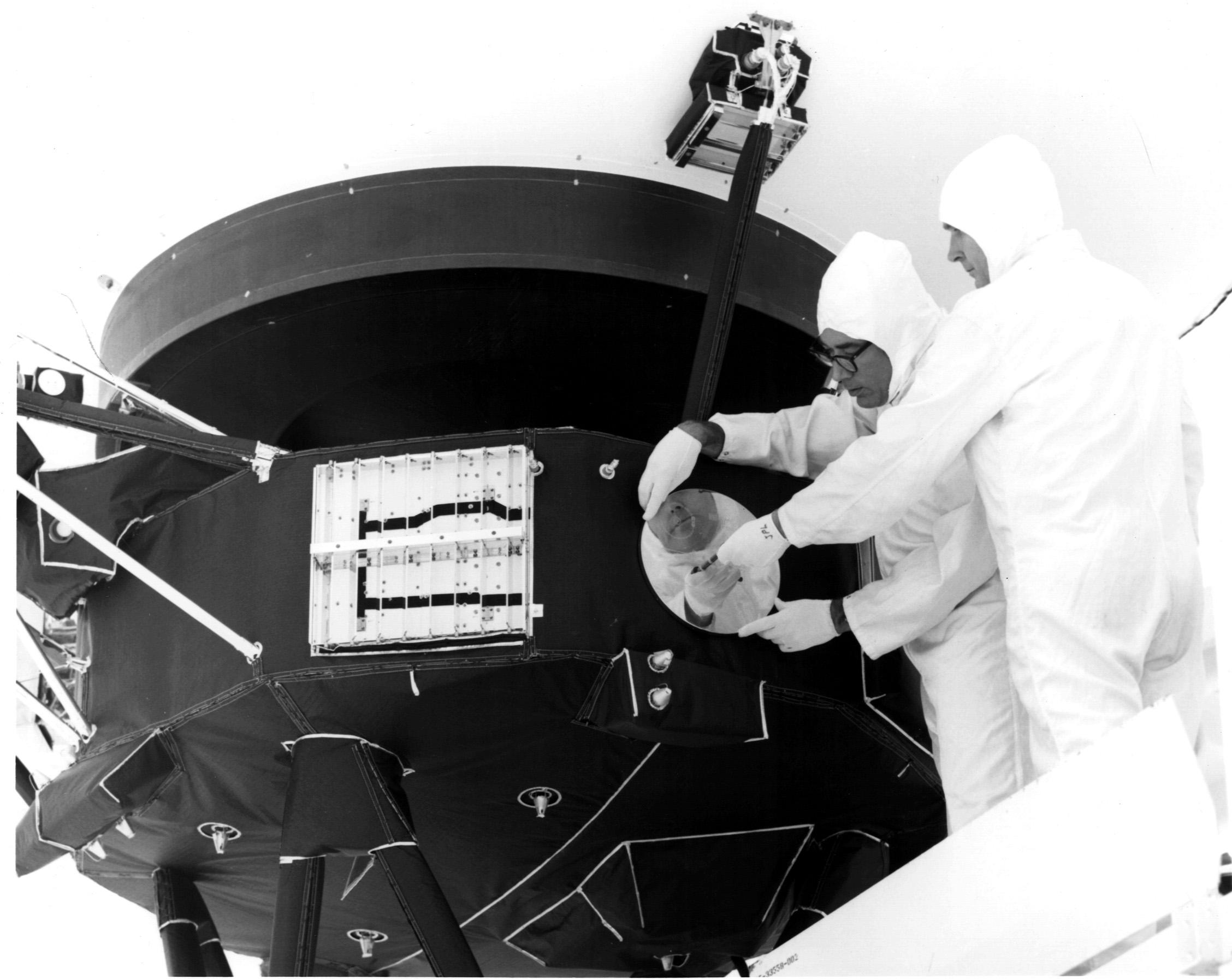
Installing the record package on Voyager 1, 1977. The image was published in JPL’s archive as PIA21740 in 2017. Courtesy NASA/JPL-Caltech. Archive entry
A photograph cropped tightly around the record gives it the whole stage. The wider view shows how much machinery had to leave Earth for this one item to travel with it. The technicians have access to the mounting while the spacecraft is still within reach. After launch, a loose physical part cannot be tightened by sending a better sentence from the ground.
Voyager 1 crossed the heliopause in August 2012. That transition placed it in interstellar space, beyond the region dominated by the outward solar wind. It did not carry it beyond every object held in the Sun’s much larger gravitational neighborhood. NASA distinguishes this boundary from the distant Oort Cloud. NASA’s explanation of the boundary
Several boundaries can be relevant to the same journey. A town’s administrative limit, the edge of its continuous buildings and the area served by its railway are different lines. Crossing one does not require crossing all of them. This is an analogy about definitions, not a model of the heliosphere, but it helps explain why the phrase “left the solar system” needs qualification.
For the record, no new playback procedure begins at the heliopause. There is no stylus poised to descend when a boundary is crossed. The package continues as cargo. Its imagined reader remains hypothetical while the spacecraft’s instruments make actual measurements in a new environment.
That difference produces two histories running together. One follows information returning to Earth: measurements, engineering status and the work needed to keep them readable. The other follows the physical carrier going outward. The first can be interrupted by an electronic failure. The second continues unless the motion or object itself is changed.
September 5, 2026, the date of this edition, is Voyager 1’s forty-ninth launch anniversary. The spacecraft is old enough that keeping it useful involves interpreting hardware and software created for a very different working environment. Its record is still the selection made before departure. New events can change how people on Earth hear that selection; they cannot add another track to the disc already in flight.
CHAPTER 18
Moving code around a broken chip
On November 14, 2023, Voyager 1 stopped returning readable engineering and science data. It was still receiving commands. The trouble lay in the flight data subsystem, which packages information for transmission. A failed memory chip had taken part of its software out of service.
Engineers could not replace the chip. They moved the affected code into working memory instead. No single available space was large enough, so they divided the code among several locations and changed the references that pointed to it. On April 20, 2024, the team received usable engineering data after sending the first relocation command two days earlier. Science-data recovery was a subsequent task. JPL’s account of the repair
The repair is easier to appreciate with a small invented memory map. Suppose a program has a routine occupying twelve consecutive numbered slots. A fault makes that area unusable. Elsewhere there are free areas of five, four and three slots. Their total is twelve, but the original routine cannot simply be copied into one of them.
Dividing it requires more than moving its text. If an instruction says to continue at slot 108, and the intended instruction now lives at slot 407, that reference must change. If the processor normally continues to the next slot, reaching the end of a relocated fragment may require a jump to the start of another. Other routines that call this one need valid destinations too.
The numbers and layout here are invented. They illustrate the dependency described in JPL’s report without pretending to reproduce Voyager’s memory addresses or instruction set. Actual flight software has constraints absent from the example, and a change must preserve the behavior of the larger system.
There is an archival lesson in the physical circumstances of this repair. A failed component did not make every surviving component useless. The team had enough knowledge of the software and hardware to arrange the remaining capacity differently. The spacecraft’s continued usefulness depended partly on information retained and understood on Earth.
The delay made experimentation expensive in time. JPL reported a one-way signal time of about twenty-two and a half hours during the April repair. A command and a response therefore required roughly forty-five hours of travel alone. Processing and operational schedules could add more. This was no interactive session in which a developer could watch a log update as each keystroke arrived.
A careful test plan has to separate what a returned message establishes from what it leaves untested. Readable engineering data can show that one part of the packaging process works. It does not automatically show that every science-data path has been repaired. The team’s staged account makes that distinction visible.
Meanwhile, the Golden Record needed no software relocation. Its grooves were not stored on the failed chip. The package and the computer shared a spacecraft but used different means of preserving information. The 2024 repair kept an active stream of reports coming home; the record remained a fixed object traveling outward.
CHAPTER 19
Four watts a year
In April 2026, the Voyager team sent commands to turn off Voyager 1’s Low-energy Charged Particles experiment to conserve power. NASA’s report identified two science instruments still operating: the plasma-wave and magnetic-field instruments. A small motor associated with the shut-down experiment was left running, using about half a watt, to preserve the possibility of restarting the instrument if power became available. NASA’s April report
The decision had a specific electrical and thermal setting. The spacecraft’s radioisotope power supply produces less electrical power as it ages. The report puts the annual loss at about four watts for each Voyager. Conserving electricity also means accounting for heat: equipment and lines must remain warm enough to function.
A small terrestrial example shows the difficulty. Suppose an insulated box contains electronics using ten watts and a heater using five. If the electronics are switched off, their electrical consumption disappears, but so does heat they released inside the box. Keeping the same temperature may require more heater power. The saving at the battery can be smaller than ten watts.
Those figures are invented, not a thermal model of Voyager. The real balance depends on where heat is produced, how it moves and the temperatures each component can tolerate. A list of devices and wattages is only part of the engineering problem.
On August 4, 2026, NASA reported that a power-saving reconfiguration had been carried out on Voyager 2. The team called it the Big Bang: a coordinated change that turned off a group of powered devices and used lower-power alternatives while maintaining necessary warmth. NASA expected the change to preserve all three of Voyager 2’s remaining science instruments for at least an additional year. The corresponding Voyager 1 change was still planned for coming months in that report. NASA’s August update
The nickname describes a coordinated operation, not an explosion or a new propulsion system. The distinction is worth making because an evocative name can easily become the wrong mental picture. This work concerns electrical arrangements on existing hardware.
The time bought by a saving also depends on the trend in available power. In a deliberately simplified example, saving eight watts against a steady decline of four watts per year would create two years of margin. Real operation cannot be forecast from that division alone. Component temperatures, other failures and the minimum power needed for communication can impose different limits.
These reports describe the mission as known for this edition in September 2026. They are dated observations and plans, not promises about how long the spacecraft will continue. Earlier forecasts can change as engineers find new ways to operate the hardware.
The record does not consume the electrical power being rationed. Turning off a science instrument does not stop its motion. If radio contact eventually ends, the latest received telemetry will become the end of one kind of evidence. It will not mark the moment when the disc stops existing or starts playing.
CHAPTER 20
A copy within reach
Return to the inspection photograph. The disc is accessible. Somebody can move it, examine it and decide whether the next manufacturing step should proceed. That opportunity belongs to a brief part of its history.
We now have several things the hypothetical finder may lack: explanations written by the makers, names attached to performances, photographs of the work and accounts of the mission’s repairs. They let us move between the object and the circumstances of its production. A reader can check an interpretation instead of relying entirely on what the engraving appears to suggest.
A small archive of your own can make use of that advantage. Choose one recording or image you would actually like another person to understand. Preserve the original file. Beside it, put a readable note saying who made it, when, what it shows or contains, and what you know about its use. Describe edits separately. If a detail is uncertain, leave the uncertainty visible.
Then give a copy to someone and let them open it. The most valuable result may be an unremarkable question: which file comes first, why the picture looks stretched, whether the voice is yours. Answer it in the material that will travel with the file. The next reader should not have to find you to ask the same thing.
You do not have to select the contents on behalf of a planet. A collection can be useful because it is narrow and well described. One street, one workshop, one person’s account of an afternoon can sustain close attention without claiming to stand for everyone.
The Voyager record attempted something much larger, within a particular deadline and a particular circle of collaborators. Its remaining Earth copies and documentation let us inspect that attempt. We can listen to a named musician, study an etched instruction, or change a line length until a broken ring closes.
The flight records are far away. This work is still within reach.
Sources & edition note
This is AI-generated nonfiction based on the linked sources. Iris Bell is a fictional editorial pen name. NASA, JPL and the researchers cited did not author or review this book.
The historical accounts are separated from original numerical and archival exercises. The 64 × 64 raster experiment is a teaching model, not Voyager’s analog encoding or a decoder for its recording. The photographs document real artifacts and manufacturing; credits accompany each image.
The mission’s current-status discussion uses NASA’s April 17 and August 4, 2026 reports. Future encounters are dated model estimates, not delivery destinations. This edition was prepared for Voyager 1’s forty-ninth launch anniversary, September 5, 2026.
The music and protected picture contents of the flight record are linked rather than reproduced. Download the original experiment, data and checks.
- NASA · Mother-record inspection, July 28, 1977 ↗
Archival photograph and identification of the nickel-plated mother record.
- JPL · Voyager Will Carry Earth Sounds Record, August 1, 1977 ↗
Contemporary installation announcement and recording permissions. Planned launch dates in this document are historical forecasts.
- NASA · Making of the Golden Record ↗
Materials, suppliers and uranium dating reference. The book does not use the page’s ambiguous late-August plating date.
- Julie Cooper / JPL · Golden Record inscription ↗
JPL archive account of the lacquer masters and Timothy Ferris’s handwritten inscription.
- NASA · Golden Record contents ↗
Playback speed, accompanying pickup and overview of the selection.
- NASA · Golden Record cover ↗
Guide to the timing, image and astronomical diagrams.
- Wiese and Fuhr · Atomic transition data, 2009 ↗
Hydrogen hyperfine frequency, section 2.1.2 and Table 11; doi:10.1063/1.3077727.
- NASA · Images on the Golden Record ↗
Selected picture subjects and copyright notice. The contents photographs are not reproduced here.
- Janna Brancolini / NASA · Voyager at 30, 2007 ↗
Interviews including Nick Sagan’s account of recording his greeting at age six.
- Linda Salzman · The greetings ↗
First-person selection account and links to the greetings and translations.
- NASA · Music on the Golden Record ↗
The twenty-seven selections, performers and running order.
- Library of Congress · Recording Registry descriptions ↗
Curatorial entry on Blind Willie Johnson’s 1927 performance.
- Shane Ford · Dark Was the Night ↗
Research essay on Johnson’s recording, religious musical practice and later life; hosted by the Library of Congress.
- Fimmel, Van Allen and Burgess · Pioneer: First to Jupiter, Saturn, and Beyond ↗
NASA SP-446, 1980, plaque section, reproduced by the University of Iowa.
- NASA · Pioneer plaque ↗
Artifact description and the relation of the human figures to the spacecraft outline.
- NASA · SEXTANT navigation demonstration, 2018 ↗
Report of the November 2017 autonomous X-ray navigation experiment; distinct from the record’s map.
- Bailer-Jones and Farnocchia · Future stellar flybys, 2019 ↗
Research Notes of the AAS 3, 59; doi:10.3847/2515-5172/ab158e. Table 1 gives the Gl 445 encounter and uncertainties.
- NASA · Voyager mission overview ↗
Launch order and planetary itineraries.
- NASA · Voyager 1 mission history ↗
September 5, 1977 launch. Current instrument counts are taken from the dated 2026 reports below.
- JPL · Installing the Golden Record, PIA21740 ↗
1977 installation photograph, published in the archive in 2017.
- JPL · How do we know when Voyager reaches interstellar space? ↗
2013 account distinguishing the heliopause from the more distant Oort Cloud.
- JPL · Engineering data restored, April 22, 2024 ↗
Failed memory chip, code relocation and the return of engineering telemetry.
- NASA · Voyager 1 instrument shutdown, April 17, 2026 ↗
Power decline, LECP shutdown, retained motor and two remaining science instruments.
- NASA · Voyager 2 power reconfiguration, August 4, 2026 ↗
Completed Voyager 2 change and expected extension; Voyager 1 operation still planned in this report.
- JPL · Image-use policy ↗
Terms for the separately credited archival production photographs.
- NASA · Images and media guidance ↗
Educational use, attribution and third-party material distinctions.